
new
Rox.com Products Catalog: Complete Guide

Introduction
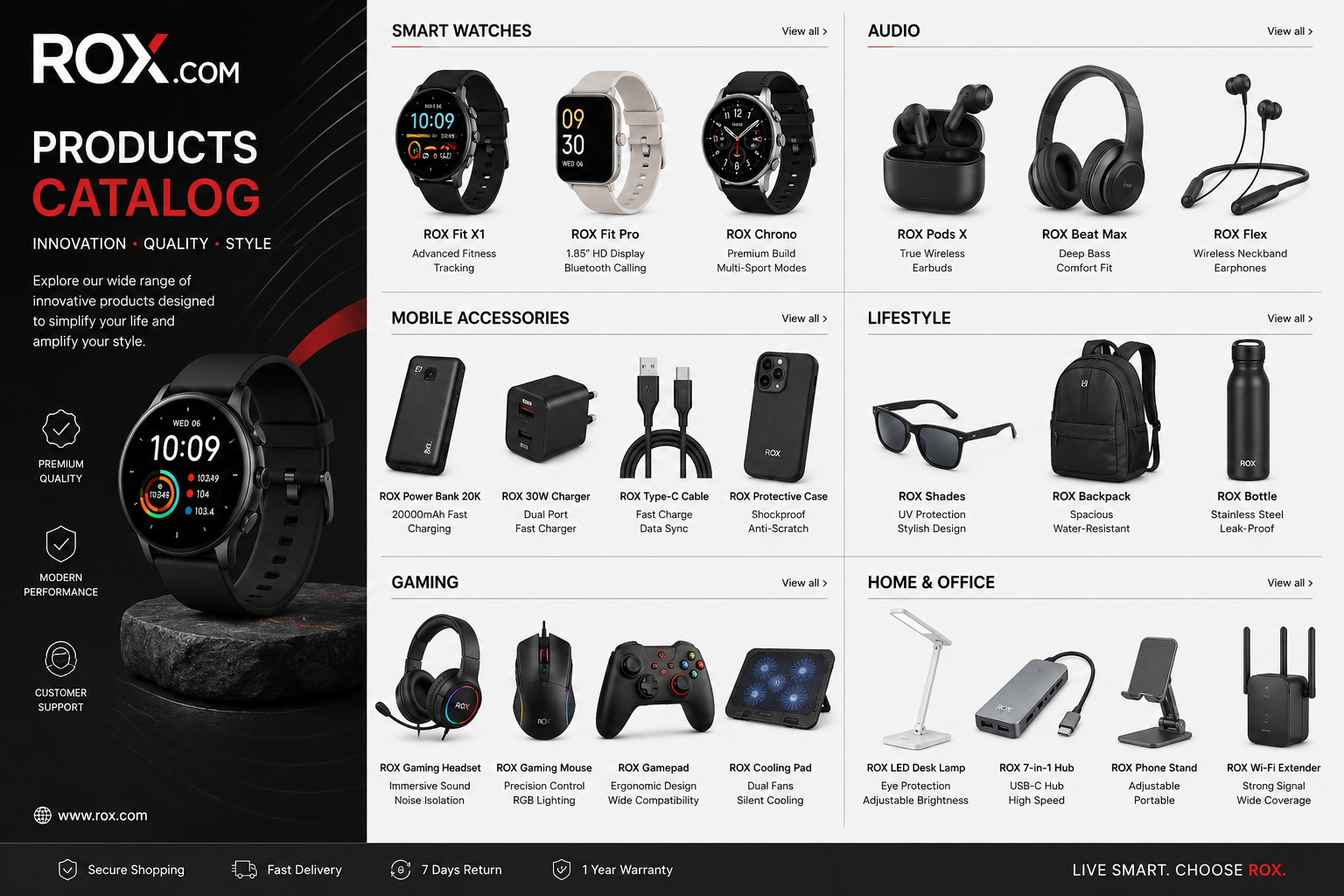
Many people search for the ROX catalog expecting a normal online store, but the reality is more specific and more interesting. ROX is built around connectivity, rewards, events, lifestyle deals, and app-based access rather than a simple product shelf. That difference matters because users who understand the catalog structure can choose better bundles, unlock stronger perks, and avoid confusing unofficial information.
Rox.com Products Catalog Overview
| Aspect | Key Details |
|---|---|
| Main Purpose | Helps users explore ROX connectivity plans, lifestyle deals, rewards, events, and app-based benefits. |
| Core Sections | ROX Connect, ROX Vault, ROX High Street, ROX Life, ROX Arena, add-ons, package sharing, and support. |
| Best For | Users who want mobile bundles, discounts, partner perks, entertainment access, and youth-focused digital experiences. |
| Access Method | Most benefits are managed through the ROX app, while public pages explain packages, features, and support topics. |
| Key User Question | “Is this a shopping catalog, a telecom package list, or a lifestyle rewards platform?” The answer is that it combines all three, but the app is the main control center. |
| Smart Buying Tip | Always check the ROX app for live prices, eligibility, partner offers, and availability before making a decision. |
What the Rox.com Products Catalog Actually Means
The rox.com products catalog should not be understood as a traditional online shop with fixed shelves of fashion, electronics, furniture, and home goods. Based on the official ROX ecosystem, the catalog is better described as a digital menu of packages, perks, partner deals, events, add-ons, and lifestyle rewards. This makes it closer to an app-based benefits hub than a standard retail catalog.
The catalog experience begins with ROX Connect, where users compare mobile bundles by data allowance, SMS, minutes, package sharing, and price. From there, the value expands into ROX Vault, ROX High Street, and ROX Life, which connect subscribers with discounts, brand offers, entertainment, and experiences. A user is not only choosing a telecom plan; they are choosing a bundle of digital and lifestyle access.
This distinction is important because many online explanations use broad phrases like “fashion, electronics, and home essentials” without clearly separating official ROX features from general catalog assumptions. A stronger explanation should tell users what ROX publicly offers, what appears inside the app, and what should be verified before trusting any third-party claim. That gives the reader a practical map instead of a vague product-list summary.
Why Search Intent Around ROX Is Confusing
The search term looks simple, but it carries several possible meanings. Some users may be looking for the official ROX by Jazz platform in Pakistan, while others may confuse it with different businesses using similar “ROX” branding. This is why search results can show telecom pages, catalog PDFs, unrelated stores, and SEO blog posts in the same result set.
The strongest search intent is informational. Users want to know what products or services ROX offers, how the catalog is organized, whether there are real discounts, and whether they can shop directly through the website. They also want a clear answer on whether ROX is an e-commerce site, a mobile network product, or a lifestyle app.
The best answer is balanced: ROX functions as a digital lifestyle ecosystem powered by telecom services. Its catalog includes mobile plans, app-based benefits, rewards, deals, events, games, merchandise, and partner offers. Some product-style offers may appear through High Street or app promotions, but the official experience is centered on the app, not only on a public website catalog page.
Main Parts of the ROX Catalog Experience
ROX Connect: The Package Foundation
ROX Connect is the base layer of the catalog because it gives users the core mobile plans. These packages usually focus on data, minutes, SMS, and sometimes sharing options for friends or family. For many users, this is the first comparison point because the value of other perks often depends on being a ROX subscriber.
A smart user should compare the actual usage pattern before choosing a plan. Someone who streams heavily will care more about data, while someone managing a small group may care about package sharing. The best package is not always the one with the biggest allowance; it is the one that matches daily behavior without forcing the user to pay for unused benefits.
The important detail many guides miss is that Connect is not just a price table. It acts as the entry point for unlocking wider ROX features. Once a user subscribes, the rest of the catalog becomes more relevant because discounts, perks, and app-only options may depend on active subscription status.
ROX Vault: Discounts and Perks
ROX Vault is where the catalog starts to feel less like a telecom page and more like a lifestyle rewards platform. It can include discounts from food, fashion, sports, travel, fitness, beauty, and other partner categories. The goal is to make the subscription feel useful beyond internet data and calling minutes.
For users, the real value of Vault depends on partner relevance. A discount is only valuable if it applies to a brand, city, or service the user already wants. Before choosing a package because of Vault benefits, users should check current partner availability, offer conditions, redemption method, and expiry dates.
This is one of the biggest content gaps in competing articles. They often say “exclusive deals” but do not explain how users should judge those deals. A better approach is to treat every Vault offer like a mini-purchase decision: check the discount size, location, eligibility, minimum spend, and whether the deal can be used more than once.
ROX High Street: Brand Deals and Product Offers
ROX High Street is the section most closely connected to the idea of a product catalog. It highlights deals from fashion, gadgets, fitness, handset, and lifestyle brands. This makes it especially relevant for users who search for ROX products because it is where product-style offers are most likely to appear.
Still, High Street should not be confused with a full marketplace like a large e-commerce platform. It is better understood as a curated deal section inside the ROX experience. The offers may change over time, and the exact available products may depend on partner campaigns, location, and app visibility.
Users should treat High Street as a discovery and savings section. The right way to use it is to open the app, check live brand offers, compare the discount with the brand’s direct price, and confirm any terms before buying. That simple process prevents disappointment and helps users understand whether the listed deal is genuinely better.
ROX Life: Events, Entertainment, and Experiences
ROX Life expands the catalog into experiences rather than physical products. It may include concerts, stand-up shows, gaming tournaments, qawwali nights, youth events, merchandise drops, and other lifestyle activities. This section is important because it explains why ROX describes itself as more than a network.
For students, young professionals, and entertainment-focused users, ROX Life can be a major reason to stay inside the ecosystem. A normal telecom package gives data and calls, but an experience-led platform gives social value. That emotional layer is part of the brand’s positioning and should be explained in any serious guide.
The main limitation is that events are time-sensitive. A page or blog post may mention an event that has already passed, while the app may show newer opportunities. Users should always check the current event calendar inside ROX before assuming that a specific event, ticket, location, or merchandise offer is still active.
ROX Arena and Rewards
ROX Arena adds a game and rewards angle to the catalog. It is designed for users who like casual games, leaderboards, and small incentives inside the app experience. This may not be the primary reason someone joins ROX, but it gives the platform another layer of engagement.
Rewards-based features work best when users understand what they are earning and how redemption works. Points, streaks, giveaways, and leaderboard benefits should be checked carefully because reward rules can change. A user should ask: What do I need to do, what can I win, when does it expire, and is there any condition attached?
This section also shows why ROX is not just a static catalog. It is dynamic, app-driven, and built around recurring engagement. That makes freshness a major ranking opportunity for content creators because outdated information becomes weak very quickly.
How to Use the ROX Catalog Before Choosing Anything
The first step is to identify what you actually want from ROX. If your main need is internet data, start with Connect packages and compare allowances. If your main interest is lifestyle value, check Vault, High Street, and events before deciding whether the subscription is worth it.
The second step is to verify access requirements. Some offers may require an active ROX subscription, some may depend on the app, and some may be limited to specific partners or cities. Do not judge the catalog from a third-party blog alone because the live app is more likely to show the latest conditions.
The third step is to compare total value, not only headline discounts. A 40% discount sounds attractive, but it may have a minimum spend, product restriction, or short expiry window. A smaller discount on a brand you already use may be more valuable than a large discount on something irrelevant.
What Most Competing Guides Miss
Many existing guides explain the catalog as if it were a broad e-commerce store. That creates confusion because it makes readers expect a classic shopping website with endless categories and direct checkout. A more accurate explanation should separate official ROX app features from generic catalog assumptions.
Another missing point is the subscriber journey. Users need to know that downloading the app, logging in, subscribing to a Vibe package, and unlocking benefits are connected steps. Without that journey, the catalog feels like a random list of offers instead of a structured ecosystem.
The third gap is freshness. ROX deals, events, partner discounts, package prices, and app features can change, so a strong guide should teach users how to verify information rather than only listing offers. That makes the content more trustworthy and more useful over time.
Who Gets the Most Value From ROX
ROX is most useful for users who want mobile connectivity plus lifestyle benefits in one app. A heavy data user may appreciate large data bundles, while a value-focused user may care more about partner discounts and rewards. Someone who attends events, uses food delivery, shops from partner brands, or enjoys app-based games may find more reasons to stay active.
The platform is especially relevant for younger users who want their mobile plan to feel connected with entertainment and social experiences. This is different from a traditional telecom product that only sells calls, SMS, and data. ROX tries to turn connectivity into a daily-use lifestyle layer.
It may be less useful for someone who only wants the cheapest basic mobile package. If a user does not care about deals, events, games, rewards, or partner benefits, they should compare ROX against regular mobile bundles more carefully. The catalog is strongest when the user actually uses the extra benefits.
Trust Checks Before You Rely on Any ROX Catalog Page
The first trust check is the domain. Official ROX information should come from the ROX website, the ROX app, official app store listings, or verified ROX social channels. Third-party articles can help explain the idea, but they should not be treated as the final source for live prices or active offers.
The second trust check is date sensitivity. Telecom packages, app features, brand partners, and event listings can change quickly. A page from last month may still be useful for background, but the final decision should be made using the current app screen or official support page.
The third trust check is wording. Be cautious when an article claims that ROX has a huge catalog of unrelated products without showing where those products appear officially. Clear content should name the actual ROX sections, explain how users access them, and avoid making unsupported claims about categories that may not be available.
How ROX Could Improve Catalog Transparency
ROX could make the user journey easier by publishing a clearer public catalog hub. A single page that separates Connect packages, Vault partners, High Street deals, Life events, Arena rewards, and support rules would reduce confusion. It would also help searchers understand the platform without downloading the app first.
A better public catalog could include filters for city, category, partner, offer type, expiry date, and eligibility. Users could then quickly check whether a discount is relevant before signing up. This would also reduce reliance on third-party blog posts that may become outdated or inaccurate.
Another improvement would be clearer comparison cards. Each package could show not only data, minutes, and SMS, but also which perks are unlocked, how sharing works, and which benefits are app-only. That would turn the ROX catalog into a stronger decision tool for both new and existing users.
Conclusion
- Use the ROX catalog as a guide to packages, rewards, deals, and experiences, not as a normal e-commerce product list.
- Check ROX Connect first because the package you choose may affect which app benefits and subscriber perks you can unlock.
- Review ROX Vault and High Street inside the app before trusting any third-party claim about discounts or available products.
- Treat event listings, rewards, and partner offers as time-sensitive because availability can change faster than blog articles are updated.
- Compare total value by looking at your real usage, preferred brands, city availability, and redemption conditions before subscribing.
FAQs
What is the rox.com products catalog?
The rox.com products catalog is best understood as a digital guide to ROX’s app-based ecosystem, including mobile packages, rewards, partner discounts, High Street brand offers, events, games, and support features. It is not simply a traditional online shop with fixed product shelves. The most reliable way to view current offers is through the official ROX app or official ROX pages.
Is ROX an online shopping website?
ROX is not mainly a standard online shopping website. It is a lifestyle and connectivity platform where users can manage packages, access discounts, explore events, play games, and discover selected brand offers. Product-style deals may appear through ROX High Street, but the wider experience is built around the app.
How do I access ROX catalog offers?
You generally access ROX offers by downloading the ROX app, logging in, choosing or managing a package, and checking sections such as Vault, High Street, Life, and Arena. Some public pages explain the features, but the live app is usually the better place to confirm current prices, eligibility, and active offers. Always read offer terms before redeeming a discount or choosing a package.
Are ROX discounts and product offers always available?
ROX discounts and product offers may change based on partner campaigns, city coverage, subscription status, expiry dates, and app updates. A deal shown in an old article may no longer be active, while new deals may appear inside the app. The safest approach is to verify every offer through official ROX channels before making a purchase decision.

If you searched for raceordie2.comabout us, you are probably trying to understand what RaceOrDie2.com is, what kind of information it publishes, who contributes to the website, and whether there are clear ways to contact the people behind it.
RaceOrDie2.com operates as a multi-topic content website rather than a narrowly focused racing platform. Its current navigation and homepage feature content across lifestyle, news, celebrity topics, finance, crypto, technology, sports, business, and fashion.
This guide looks at what the website itself currently reveals, what visitors can verify, and what should not be assumed without stronger evidence.
Quick Facts About raceordie2.com
| Detail | What the Website Currently Shows |
|---|---|
| Website | RaceOrDie2.com |
| Website type | Multi-topic content and information site |
| Main topics | Lifestyle, news, celebrity, finance, crypto, tech, sports, business, fashion |
| Team page | Yes |
| Contact page | Yes |
| Public contact email | Raceordie2.uk@gmail.com |
| Named contributors | Several names/user profiles appear |
| Dedicated About Us link in main navigation | Not prominently shown during this review |
| Best use | Reading informational articles, guides, news-style content, and topic explainers |
The homepage makes the site’s broad editorial approach clear. Recent and categorized content ranges from technology and business guides to sports, celebrity profiles, finance topics, lifestyle articles, and current-event coverage.
What Is RaceOrDie2.com?
Despite the word “race” in its domain name, RaceOrDie2.com should not be assumed to be exclusively about motorsports or racing.
The current website functions more like a general digital publication. Its navigation includes dedicated sections for Lifestyle, News, Celebrity, Finance, Crypto, Tech, Sports, Business, and Fashion.
Visitors may therefore encounter articles covering very different subjects during the same browsing session.
For example, the homepage has recently displayed content involving:
- technology platforms and online tools;
- business websites and services;
- financial and cryptocurrency topics;
- celebrities and public-interest profiles;
- sports schedules and related guides;
- lifestyle products and destinations;
- fashion brands and websites;
- news and online controversies.
This variety is one of the first things users searching for raceordie2.comabout us should understand.
What Does RaceOrDie2.com Say About Its Purpose?
The clearest description of the site’s stated publishing goal appears on its Contact Us page.
RaceOrDie2.com says it aims to provide readers with accurate, engaging, and up-to-date content. The page also invites visitors to submit questions, feedback, business inquiries, and reports about problems found on the website.
That suggests the platform sees itself primarily as an informational publishing site serving readers across multiple categories.
However, a short statement of intent is different from a detailed editorial policy. Readers evaluating important information should still examine individual articles, sources, author information, and update dates.
Who Is Behind RaceOrDie2.com?
One useful element is the site’s Meet The Team section.
At the time of review, the page displays several contributor or profile names, including Soban, Team Raceordie2, danseo, Infomuhammad ghous, and alina develux. These profiles appear alongside articles published on the website.
That provides more transparency than a site where every article is completely anonymous.
Still, visitors should distinguish between seeing a contributor name and having a complete professional biography.
What readers may still want to know
A stronger team profile would ideally explain:
- each person’s editorial role;
- subjects they specialize in;
- relevant professional experience;
- qualifications where applicable;
- previous publishing experience;
- how articles are researched and reviewed;
- whether contributors write, edit, fact-check, or manage the platform.
These details matter because authorship helps readers judge whether a writer has appropriate experience for the subject being discussed.
How Can You Contact RaceOrDie2.com?
RaceOrDie2.com provides a dedicated Contact Us page and publicly lists the email address Raceordie2.uk@gmail.com.
The website states that users can contact the team regarding feedback, general questions, business inquiries, or website issues.
This contact route can be particularly useful if you want to:
- report incorrect information;
- ask how an article was researched;
- request clarification;
- discuss a business matter;
- report copyright concerns;
- point out a broken page or link;
- ask about content updates.
A visible contact method is a useful trust signal, although it should always be considered together with the quality and transparency of the site’s actual content.
What Type of Content Does RaceOrDie2.com Publish?
One of the most distinctive characteristics of RaceOrDie2.com is its broad subject coverage.
Technology
The Tech category contains articles about websites, digital platforms, software-related topics, online services, and practical technology guides. The homepage currently links to several such explainers.
These articles appear designed largely for users searching unfamiliar website names, tools, or digital terms.
Business
Business content includes website evaluations, company-related topics, online services, and general business information.
For readers researching an unfamiliar company, such articles may provide an introductory overview, but significant business decisions should always be supported by primary company information and independent verification.
Finance and Crypto
RaceOrDie2.com also maintains Finance and Crypto sections. Current listings include financial-profile articles and guides concerning crypto-related websites and services.
Financial and cryptocurrency subjects can involve rapidly changing information, so dates and supporting sources are especially important.
Sports
The Sports category includes both conventional sports content and more specialized topics. Current homepage examples include MotoAmerica schedule guides alongside other sports-related articles.
Readers looking for schedules or event details should check whether the article links back to official organizers.
Celebrity and Entertainment-Style Content
Celebrity profiles form another significant category on the site. Current examples cover individuals’ ages, careers, backgrounds, relationships, and public interest surrounding their lives.
For biographical information, the quality of sourcing becomes important because inaccurate details can easily spread between websites.
Lifestyle and Fashion
Lifestyle and Fashion pages cover products, brands, websites, travel-related subjects, beauty businesses, and other consumer-interest topics.
This reinforces the site’s identity as a broad publishing platform rather than a single-industry specialist.
Why Do People Search for raceordie2.comabout us?
The phrase raceordie2.comabout us appears to combine the domain name with a common navigational search phrase.
A user entering this query is generally not just looking for another article. They are likely trying to understand the website itself.
Common questions behind the search may include:
- What is RaceOrDie2.com?
- Who runs the website?
- What does it publish?
- Is there a team behind the articles?
- How can readers contact the publisher?
- Is the information reliable?
- Is RaceOrDie2.com connected with another similarly named brand?
That makes transparency more important than promotional language.
Is RaceOrDie2.com Only About Racing?
No. Based on the website’s current structure, RaceOrDie2.com covers far more than racing.
Although racing-related content may appear within the Sports section, the homepage prominently organizes articles into numerous unrelated categories such as technology, finance, business, lifestyle, celebrity, fashion, and news.
This is an important distinction because users could easily infer the wrong purpose from the domain name alone.
A domain name is a brand identifier; it does not necessarily describe the site’s complete editorial scope.
How to Evaluate Information Published on RaceOrDie2.com
Readers should evaluate individual articles rather than treating an entire website as automatically trustworthy or untrustworthy.
1. Check the author
Look for the author’s name and, when available, open the author’s profile.
Ask whether the writer’s background or previous work provides relevant experience for the subject.
2. Look for primary sources
Strong informational articles should connect important claims to reliable evidence.
Depending on the topic, primary sources may include:
- official company websites;
- government agencies;
- court records;
- regulatory authorities;
- sports organizations;
- research institutions;
- original announcements;
- official product documentation.
The more important the claim, the more important verification becomes.
3. Check the publication date
RaceOrDie2.com publishes content on subjects that can change quickly, including technology, sports, finance, online platforms, and news.
An article that was accurate when published may become outdated later.
4. Separate confirmed facts from interpretation
A useful article should make it clear when something is confirmed, reported, estimated, alleged, or interpreted.
This is especially important for controversies, lawsuits, business reviews, financial claims, and biographies.
5. Compare critical information
If information could affect your money, privacy, health, legal position, or another important decision, do not rely on a single secondary article.
Cross-check the claim with authoritative sources before acting.
Positive Trust Signals Visible on the Website
RaceOrDie2.com currently provides several elements that help readers understand the platform.
These include:
- a dedicated Contact Us page;
- a publicly displayed contact email;
- contributor names;
- a Meet The Team page;
- category-based navigation;
- publication information on articles;
- a visible archive of recent and older content.
None of these features alone proves that every article is correct. They do, however, give visitors more information with which to evaluate the website.
Areas Where Greater Transparency Could Help Readers
A comprehensive About Us page could make RaceOrDie2.com easier to understand.
A clearer origin story
Readers may want to know when the website was established, why it was created, and how its editorial focus developed.
This information would help explain why such a broad range of topics appears under the same brand.
More detailed contributor biographies
The existing team page identifies several profiles, but detailed biographies could give users more context about contributors’ roles and experience.
For specialist subjects, relevant expertise is particularly valuable.
An editorial methodology
The website could strengthen transparency by explaining how articles move from idea to publication.
For example:
- How are topics selected?
- Who performs the research?
- What types of sources are preferred?
- Are articles edited or fact-checked?
- How are factual errors corrected?
- When are older articles updated?
Explaining this process can build more confidence than simply saying content is accurate.
Clear correction procedures
Because the Contact Us page encourages readers to report issues, publishing a formal corrections process could make that invitation even more useful.
Readers would then know how reported errors are reviewed and whether corrected articles are visibly updated.
Do Not Confuse RaceOrDie2.com With Similar Names
This is an important point for anyone researching raceordie2.comabout us.
There are other websites and brands online using phrases such as “Ride or Die.” Search results can therefore surface unrelated businesses, clothing companies, communities, games, and motorsport-themed brands.
Those websites should not automatically be treated as connected with RaceOrDie2.com.
Always check the exact domain:
raceordie2.com
Even a small difference in spelling, wording, numbers, or domain extension can refer to an entirely separate organization.
Common Mistakes When Researching RaceOrDie2.com
One mistake is assuming that the domain is entirely about racing. Its current navigation clearly shows a much broader content mix.
Another mistake is assuming that a contributor name automatically confirms professional qualifications. A byline establishes authorship, but expertise should be supported by meaningful biography or experience.
Readers should also avoid assuming that similarly named websites belong to the same organization.
Finally, do not judge an entire site from one article. Review several pages, check sourcing patterns, explore author profiles, and verify important claims independently.
How RaceOrDie2.com Can Strengthen Its E-E-A-T
E-E-A-T refers to experience, expertise, authoritativeness, and trust.
For a broad informational publisher, these qualities can be demonstrated through practical site features rather than marketing claims.
Experience
Writers can explain first-hand experience relevant to the topics they cover.
Original observations, testing, interviews, research, screenshots, data, or direct participation can help distinguish genuine experience from generic summaries.
Expertise
Contributor profiles should explain subject knowledge and relevant backgrounds.
A writer does not always need a formal qualification, but readers should understand why that person is suited to cover the topic.
Authoritativeness
Articles become stronger when they reference authoritative primary sources and develop a consistent reputation within clearly defined subject areas.
Original research or analysis can also help.
Trust
Trust is supported by transparency.
Clear authorship, contact information, corrections, disclosure policies, accurate sourcing, publication dates, and honest treatment of uncertainty all contribute to a more credible reading experience.
FAQ About raceordie2.comabout us
What is RaceOrDie2.com?
RaceOrDie2.com is currently structured as a multi-topic publishing website featuring content across news, lifestyle, technology, sports, business, finance, crypto, celebrity, and fashion categories.
Does RaceOrDie2.com have a team page?
Yes. The website has a Meet The Team page that displays multiple contributor profiles associated with published articles.
Who writes for RaceOrDie2.com?
Profiles currently visible on its team page include Soban, Team Raceordie2, danseo, Infomuhammad ghous, and alina develux.
How can I contact RaceOrDie2.com?
The site’s Contact Us page lists Raceordie2.uk@gmail.com and invites communication regarding questions, feedback, business inquiries, and website issues.
Is RaceOrDie2.com a racing-only website?
No. Its current content categories extend well beyond racing and include technology, business, finance, celebrity, lifestyle, fashion, crypto, news, and sports.
Can I trust information from RaceOrDie2.com?
Trust should be evaluated article by article. Check the author, publication date, evidence, external sources, and whether major claims can be verified through primary or authoritative sources.
Why is the keyword written as raceordie2.comabout us?
The phrase raceordie2.comabout us appears to combine the website’s domain with the navigational phrase “about us.” The likely intent is to find information about the people, purpose, content, and identity behind RaceOrDie2.com.
Final Thoughts
The search for raceordie2.comabout us is ultimately about understanding the website before deciding how much confidence to place in its content.
RaceOrDie2.com currently presents itself as a broad informational publication covering categories ranging from technology and business to sports, news, lifestyle, celebrity topics, finance, crypto, and fashion. It also provides a Meet The Team section and a public contact route, giving visitors some useful information about the people and communication channels behind the platform.
For readers, the best approach is simple: use the site’s articles as a starting point, examine authorship and sourcing, check publication dates, and independently verify important claims. For RaceOrDie2.com itself, expanding its team biographies, editorial methodology, corrections process, and organizational background would make its identity even clearer to visitors searching for raceordie2.comabout us.

The unusual name raceordie2.com may suggest a racing game, gaming community, or sequel to an older mobile title. However, the website currently operates as a broad digital publication covering technology, lifestyle, business, entertainment, celebrity stories, sports, finance, gaming, and online platform reviews.
People searching for the domain usually want to know what the website offers, whether it is connected to the old Race Or Die 2 game, and how much confidence they should place in its articles. This guide examines the site’s visible content, navigation, authorship signals, limitations, and practical safety considerations as of July 31, 2026.
raceordie2.com Quick Facts
| Feature | Details |
|---|---|
| Website | raceordie2.com |
| Search intent | Primarily informational and navigational |
| Current website type | Multi-category digital publication |
| Main content areas | Technology, lifestyle, news, celebrity, finance, crypto, sports, business, fashion, entertainment and gaming |
| Account required | No account appears necessary for reading public articles |
| Visible contact option | Contact page with an email address |
| Visible contributor information | A “Meet The Team” page lists several contributor profiles |
| Best use | Casual reading, topic discovery and early-stage research |
| Important limitation | Articles should be verified independently when decisions involve health, finance, law, safety or personal data |
| Game connection | The domain currently appears to be a publication rather than a playable racing game portal |
What Is raceordie2.com?
raceordie2.com is currently a general-interest content website. Its homepage displays recently published articles alongside category archives, trending stories, older posts, author information and links to additional pages.
The website’s visible categories include Lifestyle, News, Celebrity, Finance, Crypto, Tech, Sports, Business and Fashion. The homepage also presents entertainment and gaming-related content, meaning the publication is not limited to one specialised subject.
This broad editorial model is similar to an online magazine or multi-niche blog. A visitor may find a software guide next to a celebrity biography, a business article, a website review or a gaming explanation.
Is It a Racing Website?
Despite its name, the current site is not presented primarily as a racing news platform. Racing is not the main focus of its visible homepage, navigation or recent article feed.
The domain name may create confusion because an older mobile game called Race Or Die 2 was promoted as an online racing title. Archived gameplay material describes that game as an iPhone-compatible online experience involving street racing, upgrades and social casino-style features. However, the present website does not display a game launcher, player login, download page or official game-support section.
Visitors should therefore distinguish between:
- The older mobile game called Race Or Die 2
- The current raceordie2.com content publication
- Unofficial downloads or third-party pages using similar names
There is no clear evidence on the reviewed pages establishing that the current publication is the official website of the former mobile game.
What Type of Content Does raceordie2.com Publish?
The site covers a wider range of topics than its domain name suggests. This variety may be useful for casual readers, but it also means that article quality and expertise should be judged page by page.
Technology and Website Reviews
Technology is one of the most active visible sections. Articles include explanations of software, digital platforms, online tools, website credibility, internet safety and emerging technology terms.
Recent homepage examples include website reviews, software storage guides and articles explaining digital services. Many of these posts target readers who have encountered an unfamiliar name in search results and want to understand what it means.
These guides can be useful for:
- Identifying the apparent purpose of an unfamiliar domain
- Learning basic platform features
- Discovering possible risks
- Finding questions that require further investigation
- Comparing a site’s public claims with its visible structure
However, a website review published by another general-interest site should not replace an independent malware scan, official company records or professional advice.
Lifestyle and General Information
The Lifestyle section contains website guides, personal-interest stories and explanatory articles. Its subject range appears flexible rather than tightly defined.
This makes the category suitable for broad browsing, although readers may need to use the article title, publication date and author line to understand each page’s specific purpose.
Celebrity and Biography Content
The publication features biographies and profiles of public figures, relatives of celebrities and people attracting online search interest.
Some articles attempt to separate confirmed information from online speculation. For example, a profile about Charity Nye openly notes that much of the information repeated about her online remains unverified. That type of transparency is helpful when writing about people with limited public records.
Readers should still check whether biographical claims are supported by:
- Direct interviews
- Official profiles
- Established news organisations
- Public records
- Statements from the individual or representative
Repeated claims across small biography websites do not automatically become verified facts.
Business, Finance and Cryptocurrency
The website includes categories for business, finance and cryptocurrency. These subjects can involve decisions with real financial consequences, so they require stricter verification than entertainment or general-interest content.
A useful article may explain terminology or introduce a platform. It should not be treated as personalised investment, tax, banking or legal guidance unless the author’s qualifications and supporting evidence are clearly established.
Before acting on financial content, check official regulators, company filings, recognised market data and qualified professional advice.
Sports, Gaming and Online Entertainment
Sports and gaming material appears across several sections. The site has published gaming guides, casino-related discussions, basketball content and older sports news.
The Game archive currently includes both gaming website reviews and an article discussing reward systems in slot games.
Readers should distinguish among:
- Traditional video-game coverage
- Sports reporting
- Gambling-related content
- Sponsored entertainment articles
- Reviews of gaming websites
These categories may share similar language but involve different risks, age restrictions and legal considerations.
How Is the Website Organised?
The website follows a news-magazine layout. Its navigation combines category menus, recent posts, trending material, archive pagination and individual article pages.
Homepage and Category Navigation
The homepage is the most practical starting point. It displays recent articles and links to the main topic categories.
Readers looking for a specific subject can open the relevant category instead of scrolling through unrelated posts. For example, technology articles can be found through Tech, while business-related material appears under Business.
Latest and Trending Sections
The site includes Latest and Trending areas. These labels can help readers discover content, but “trending” should not be interpreted as proof that a subject is currently popular across the wider internet.
It may simply reflect the website’s own theme settings, editorial choices or internal engagement data.
Publication Dates Require Attention
One notable feature of raceordie2.com is that recently published material appears alongside posts marked as approximately nine years old. The homepage displays current 2026 articles together with archived entertainment, sports, politics and fashion stories from around 2017.
This mixed archive is not automatically a problem, but readers should always inspect the date. An older fashion or entertainment feature may still be enjoyable, while an old technology, financial, legal or political article may no longer be accurate.
Author and Team Pages
The website has a visible “Meet The Team” page. It lists contributor names including Soban, Team Raceordie2, danseo, Infomuhammad ghous and alina develux, with links to content associated with those profiles.
This is more useful than publishing every article anonymously. Nevertheless, a username alone does not establish subject-matter expertise.
For sensitive topics, look for:
- A detailed author biography
- Professional qualifications
- Relevant work experience
- Links to recognised profiles
- Clear sourcing and editorial review
- A correction or update history
Is raceordie2.com Safe to Visit?
A normal public page loading successfully does not prove that every page, advertisement, download or external link is completely safe. Technical safety can also change over time.
The reviewed pages function as ordinary article pages, and no account appears necessary simply to read them. However, this assessment is not a malware audit, penetration test or guarantee.
Basic Safety Practices
Use the same precautions you would apply to any unfamiliar content website:
- Confirm that the address bar shows the correct domain
- Avoid downloading unexpected files
- Do not install unknown browser extensions
- Be cautious with notification requests
- Do not enter payment information without verifying the merchant
- Check external links before opening them
- Keep your browser and security software updated
- Scan downloaded files before opening them
Be Careful With Similar Domain Names
Typosquatting is a common online risk. A misleading website may use a domain that differs by only one character, an added hyphen or an alternative extension.
Before interacting with a page, check that the address is exactly:
raceordie2.com
Do not assume that a similarly named application, social-media page or download site is operated by the same publisher.
Can You Trust the Information on raceordie2.com?
The most accurate answer is that trust should be evaluated at article level.
The website provides some positive transparency signals, including dated articles, contributor names, a team page and a contact page. Its contact page states that readers may send questions, feedback, business enquiries or reports of website issues to a published email address.
These elements make communication possible, but they do not independently verify every claim published on the site.
Stronger Trust Signals
An article becomes more reliable when it includes:
- A clearly identified author
- Relevant expertise
- A recent publication or update date
- Links to original evidence
- Accurate quotations
- A distinction between fact and opinion
- Disclosure of commercial relationships
- Corrections when errors are discovered
- Clear explanations of uncertainty
Warning Signs to Watch For
Use additional caution when an article:
- Makes major claims without sources
- Predicts guaranteed financial returns
- Presents rumours as confirmed facts
- Gives medical treatment instructions without expert support
- Uses urgency to push a purchase or registration
- Links to an unrelated download
- Copies the same claims found across low-quality websites
- Does not explain where its information came from
- Uses an old article to describe a rapidly changing topic
A professional layout can improve readability, but design alone is not proof of accuracy.
Strengths and Limitations
| Strengths | Limitations |
| Covers many topics in one place | Broad coverage may reduce subject specialisation |
| Public articles are easy to access | Article quality may vary between topics and contributors |
| Includes visible dates and author names | Contributor names do not always show professional qualifications |
| Provides contact and team pages | A contact page does not verify every published claim |
| Useful for discovering unfamiliar topics | Not a replacement for primary or official sources |
| Maintains category and archive pages | Current posts are mixed with much older content |
| Publishes practical website guides | Website safety conclusions may require independent technical checks |
The Best Way to Use raceordie2.com
The site is most useful as an entry point. It can help you understand basic terminology, discover related questions and identify subjects requiring deeper research.
A responsible research process looks like this:
- Read the article for a general overview.
- Note the author and publication date.
- Identify the article’s main factual claims.
- Open any cited original sources.
- Compare the information with at least two reputable references.
- Check whether the topic has changed since publication.
- Use an official or expert source before making an important decision.
This approach is particularly important for money, health, law, privacy, cybersecurity and public accusations.
Common Mistakes Readers Should Avoid
Assuming the Domain Is an Official Game Website
The name strongly resembles the old Race Or Die 2 mobile game, but the current site behaves like a multi-topic publication. Do not download software merely because another page uses the same name.
Trusting Every Article Equally
A general entertainment article and a cryptocurrency guide do not carry the same level of risk. The more serious the consequences of being wrong, the stronger the evidence should be.
Ignoring Publication Dates
The website mixes current articles with much older archived posts. Always check whether the information is still relevant.
Confusing Search Visibility With Authority
A page appearing prominently in search results does not mean it is an official, expert or independently verified source. Search visibility can be influenced by relevance, optimisation, links and many other factors.
Treating Repeated Claims as Confirmation
Many websites repeat material from one another. Look for the earliest reliable source rather than counting how many pages publish the same statement.
Who May Find the Website Useful?
raceordie2.com may appeal to:
- Casual readers exploring trending subjects
- Users researching an unfamiliar website or term
- Gaming and entertainment readers
- Content marketers studying article formats
- Bloggers looking for topic inspiration
- Readers seeking introductory explanations
- Researchers building an initial list of questions
It is less suitable as the only source for academic research, medical decisions, legal disputes, investment choices or technical security assessments.
How raceordie2.com Could Improve Reader Trust
A multi-category publication can strengthen its credibility by making expertise and editorial processes more visible.
Potential improvements include:
- Detailed author biography pages
- A clear editorial policy
- A formal corrections policy
- Source standards for sensitive topics
- Visible update dates
- Sponsored-content disclosures
- Clear ownership information
- Medical or financial expert review where relevant
- Consistent links to primary evidence
- Better separation of archived and current stories
These additions would make it easier for readers to judge who created an article, why it was published and how its claims were verified.
Frequently Asked Questions
What is raceordie2.com?
raceordie2.com is currently a multi-category content website publishing articles about technology, lifestyle, celebrity topics, business, sports, gaming, finance, cryptocurrency, fashion and entertainment.
Is raceordie2.com a game?
The current website is presented as a digital publication rather than a playable game. An older mobile game called Race Or Die 2 existed, but the reviewed website does not show a game launcher, official download section or player account system.
Is raceordie2.com connected to the original Race Or Die 2 game?
The reviewed pages do not clearly establish an official connection. Users should not assume that the domain is operated by the original game developer without direct confirmation.
Do I need an account to read the website?
The public articles reviewed were accessible without account registration.
What content can I find on the site?
The site publishes general information, website reviews, biographies, technology guides, business material, gaming content, sports stories and entertainment articles.
Is the information accurate?
Accuracy may vary by article. Check the author, date, evidence and original sources before relying on important claims.
Can I use raceordie2.com for research?
It can be used for topic discovery and introductory research. Academic, financial, medical, legal and technical work should rely on primary sources and recognised authorities.
How can I contact the website?
The site provides a Contact Us page containing a public email address for questions, feedback, business enquiries and issue reports.
Does the site publish old content?
Yes. The homepage includes current 2026 material alongside archived posts marked as around nine years old. Readers should check dates before assuming information is current.
Final Verdict
raceordie2.com is best understood as a broad online publication, not simply as a racing website or an official portal for the former Race Or Die 2 mobile game. It offers accessible articles across numerous categories and can be useful for casual browsing, discovering unfamiliar topics and beginning a research process.
The website has several visible credibility signals, including article dates, author names, a team page and contact information. At the same time, its broad subject range, mixed-age archive and varying contributor detail mean that readers should not treat every article as equally authoritative.
Use raceordie2.com as a starting point rather than the final word. Check dates, inspect sources, verify important claims and rely on official or expert guidance whenever the information could affect your health, finances, legal position, privacy or online security.
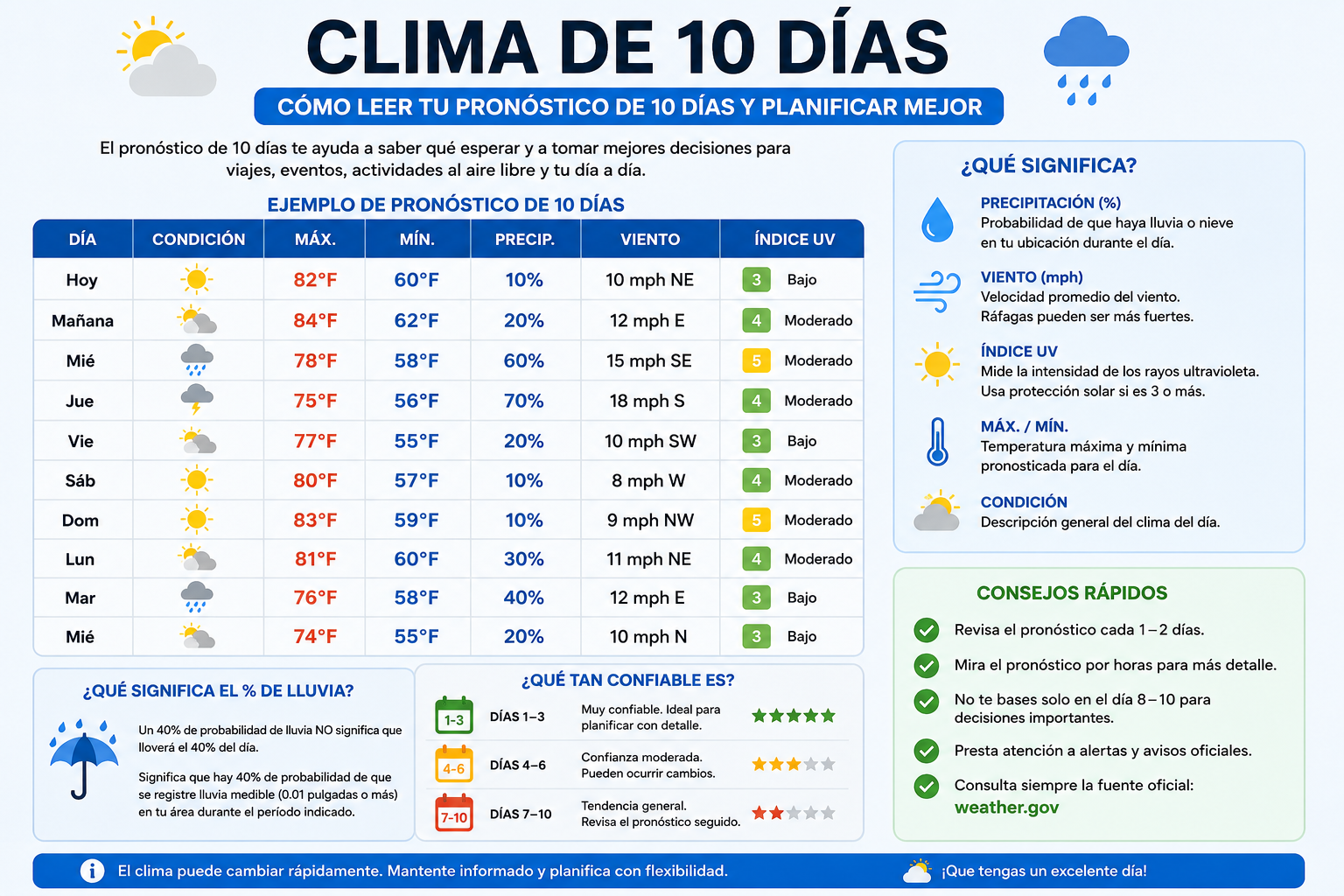
Searching for clima de 10 días usually means you want a quick answer to a practical question: What will the weather be like over the next week and a half?
A 10-day forecast can help you choose travel dates, plan an outdoor event, prepare for temperature changes, or decide what to pack. However, the forecast is most useful when you understand what its percentages, symbols, temperatures, and warnings actually mean.
This guide explains how to read a 10-day weather forecast in the United States and how much confidence to place in each part of it.
What Is a 10-Day Weather Forecast?
A 10-day forecast is a day-by-day estimate of expected atmospheric conditions for a specific location. Most forecasts include daytime highs, nighttime lows, sky conditions, precipitation probability, wind, humidity, and other planning information.
The forecast must be connected to a location. A nationwide forecast cannot tell you what to expect in your neighborhood because conditions can differ significantly between cities, suburbs, mountain areas, coastlines, and even nearby ZIP codes.
For the most relevant result, search using one of these formats:
- City and state, such as “Phoenix, Arizona”
- ZIP code, such as “85001”
- Neighborhood and city
- Airport code for travel planning
- A specific park, beach, resort, or destination
Check that the selected location is correct before relying on the displayed forecast. Many U.S. cities share the same name.
What Information Should a Useful Forecast Include?
A strong forecast gives you more than a weather icon. It should provide enough information to help you understand when conditions may occur and how they could affect your plans.
| Forecast field | What it tells you | How to use it |
|---|---|---|
| High temperature | Warmest expected temperature during the day | Choose clothing and plan outdoor activity |
| Low temperature | Coldest expected overnight temperature | Prepare for early mornings and nighttime travel |
| Precipitation chance | Probability of measurable rain or snow at your location | Decide whether you need rain protection or a backup plan |
| Precipitation amount | Approximate amount of rain, snow, or ice | Evaluate travel, flooding, or event risks |
| Wind speed | Expected sustained wind | Consider cycling, boating, driving, and outdoor setup |
| Wind gusts | Short bursts stronger than sustained wind | Secure tents, decorations, and loose objects |
| Feels-like temperature | How conditions may feel to the human body | Judge comfort and potential heat or cold stress |
| Humidity or dew point | Amount of moisture in the air | Estimate how muggy or dry conditions may feel |
| UV index | Expected intensity of ultraviolet radiation | Plan sun protection |
| Weather alerts | Official information about hazardous conditions | Adjust plans and follow safety instructions |
How Accurate Is a 10-Day Forecast?
A 10-day forecast is not equally certain on every day. Conditions in the first few days are usually clearer because meteorologists have more recent observations and less time for small atmospheric changes to alter the outcome.
Forecasting becomes more uncertain farther into the future. Weather systems can change speed, direction, strength, or timing, and small differences in initial conditions may produce different outcomes several days later. The National Weather Service describes forecasting as a complex process involving observations, prediction, and communication.
A practical way to use the forecast is:
Days One Through Three: Detailed Planning
Use these days for specific decisions such as departure times, clothing, outdoor activities, and transportation. Still check for updates, especially when thunderstorms, snow, tropical weather, or extreme temperatures are possible.
Days Four Through Six: Flexible Planning
The general pattern may be useful, but the timing and intensity can change. Make plans while keeping an indoor alternative or flexible schedule.
Days Seven Through Ten: Trend Monitoring
Treat these days as an early indication rather than a final promise. Focus on broader patterns, such as whether the period may be warmer, cooler, wetter, drier, or more unsettled.
The National Weather Service’s Climate Prediction Center uses probabilistic temperature and precipitation outlooks for the 8-to-14-day period rather than presenting those longer-range conditions as exact local outcomes.
What Does a 40% Chance of Rain Mean?
Rain percentages are frequently misunderstood.
A 40% probability of precipitation means there is a 40% chance that a specific forecast point will receive at least 0.01 inch of precipitation during the stated period. It does not mean that it will rain for 40% of the day. It also does not automatically mean that 40% of the entire city will receive rain.
The forecast period also matters. A 40% chance during the afternoon is different from a 40% chance across an entire 24-hour day.
When rain could affect important plans, examine:
- The hourly forecast
- Expected rainfall amount
- Thunderstorm probability
- Radar closer to the event
- Flood watches or warnings
- Whether rain is expected to be scattered or widespread
A low rain percentage does not necessarily mean the impact will be minor. A brief thunderstorm can still produce lightning, strong wind, or heavy rain at a particular location.
Temperature Versus Feels-Like Temperature
The standard temperature measures the air. A feels-like value estimates how the conditions may affect the human body.
Heat Index
The heat index combines air temperature and relative humidity to estimate how hot it feels. High humidity can reduce the body’s ability to cool through evaporation, making conditions feel hotter than the measured air temperature.
For summer activities, do not look at the afternoon high alone. Check the heat index, cloud cover, access to shade, and the amount of time you expect to spend outside.
Wind Chill
The wind chill estimates how cold exposed skin may feel when wind increases heat loss from the body. It applies to people and animals rather than describing the temperature of objects.
During cold weather, wind chill may be more useful than the ordinary temperature when choosing clothing or deciding how long to remain outside.
Why Wind and Gusts Matter
A forecast may show both sustained wind and gust speed. Sustained wind represents the more consistent flow, while gusts are shorter periods of stronger wind.
Gusts can affect:
- High-profile vehicles
- Bridges and exposed highways
- Tents and temporary structures
- Outdoor decorations
- Boating and paddle sports
- Cycling
- Tree branches and power lines
Always check the wind direction as well. An onshore wind may make a beach feel cooler, while a strong crosswind can affect driving even when the temperature is comfortable.
How to Read the UV Index
The U.S. UV Index uses a scale ranging from low exposure levels to 11 or higher, which represents extreme intensity. The Environmental Protection Agency recommends using the index to understand the risk of excessive ultraviolet exposure.
Cloudy weather does not make the UV index irrelevant. Check it when planning time at beaches, parks, sporting events, pools, hiking areas, or other exposed locations.
The UV forecast is particularly useful when you will be outside near midday or around reflective surfaces such as water, sand, or snow.
Weather Watch, Warning, and Advisory: What Is the Difference?
Weather alerts should carry more weight than an ordinary icon on a 10-day forecast.
In general:
- A watch means hazardous conditions are possible, so you should prepare and continue monitoring updates.
- A warning means a hazardous event is occurring, imminent, or highly likely, so protective action may be necessary.
- An advisory covers conditions that are less severe than warning-level events but may still create meaningful hazards or disruption.
Exact definitions and thresholds depend on the hazard and local National Weather Service office. For example, a flood warning means flooding is imminent or already occurring, while advisories commonly describe less serious conditions that still require caution.
Do not rely only on a commercial weather app during severe conditions. Check official National Weather Service information and local emergency instructions.
What to Do When Weather Apps Disagree
Two forecast services may display different temperatures or rain percentages because they use different models, update schedules, locations, and interpretation methods.
Do not simply average the two numbers. Instead:
- Confirm that both services are forecasting the same exact location.
- Compare their update times.
- Look for agreement in the overall weather pattern.
- Check the hourly timing instead of only the daily icon.
- Review official alerts from the National Weather Service.
- Recheck the forecast as the event gets closer.
A forecast showing 40% rain and another showing 60% rain may still reflect broad agreement that showers are possible. The difference matters less than whether your plans are sensitive to even a brief period of rain.
How to Use a 10-Day Forecast for Real Decisions
Travel
Use later forecast days to identify possible disruptions, but avoid making major changes based only on a single day-eight or day-nine forecast.
As the trip approaches, check the departure city, destination, driving route, and any connecting airport. Weather at one location may not reflect conditions across the entire journey.
Outdoor Events
Look beyond the main weather icon. Check hourly rain timing, wind gusts, feels-like temperature, lightning potential, and nighttime conditions.
For an important event, create an indoor or covered alternative even when rain probability is moderate.
School and Sports Activities
Consider heat index, wind chill, lightning, air quality, and official local guidance. A sunny symbol does not automatically mean conditions are suitable for prolonged physical activity.
Commuting
Check the forecast shortly before leaving. Fog, freezing temperatures, thunderstorms, or intense rain may matter more than the daily high temperature.
Home and Yard Planning
Use temperature lows to identify possible freezing conditions. Wind and rain information can also help with gardening, painting, roof work, deliveries, and outdoor maintenance.
A Practical Forecast Example
Imagine a forecast showing:
- Monday: 82°F, partly cloudy, 15% rain
- Tuesday: 84°F, 45% afternoon thunderstorms
- Wednesday: 78°F, 70% rain with gusty wind
- Thursday: 80°F, 30% showers
For a Wednesday outdoor event, the correct conclusion is not simply “there is a 70% chance it will be canceled.”
Instead, check the expected timing, storm risk, wind gusts, rainfall amount, radar, and any alerts. If storms are expected mainly during the evening, a morning event may still be possible. If lightning is expected throughout the afternoon, an indoor plan would be more appropriate.
How Often Should You Recheck the Forecast?
For normal plans, check the forecast once when planning and again within one or two days of the activity.
For weather-sensitive travel or outdoor events, check more frequently as the date approaches. During rapidly changing or hazardous conditions, follow official updates and alerts rather than waiting for the next routine check.
The National Weather Service specifically advises people to keep checking the latest information because forecast accuracy and detail improve as an event approaches.
Suggested Internal Links
Relevant internal links could include:
- How to read weather radar
- What percentage chance of rain means
- Heat index safety guide
- Weather forecast by ZIP code
- Weekend travel planning checklist
- Difference between a weather watch and warning
Place the rain-probability link in the precipitation section, the heat-safety link under heat index, and the radar guide in the outdoor-event section.
Recommended External Sources
For U.S. readers, factual weather and safety claims should reference:
- The National Weather Service for official forecasts, watches, warnings, and advisories
- NOAA forecasting and climate resources
- The EPA UV Index resources
- State and local emergency-management agencies during major weather events
The National Weather Service is responsible for forecasts and warnings intended to protect life and property in the United States.
Conclusion
- A 10-day forecast is most useful when it is connected to the correct city, neighborhood, or ZIP code.
- The first few forecast days support detailed planning, while later days should be treated as changing trends.
- Rain probability describes the chance of measurable precipitation at a location during a stated period.
- Feels-like temperature, wind gusts, UV levels, and official alerts may be more important than the main weather icon.
- Rechecking the forecast as an activity approaches allows you to make decisions using newer and more reliable information.
FAQs
Is a 10-day weather forecast reliable?
A 10-day forecast can provide a useful overview, but confidence generally decreases with time. Use the first few days for detailed planning and the final days to identify broad patterns that should be checked again later.
Why does the 10-day forecast keep changing?
Forecasts change when new observations are added, weather systems develop differently than expected, or computer models adjust their predictions. Changes do not necessarily mean the original forecast was careless; they reflect the arrival of newer information.
Does a 50% chance of rain mean it will rain for half the day?
No. It means there is a 50% probability of measurable precipitation at the forecast point during the stated time period. The hourly forecast can provide better information about when that rain may occur.
Which weather source should I trust in the United States?
Use the National Weather Service for official forecasts and hazardous-weather alerts. Commercial weather apps can be useful for convenient maps, hourly displays, and notifications, but important safety decisions should include official local information.


MyGreenBucks Net Jones: What’s Verified, What Isn’t

andy ham radio linux: Complete Setup Guide (2026)

aiostream apk: Android Setup, Safety & Best Options
-

 Fashion9 years ago
These ’90s fashion trends are making a comeback in 2017
-
Entertainment9 years ago
The final 6 ‘Game of Thrones’ episodes might feel like a full season
-
Fashion9 years ago
According to Dior Couture, this taboo fashion accessory is back
-
Entertainment9 years ago
The old and New Edition cast comes together to perform
-
Sports9 years ago
Phillies’ Aaron Altherr makes mind-boggling barehanded play
-
Business9 years ago
The 9 worst mistakes you can ever make at work
-
Entertainment9 years ago
Disney’s live-action Aladdin finally finds its stars
-
Sports9 years ago
Steph Curry finally got the contract he deserves from the Warriors