Health
Couples Therapy What to Expect First Session: A Complete Guide

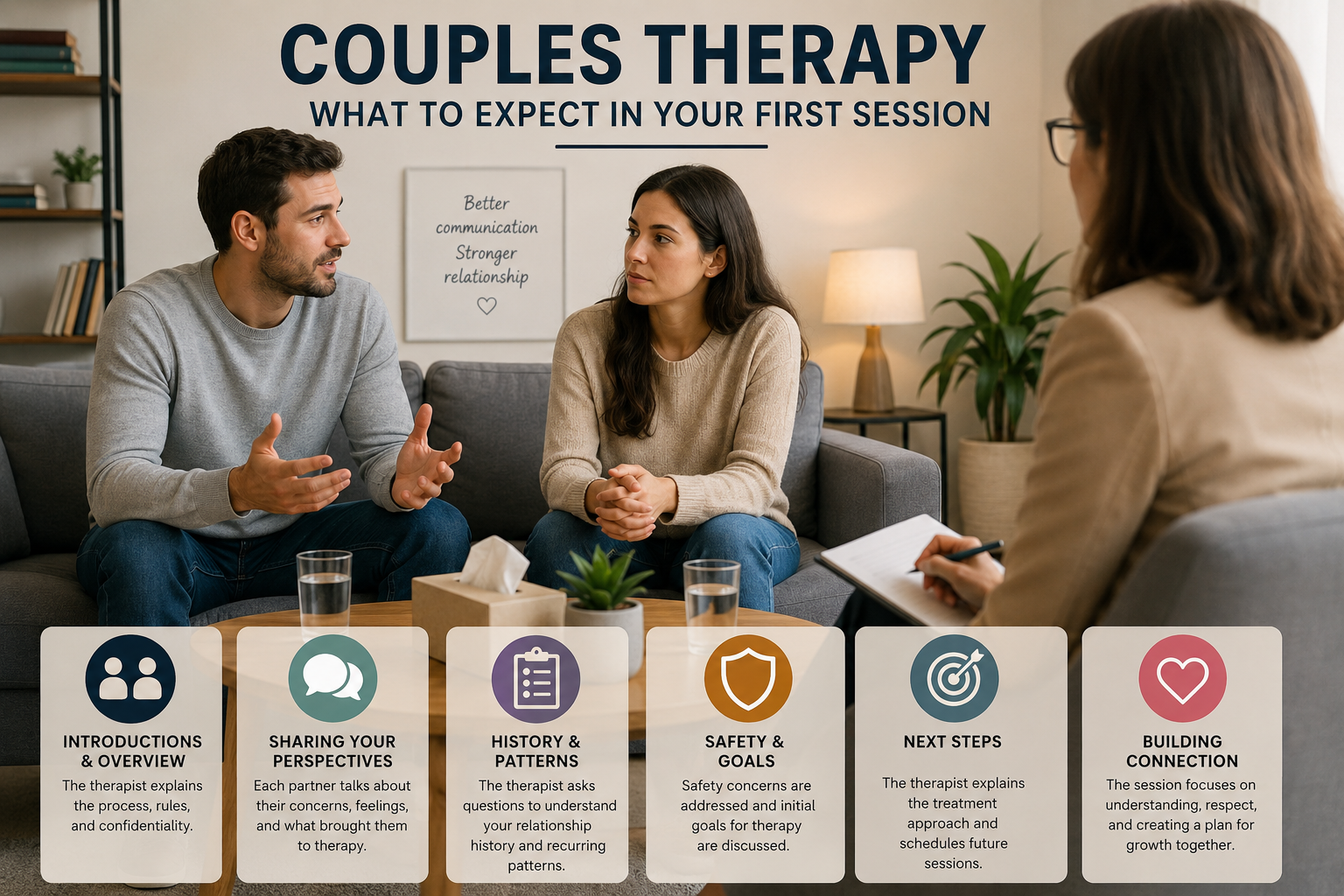
Searching for couples therapy what to expect first session usually means you are ready to seek help but feel uncertain about what will happen once you enter the room. Will the therapist take sides? Will you have to discuss your most painful problems immediately? What happens if one partner barely speaks?
The first appointment is generally an assessment and orientation rather than an attempt to repair the entire relationship in one hour. Your therapist will begin learning how the relationship works, what each partner wants, where communication breaks down, and whether couples therapy is a safe and suitable option.
Quick Facts About the First Couples Therapy Session
| Question | What Usually Happens |
|---|---|
| How long is the session? | Commonly 50–60 minutes, although some therapists schedule 75–90 minutes for an initial assessment |
| Who attends? | Usually both partners, with possible individual check-ins later |
| What is discussed? | Present concerns, relationship history, recurring conflicts, strengths and therapy goals |
| Will the therapist take sides? | A skilled couples therapist focuses on the relationship pattern rather than declaring one partner the winner |
| Will problems be solved immediately? | Usually not; the first meeting is primarily about assessment, safety, goals and therapeutic fit |
| Is everything confidential? | Generally yes, within legal and ethical limits; policies concerning secrets between partners vary |
| Will there be homework? | Possibly, but it is usually simple and based on what the therapist observes |
Counselling appointments commonly last around 50 to 60 minutes, although exact arrangements depend on the provider and therapeutic approach.
What Is the Main Purpose of the First Session?
The first session gives the therapist a structured introduction to your relationship. It also gives both partners an opportunity to evaluate the therapist.
The appointment usually has five main purposes:
- Understanding why you are seeking help now
- Hearing each partner’s perspective
- Identifying recurring relationship patterns
- Screening for safety concerns
- Establishing goals, expectations and practical boundaries
Relationship counselling can address communication breakdowns, emotional or physical intimacy, trust, jealousy, infidelity, family conflict, financial stress and major life transitions.
You do not need to arrive with a perfect explanation. A simple statement such as “We keep having the same argument and cannot resolve it” gives the therapist a useful place to begin.
What Happens During the First Couples Therapy Session?
Every therapist works differently, but most first appointments follow a recognizable structure.
1. Introductions and an Explanation of the Process
The therapist will introduce themselves and explain how couples therapy works. They may describe their training, therapeutic approach and expectations for participation.
You may also discuss:
- Session length and frequency
- Fees and cancellation policies
- Online or in-person arrangements
- Communication between sessions
- Emergency contact procedures
- Whether individual meetings may be included
This opening portion can feel administrative, but it creates important boundaries for the work ahead.
2. Confidentiality and the Therapist’s Secrets Policy
The therapist should explain confidentiality and its limits. Information may need to be disclosed in certain circumstances involving immediate danger, abuse, safeguarding concerns or legal requirements.
Couples therapy also creates a special question: what happens when one partner tells the therapist something privately?
Some practitioners use a no-secrets policy, meaning they will not hold relationship-relevant information indefinitely from the other partner. Others handle private disclosures differently.
Ask directly:
- Do you meet partners individually?
- What happens if one of us reveals a secret?
- Can either partner email you privately?
- What information would you be required to disclose?
Do not assume that every couples therapist follows the same policy.
3. Each Partner Explains Why They Came
The therapist will normally invite both partners to describe the relationship from their own perspective.
Common opening questions include:
- What brought you to therapy?
- Why are you seeking support at this point?
- How long has this problem been occurring?
- What have you already tried?
- What would need to change for therapy to feel worthwhile?
One partner may speak more confidently or provide more detail. A capable therapist will make space for both voices without treating different accounts as a courtroom dispute.
Ideally, the therapist listens to each person without automatically aligning with either side.
4. The Therapist Explores Your Relationship History
You may be asked how you met, what attracted you to each other and how the relationship developed.
Questions may cover:
- Important stages in the relationship
- Marriage, commitment or separation history
- Children and parenting responsibilities
- Previous breakups or reconciliations
- Changes in affection or intimacy
- Health, employment or financial pressures
- Family and cultural influences
- Previous individual or couples therapy
This history helps the therapist distinguish a recent crisis from a long-standing relational pattern.
The therapist may also ask about positive periods. Understanding when the relationship worked well can reveal strengths that therapy can build upon.
5. The Therapist Observes How You Interact
Your therapist is not only listening to the facts. They are also observing what happens between you while those facts are discussed.
They may notice:
- Who interrupts or withdraws
- How criticism is expressed
- Whether one partner becomes defensive
- How emotions are acknowledged or dismissed
- Whether disagreements escalate quickly
- Whether either partner appears afraid to speak
- How each person attempts to reconnect
For example, one partner may demand an immediate answer while the other becomes silent. The apparent problem may be the topic of the argument, but the clinically useful pattern is the cycle of pressure and withdrawal.
Couples therapy often focuses on changing these repeated interactional cycles rather than proving whose account is objectively correct.
6. Safety Questions May Be Asked
A responsible therapist may ask about physical violence, threats, coercive control, sexual pressure, stalking, intimidation, substance misuse, self-harm or fear within the relationship.
These questions may be asked together or privately.
Be honest, even when the information feels uncomfortable. The therapist needs an accurate understanding of safety before recommending joint therapeutic work.
Couples counselling may not be appropriate when there is ongoing abuse, coercive control or a credible fear of retaliation. The National Domestic Violence Hotline advises against attending couples counselling with an abusive partner because joint disclosure can create additional risks for the person experiencing abuse.
In such circumstances, confidential individual support and personalized safety planning should take priority.
7. Initial Goals Are Identified
Near the end of the appointment, the therapist may help you convert broad frustrations into workable goals.
A complaint such as “We communicate badly” might become:
- Discuss difficult subjects without shouting or shutting down
- Understand the emotions beneath recurring arguments
- Rebuild trust after dishonesty
- Make a clear decision about the relationship
- Improve affection and emotional connection
- Create healthier boundaries with relatives
- Cooperate more effectively as parents
Marriage and family therapy is commonly structured around specific, attainable therapeutic goals and relational healing.
The goals do not have to be finalized during the first meeting. Early sessions often continue the assessment before a detailed treatment plan is established.
Questions Your Couples Therapist May Ask
Therapists use questions to understand both the presenting problem and the larger relational system.
Questions About the Current Problem
- What happens during a typical argument?
- What usually triggers the conflict?
- How does the argument end?
- What does each partner do afterward?
- Which issues feel impossible to discuss?
- When did you first notice the relationship changing?
Questions About Connection
- When do you feel closest to your partner?
- When do you feel ignored or rejected?
- How do you express affection?
- What helps you feel emotionally safe?
- What do you miss about the earlier relationship?
Questions About Personal Background
- How was conflict handled in your childhood home?
- What did commitment look like in your family?
- Were emotions discussed openly?
- What experiences influence how you respond to rejection or criticism?
These questions are not necessarily attempts to blame your parents or excavate every childhood memory. They help identify learned expectations that may be affecting the current relationship.
Questions About Motivation
- What are you willing to change personally?
- Are you both attending voluntarily?
- What would progress look like?
- Are you seeking reconciliation, clarity or support during separation?
- What concerns do you have about therapy?
A therapist may pay close attention to whether both partners expect the other person to do all the changing.
Will the Therapist Ask to Meet You Separately?
Possibly.
Some therapists conduct one joint assessment followed by a short individual session with each partner. Others keep every appointment joint unless a specific need arises.
Individual meetings may allow the therapist to ask more privately about:
- Safety and fear
- Trauma history
- Substance use
- Affairs or hidden behavior
- Mental health symptoms
- Commitment to the relationship
- Concerns that are difficult to express together
One NHS couples-therapy pathway, for example, begins with a joint meeting and then schedules individual assessments before the therapist shares a formulation of the relationship difficulties.
Separate sessions should not be used to create permanent alliances or secret negotiations. Ask how individual information will be handled before disclosing something you expect the therapist to conceal.
Will You Have to Discuss Sex or Infidelity Immediately?
Not necessarily.
If intimacy, pornography, sexual pain, desire differences or infidelity brought you to therapy, the therapist will probably acknowledge the subject. However, you should not be forced to describe sensitive details before enough trust and structure have been established.
You can say:
“This is important, but I am not ready to discuss the details today.”
A good therapist can respect your pace while still assessing whether the issue affects safety, informed consent or the direction of treatment.
When an affair is involved, the first session may focus on immediate stabilization rather than investigating every event. The therapist may explore whether contact with the third party is continuing, what each partner needs to remain emotionally safe and whether both people are willing to participate honestly.
Will the Therapist Decide Who Is Right?
Couples therapy is not usually designed to produce a verdict.
The therapist may challenge harmful behavior, identify contradictions and hold each partner accountable. Neutrality does not mean pretending that cruelty, manipulation or intimidation are equal to ordinary communication mistakes.
However, the therapist will generally focus on questions such as:
- What happens between you?
- How does each response affect the next one?
- What keeps this cycle going?
- What responsibility can each person take?
- What would a healthier interaction look like?
The goal is not artificial fifty-fifty blame. Responsibility should be assigned accurately, especially when behavior involves betrayal, aggression or abuse.
How Emotional Is the First Session?
The session may feel calm, uncomfortable, relieving or intensely emotional.
You may experience:
- Nervousness before speaking
- Anger when hearing your partner’s version
- Relief that someone finally understands the pattern
- Shame about private relationship problems
- Fear that the therapist will judge you
- Hope that the relationship can change
- Exhaustion after the appointment
Crying is common and does not mean the session has gone badly. Silence can also be meaningful.
The therapist may slow the conversation, ask you to breathe, summarize what they are hearing or redirect you when the discussion becomes unproductive.
You are allowed to request a brief pause.
What Probably Will Not Happen in the First Session
Managing expectations can reduce unnecessary disappointment.
The therapist probably will not:
- Resolve years of conflict in one appointment
- Tell you immediately whether to stay or separate
- Guarantee that the relationship can be repaired
- Force either partner to forgive
- Assign equal responsibility regardless of the facts
- Let the entire session become an uncontrolled argument
- Reveal every conclusion they are considering
- Provide a complete treatment plan before assessment
The American Psychological Association notes that clients should generally begin developing a clearer understanding and treatment plan within the first few sessions, rather than expecting complete clarity from the first hour alone.
How to Prepare for Your First Couples Therapy Session
You do not need to rehearse a perfect speech. A small amount of preparation, however, can make the session more productive.
Identify Your Main Concern
Try to complete this sentence:
“The main reason I believe we need help is…”
Keep the answer to one or two sentences. You can discuss additional problems later.
Choose Two or Three Goals
Possible goals include:
- Reducing hostile arguments
- Rebuilding trust
- Feeling emotionally close again
- Improving parenting cooperation
- Making a decision about the relationship
- Understanding why the same conflict repeats
Goals help the therapist determine whether both partners are seeking compatible outcomes.
Think About Your Own Contribution
Before focusing on your partner’s mistakes, ask:
- What do I do when I feel hurt?
- How might my response intensify the problem?
- What behavior am I willing to change?
- What truth have I been avoiding?
Personal accountability makes therapy more effective. It does not require accepting blame for another person’s harmful choices.
Bring Practical Information
You may need:
- Completed intake forms
- Insurance or payment information
- Medication details when relevant
- Dates of major relationship events
- Information about previous therapy
- Questions about confidentiality and scheduling
Avoid arriving under the influence of alcohol or non-prescribed substances.
Agree on a Post-Session Plan
Do not assume you will want to analyze the entire appointment immediately afterward.
Consider agreeing in advance to:
- Take a short walk
- Travel home quietly
- Avoid restarting the argument in the car
- Discuss reactions after both partners have decompressed
- Contact the therapist rather than escalating a safety concern
This is especially helpful when the session involves betrayal, separation or another emotionally charged subject.
Common First-Session Mistakes to Avoid
Treating Therapy Like a Court Case
Bringing a mental file of every mistake your partner has made can consume the entire session without revealing the underlying cycle.
Specific examples are helpful. A prosecution strategy is not.
Trying to Recruit the Therapist
Statements such as “Please explain to my partner that I am right” place the therapist in an unproductive role.
A stronger approach is:
“Help us understand why this issue repeatedly turns into the same argument.”
Hiding the Real Reason You Came
Therapy cannot address an issue that remains completely concealed.
You do not need to disclose everything instantly, but tell the therapist when an important subject exists, even if you need more time before discussing it.
Expecting Immediate Communication Tricks
Communication tools are useful, but technique alone may not resolve fear, resentment, grief, trauma or broken trust.
The therapist may need to understand what drives the conflict before teaching a new way to handle it.
Continuing the Fight After the Session
Many couples leave activated and immediately argue about who “looked worse.”
Instead, write down your reactions and bring them to the next appointment.
Judging Therapy Only by Comfort
A productive session may feel difficult because it exposes a painful pattern.
The better question is not simply “Did I feel comfortable?” but “Did I feel respected, safe and constructively challenged?”
Questions to Ask the Therapist
The first appointment is also your opportunity to interview the professional.
Consider asking:
- What training do you have in couples therapy?
- What therapeutic approach do you use?
- How do you remain fair to both partners?
- How do you handle secrets or individual disclosures?
- Do you meet partners separately?
- How do you assess for abuse and coercive control?
- How will we measure progress?
- What happens when partners have different goals?
- Do you assign exercises between sessions?
- How frequently do you recommend meeting?
- How do you handle missed sessions or cancellations?
- What should we do if conflict escalates between appointments?
A therapist should be able to answer these questions clearly without becoming defensive.
How to Know Whether the Therapist Is a Good Fit
One awkward first appointment does not automatically mean the therapist is unsuitable. Everyone may need time to settle into an unfamiliar process.
Positive signs include:
- Both partners are given meaningful speaking time
- The therapist explains boundaries clearly
- Difficult behavior is addressed without humiliation
- The therapist notices interaction patterns, not only isolated facts
- Cultural, religious, sexual and family contexts are treated respectfully
- Goals are developed collaboratively
- Safety concerns are taken seriously
- The therapist can explain how their approach may help
Warning signs include:
- Consistently siding with one partner
- Minimizing threats, fear or violence
- Pressuring someone to reveal sensitive information before safety exists
- Using shame or ridicule
- Making stereotypes about gender, culture or sexuality
- Promising to save the relationship
- Allowing sessions to become repeatedly abusive
- Refusing to explain confidentiality or qualifications
Therapeutic fit matters. The first assessment should help you determine whether a productive working relationship is possible.
What Happens After the First Session?
At the end of the appointment, the therapist may:
- Summarize the main concerns
- Describe an interactional pattern they noticed
- Suggest a preliminary direction
- Recommend weekly or fortnightly sessions
- Schedule individual assessments
- Provide a short exercise
- Request additional questionnaires
- Refer one or both partners for specialized support
- Explain why joint therapy may not currently be appropriate
Homework might involve noticing a conflict cycle, scheduling a calm conversation or recording moments of connection. It should have a clear purpose rather than feeling like punishment.
You and your partner can also discuss privately whether you both felt sufficiently heard and respected. You do not need identical opinions, but serious concerns should be raised with the therapist.
Frequently Asked Questions
What if my partner does not want to talk?
The therapist may begin with less threatening questions and give your partner time to settle. Reluctance can reflect fear, skepticism, shame or concern about being blamed.
However, therapy cannot become productive when one person consistently refuses all participation.
What if we argue during the session?
Some disagreement is expected and can help the therapist observe your real interaction pattern. The therapist should intervene when the exchange becomes degrading, threatening or impossible to regulate.
Can couples therapy help us decide whether to separate?
Yes. Therapy does not always aim to preserve the relationship at any cost.
Some couples seek discernment, closure, cooperative separation or healthier co-parenting rather than reconciliation.
Can we attend if we are not married?
Yes. Couples therapy can support married, unmarried, engaged, separated, cohabiting and LGBTQ+ partners, as well as couples in other committed relationship structures.
What if only one partner wants to save the relationship?
Tell the therapist openly. Different levels of commitment are important clinical information.
The initial goal may be gaining clarity rather than beginning traditional relationship-repair work.
Should we prepare a list of every problem?
A short list is useful, but do not attempt to cover everything in the first session. Prioritize the concerns that create the greatest distress or risk.
How many sessions will we need?
There is no universal number. Duration depends on the problems involved, their severity, the therapy model, safety, attendance and each partner’s willingness to practice changes.
Couples therapy is often goal-focused, but complex trauma, repeated betrayal or long-standing conflict may require more time.
Final Thoughts
Understanding couples therapy what to expect first session can make the appointment feel less intimidating. The first meeting is usually a structured assessment in which the therapist learns about your concerns, relationship history, interaction patterns, safety and goals.
You do not need to arrive with perfect answers or expose every painful detail immediately. Come prepared to speak honestly, listen carefully, take responsibility for your own behavior and evaluate whether the therapist provides a fair, respectful and emotionally safe environment.
The first session may not fix the relationship, but it can establish something equally important: a clearer understanding of the problem and a realistic path toward change.



Searching for corvive com about us reflects a user intent focused on learning more about a brand, its identity, purpose, values, and credibility. An effective About Us experience should do more than introduce a company; it should explain why the organization exists, who it serves, and what makes it different.
A well-developed About Us page helps visitors understand the people, mission, and principles behind a business. It also plays an important role in building trust signals that support Google’s EEAT framework: Experience, Expertise, Authoritativeness, and Trustworthiness.
Why an About Us Page Matters for Brand Trust
An About Us page is often one of the first places visitors go before making a decision. Customers want context before they engage with a company, purchase a product, or share personal information.
A strong brand introduction can answer important questions:
- Who is behind the company?
- What problem does the business solve?
- What experience or expertise does the team bring?
- Why should customers choose this brand over alternatives?
- What values guide daily operations?
Businesses that clearly communicate these points create stronger relationships with their audiences.
Understanding the Purpose Behind Corvive com about us Searches
The keyword corvive com about us suggests that users are not only looking for basic company details. They may also be evaluating credibility, legitimacy, and brand alignment.
This type of search typically includes several expectations:
Brand Background and Identity
Visitors want to understand the foundation of the company. This includes:
- The company’s origin story
- Its mission and vision
- The market it serves
- The principles that guide its work
A meaningful brand story should be specific rather than generic. Details about challenges overcome, customer focus, and growth milestones make a company more relatable.
Transparency and Authenticity
Modern consumers often research businesses before interacting with them. Transparency helps reduce uncertainty.
An effective About Us page can include:
- Leadership information
- Team expertise
- Company milestones
- Business practices
- Customer-focused commitments
Avoid exaggerated claims. Clear, verifiable information creates stronger credibility.
Key Elements of a High-Quality About Us Page
A competitive About Us page combines storytelling with practical information.
1. A Clear Mission Statement
The mission should explain the company’s purpose in simple language.
A strong mission statement answers:
- What does the company do?
- Who does it help?
- What impact does it aim to create?
Avoid vague statements that could apply to any business.
2. A Compelling Company Story
The best brand stories follow a logical structure:
- Identify the original motivation behind the company.
- Explain the challenges or opportunities discovered.
- Describe how the company developed its approach.
- Show how customers benefit today.
This approach helps visitors connect emotionally while understanding the business purpose.
3. Evidence of Expertise
Expertise is demonstrated through proof, not just claims.
Useful credibility indicators include:
- Industry experience
- Professional qualifications
- Partnerships
- Customer results
- Recognized achievements
- Original research or insights
4. Customer-Centered Communication
A visitor does not only want to know about the company. They want to know how the company helps them.
Effective About Us content connects company strengths with customer outcomes.
Instead of focusing only on:
- “We are passionate.”
- “We provide quality solutions.”
Explain:
- How the company solves customer challenges
- What processes improve customer experiences
- What commitments guide service delivery
Common Mistakes to Avoid on an About Us Page
Many businesses lose opportunities by creating pages that feel impersonal or incomplete.
Mistake 1: Writing Only About the Company
An About Us page should not read like an internal report. It should explain why the company matters to its audience.
Mistake 2: Using Generic Brand Language
Phrases such as “industry-leading solutions” or “dedicated to excellence” provide little value without supporting details.
Specific examples create stronger trust.
Mistake 3: Ignoring SEO and User Experience
A well-optimized About Us page should include:
- Clear headings
- Relevant keywords
- Easy navigation
- Helpful internal links
- Mobile-friendly formatting
SEO should support readability, not interfere with it.
How to Create a Better About Us Experience
A strategic About Us page should combine brand storytelling, user needs, and search optimization.
A practical framework includes:
| Section | Purpose | Key Information |
|---|---|---|
| Introduction | Capture attention | Brand purpose and identity |
| Company Story | Build connection | History and growth |
| Mission and Values | Explain direction | Core principles |
| Expertise | Build authority | Experience and achievements |
| Customer Focus | Increase trust | Benefits and commitments |
| Call to Action | Encourage engagement | Next steps for visitors |
The Role of EEAT in About Us Content
Google’s EEAT framework emphasizes content quality and trustworthiness. About Us pages can support these signals by showing real-world experience and organizational transparency.
Important EEAT elements include:
- First-hand company experience
- Clear ownership information
- Accurate business details
- Demonstrated expertise
- Helpful information for visitors
A credible About Us page strengthens both user confidence and overall website quality.
Advanced Insights: Turning an About Page Into a Conversion Tool
An About Us page should not be treated as a simple biography. It can guide visitors toward meaningful actions.
Consider adding:
Customer Proof
Include examples of customer success, testimonials, or measurable outcomes when available.
Team Visibility
Showing real people behind a brand can improve trust and human connection.
Clear Next Steps
Visitors should know what to do after learning about the company, whether that means contacting the team, exploring services, or joining a community.
Quick Checklist for an Effective About Us Page
Before publishing, review the following:
- Does the page clearly explain the company’s purpose?
- Is the information specific and authentic?
- Does it demonstrate expertise?
- Does it address customer needs?
- Is the content easy to scan?
- Does it encourage the next step?
Conclusion
A successful corvive com about us experience should help visitors understand the brand, trust its purpose, and recognize its value. An effective About Us page combines transparency, expertise, and customer-focused storytelling to create a stronger connection between a company and its audience.
By focusing on authentic information, clear communication, and strong trust signals, businesses can transform an ordinary About Us page into a valuable resource that supports both users and long-term brand growth.


MyGreenBucks Net Jones: What’s Verified, What Isn’t

andy ham radio linux: Complete Setup Guide (2026)

aiostream apk: Android Setup, Safety & Best Options
-

 Fashion9 years ago
These ’90s fashion trends are making a comeback in 2017
-
Entertainment9 years ago
The final 6 ‘Game of Thrones’ episodes might feel like a full season
-
Fashion9 years ago
According to Dior Couture, this taboo fashion accessory is back
-
Entertainment9 years ago
The old and New Edition cast comes together to perform
-
Sports9 years ago
Phillies’ Aaron Altherr makes mind-boggling barehanded play
-
Entertainment9 years ago
Disney’s live-action Aladdin finally finds its stars
-
Business9 years ago
Uber and Lyft are finally available in all of New York State
-
Sports9 years ago
Steph Curry finally got the contract he deserves from the Warriors