
news
How Can I Get Candle Wax Out of Clothing Safely?

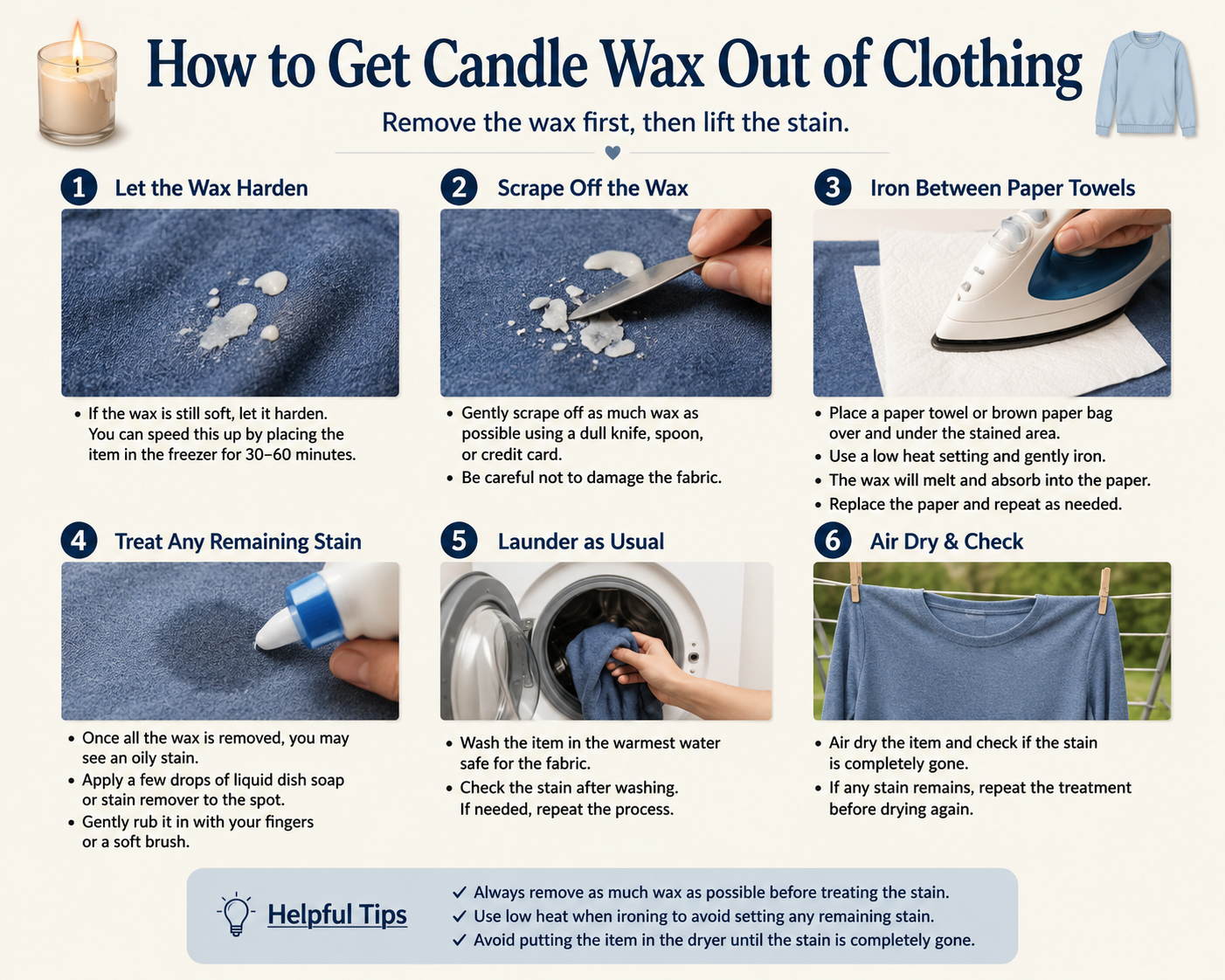
A candle drip can look permanent, but most wax stains can be removed when you treat the hardened wax, oily residue, and color separately. When you are wondering how can I get candle wax out of clothing, the safest answer is to slow down, check the care label, and use cold before applying gentle heat.
Quick Bio
| Feature | Details |
|---|---|
| Core definition | A controlled stain-removal process that hardens surface wax, lifts the solid layer, transfers embedded wax, and treats leftover oil or dye. |
| Origin | Traditional textile care relied on cooling wax and absorbing it with plain paper or cloth, while modern methods add targeted detergents and color-safe treatments. |
| Primary use | Restoring washable clothes, uniforms, table linens, denim, and household fabrics after candle drips or splashes. |
| Industry | Laundry care, textile maintenance, professional dry cleaning, hospitality, and household cleaning. |
| Popular applications | Removing paraffin, soy, beeswax, scented wax, and colored candle residue from common fabrics. |
Why Candle Wax Gets Stuck in Fabric
Candle wax creates two problems at once. The hardened layer sits on the garment’s surface, while melted wax can settle between the fibers and leave a slightly greasy mark after the solid pieces are removed. Colored or scented candles may also leave pigment or fragrance oil, which is why scraping alone rarely completes the job.
The best approach separates the cleanup into stages rather than attacking everything at once. First, remove the solid wax, then draw out the embedded material and finally treat any remaining discoloration. Laundry guidance from Persil and Whirlpool follows this basic sequence and stresses checking the garment’s care instructions before washing or applying heat.
How Wax Removal Methods Evolved
Older household methods used a simple combination of cold, a blunt edge, absorbent paper, and a warm iron. This method remains useful because cooling makes wax brittle, while controlled warmth softens the remaining layer so another material can absorb it. Modern fabric care adds liquid detergent, commercial stain treatments, oxygen-based laundry products, and professional cleaning for delicate garments.
The tools have changed, but the main principle remains the same. Wax needs to be moved away from the fibers without spreading it, scorching the cloth, or setting the remaining stain in a dryer. University of Georgia textile guidance also recommends using a dull tool, absorbent white material, gentle heat, and a hidden-area colorfastness test before stronger treatment.
What You Need Before Starting
Gather a sealed bag of ice or access to a freezer, a spoon or plastic card, plain white paper towels or a clean white cotton cloth, liquid laundry detergent, and an iron or hair dryer. White absorbent material makes transferred wax easier to see and reduces the possibility of ink or color moving onto the garment. For fleece, velvet, or other textured material, a lint-free cotton cloth is generally better than paper that might shed fibers.
Check the care label before doing anything else. Note the permitted washing temperature, ironing symbol, bleach instructions, and whether the item is marked dry-clean-only. Test detergent or stain remover on an inside seam, and never combine different cleaning products in an attempt to make them work faster.
The Safest Step-by-Step Removal Method
The most reliable routine is harden, lift, transfer, pretreat, wash, and inspect. Each stage handles a different part of the stain, so skipping directly to the washing machine often leaves a waxy patch behind. Work patiently and repeat a stage whenever wax is still transferring to the absorbent material.
1. Harden and Lift the Surface Wax
Let fresh wax cool completely instead of wiping it while it is soft. Place ice in a sealed plastic bag over the spot, or put a small washable garment in the freezer until the wax becomes firm and brittle. Gently flex the fabric and lift the thick pieces with a spoon, plastic card, or the blunt back of a butter knife.
Scrape in short movements without digging into the weave. Stop when only a thin film remains because aggressive scraping can fuzz knitwear, pull threads, or damage protective coatings. Purex and Whirlpool both recommend hardening the wax before using a blunt tool rather than rubbing warm wax deeper into the material.
2. Transfer Embedded Wax With Gentle Heat
Place the stained section between clean white absorbent layers, keeping the marked area away from any second layer of the garment. Set the iron to the lowest temperature allowed by the care label, turn off the steam, and press briefly instead of sliding the iron back and forth. Replace the paper or cloth as soon as it absorbs wax, then repeat until little or no residue transfers.
Heat control matters more than speed. Synthetic fibers can melt or become shiny under excessive heat, while printed fabric may respond differently from plain cloth. Persil, Tide, and Good Housekeeping describe low or warm heat with frequently changed absorbent material as a way to draw remaining wax away from washable fabric.
3. Pretreat, Wash, and Air-Dry
Once the waxy feeling is mostly gone, work a small amount of liquid laundry detergent into the remaining oily or colored mark. Let it sit for the time recommended on the product label, then wash the item at the warmest temperature permitted for that fabric. A color-safe oxygen laundry product may help with lingering pigment when both its instructions and the garment label allow it.
Inspect the garment before using a tumble dryer. Wet fabric can hide a faint stain, so air-dry the item and examine it under good light before repeating the treatment. Whirlpool, Purex, Persil, and Tide warn against machine-drying while residue remains because dryer heat can make the mark more difficult to remove.
How to Remove Wax Without an Iron
A hair dryer can provide controlled warmth when an iron is unavailable. Put a clean white absorbent cloth under and over the spot, use the lowest heat setting, keep the dryer moving, and blot as the wax softens. Change to a clean section of the cloth repeatedly so the softened wax is lifted instead of spread.
For heat-sensitive garments, rely more heavily on freezing and careful lifting. Do not pour boiling water over an unknown fabric because high temperatures can shrink fibers, damage finishes, or cause colored wax to spread. Whirlpool and Tide recommend a hair dryer as an alternative heat source, beginning with a low setting and absorbing the softened wax as it transfers.
Fabric-Specific Guidance
Cotton, linen, and sturdy denim normally tolerate the standard cold-and-low-heat method, but the care label still determines the safe temperature. Polyester, nylon, activewear, and blended fabrics need lower heat and shorter contact because synthetic fibers can distort or develop shiny patches. Turn printed or embellished clothing inside out when possible and avoid pressing directly on graphics, sequins, or adhesive decoration.
Wool, silk, lace, velvet, acetate, vintage garments, and dry-clean-only pieces require extra caution. Harden the wax, lift only what releases easily, and avoid experimenting with strong heat or harsh spot treatments. Professional cleaning is safer when the garment is valuable, structurally delicate, heavily dyed, lined, or difficult to rinse completely.
Colored, Scented, and Decorative Wax
White wax may leave only an oily shadow, while red, blue, black, metallic, or glitter wax can leave noticeable pigment after the solid material disappears. Treat the dye mark only after removing as much wax as possible because detergent cannot work effectively through a sealed wax layer. Use a fabric-safe stain remover or color-safe oxygen treatment according to its instructions, then wash and air-dry the garment.
Decorative candles may contain colorants, fragrance oils, or fine particles that behave differently from plain wax. Repeat gentle treatment rather than increasing the heat, and avoid chlorine bleach unless the garment label clearly permits it. If the color starts spreading during a hidden-area test, stop and use a professional cleaning service.
Old or Dryer-Set Wax Stains
An older stain is not necessarily permanent, but it may require several short treatment cycles. Harden and scrape any remaining surface material, use controlled warmth to transfer what still softens, pretreat the oily mark, and wash according to the care label. Air-dry and repeat rather than using stronger heat.
A stain that has already passed through a dryer may be more deeply embedded. Concentrate on gradual transfer and detergent treatment, not forceful scraping or extremely hot ironing. When repeated fabric-safe treatment produces no improvement, a dry cleaner may have specialized equipment that is less likely to damage the garment.
Common Mistakes and When to Stop
The most common errors are wiping liquid wax, using a sharp blade, applying excessive iron heat, rubbing the stain outward, washing before removing the solid layer, and drying before checking the result. Printed paper bags or colored towels can also transfer ink or dye, while direct ironing can leave melted wax on the iron plate. Plain white absorbent material and brief, controlled contact are safer choices.
Stop home treatment if the fabric changes color, becomes shiny, stretches, smells scorched, or shows surface damage. Treatment should also stop when the label says dry-clean-only or when the garment includes leather trim, glued decoration, fragile embroidery, or an unknown vintage fiber. Protecting the fabric is more important than removing every trace in one attempt.
Conclusion
- Let the wax harden fully before touching it so you do not push the stain deeper into the fabric.
- Lift thick wax with a blunt tool, then use only the lowest heat permitted by the garment’s care label.
- Treat leftover oil or pigment separately with a fabric-safe detergent or stain remover.
- Air-dry and inspect the garment before using a tumble dryer, repeating gentle treatment when necessary.
- Take delicate, valuable, dry-clean-only, or heat-sensitive clothing to a professional cleaner instead of risking permanent damage.
FAQs
How can I get candle wax out of clothing after it has dried?
Hardened wax is often easier to handle than soft wax. Scrape away the brittle surface layer with a spoon or plastic card, transfer the remaining film into white absorbent material using label-safe low heat, and pretreat any oily mark before washing. Air-dry the garment and repeat the process if a shadow remains.
Can I wash wax-stained clothes immediately?
It is better to remove the solid wax first. A normal wash may not dissolve the hardened layer, and softened wax can move to another part of the garment or washing load. Harden, scrape, transfer, pretreat, and then wash according to the care label.
Will candle wax come out of polyester?
It often can, but polyester requires cautious heat. Freeze and lift the wax first, then use a hair dryer or iron on the lowest fabric-safe setting with a white absorbent cloth. Stop immediately if the material becomes shiny, warped, or unusually warm.
What should I do when colored wax leaves a stain?
Remove the physical wax before treating the color. Apply a fabric-safe stain remover or color-safe oxygen laundry product only after testing it on a hidden area, then wash at the temperature allowed by the care label. Keep the garment out of the dryer until the discoloration is gone.


Sehmeres is an uncommon search term that creates curiosity because its meaning is not immediately clear. People searching for sehmeres are usually looking for identification, explanation, or context rather than a simple definition. Current search results do not show a single universally accepted meaning, making careful investigation more important than guessing.
This guide explores what sehmeres may represent, why unusual keywords appear online, how to research them correctly, and what mistakes to avoid when trying to understand unfamiliar terms.
Sehmeres Quick Facts
| Question | Answer |
|---|---|
| Is sehmeres a common dictionary word? | No widely recognized standard definition is currently established. |
| Does sehmeres have one confirmed meaning? | Not from available evidence; context is required. |
| Could sehmeres be a typo? | Yes, this is one possible explanation. |
| Could it be a name, username, or brand? | Yes, unusual terms are often created for digital identities. |
| Best way to understand it | Find the original source where the term appeared. |
What Does Sehmeres Mean?
The exact meaning of sehmeres cannot be confirmed without additional context. Unlike established words that have dictionary entries and consistent usage, sehmeres appears to be a rare or context-dependent term.
When a search query contains an unusual word, there are several possibilities:
- It may be a spelling mistake.
- It may be a username or online identity.
- It may be a new brand or project name.
- It may be a transliterated word from another language.
- It may come from incorrectly scanned or converted text.
A reliable explanation should separate confirmed information from assumptions.
Why Is Sehmeres Difficult to Define?
Limited Online Usage
Common words usually have many independent references, including dictionaries, articles, academic sources, and everyday examples.
Rare terms like sehmeres often lack these signals. When search information is limited, a single webpage should not automatically be considered authoritative.
Possible Digital or Text-Recognition Errors
Some unusual search terms appear because of errors in digital processing.
Examples include:
- Optical character recognition mistakes from scanned documents.
- Incorrect subtitles in videos.
- Automatic translations.
- Typing errors.
- Autocorrect changes.
A strange spelling does not always represent a real standalone word.
Possible Explanations for Sehmeres
1. Sehmeres Could Be a Misspelling
One of the most common reasons for unusual searches is a simple spelling variation.
A person may have:
- Heard a word but never seen it written.
- Copied text incorrectly.
- Typed letters in the wrong order.
- Used a different spelling from another language.
The correct approach is to examine where the word was found before deciding what it means.
2. Sehmeres Could Be a Username or Online Name
Modern internet culture creates thousands of unique names every day.
A term like sehmeres may function as:
- A social media handle.
- A gaming identity.
- A creator name.
- A community nickname.
- A personal brand.
If the term appears after an “@” symbol or inside a profile link, it is more likely to represent an identity rather than a traditional word.
3. Sehmeres Could Be a Brand or Project Name
Businesses and digital products often use invented names.
A company name does not always need a dictionary meaning. Many brands choose unique combinations of letters to create a memorable identity.
Look for surrounding words such as:
- Official website
- App
- Download
- Login
- Pricing
- Services
- Store
These clues can reveal whether sehmeres refers to a product or organization.
4. Sehmeres May Be Related to Another Language
Some words change significantly when written using the Latin alphabet.
Transliteration can create multiple spellings for the same original term. A word from Arabic, Persian, Urdu, Turkish, or another language may appear differently depending on pronunciation and regional spelling.
Without knowing the source language, assigning a definite meaning can lead to incorrect conclusions.
How to Find the Real Meaning of Sehmeres
Step 1: Check Where You Found the Word
The source provides valuable clues.
Ask:
- Was it on a website?
- Did it appear in a video?
- Was it part of a username?
- Did it come from a document or image?
- Was it mentioned in a conversation?
Context often solves what a dictionary cannot.
Step 2: Search More Than the Single Word
Instead of searching only:
sehmeres
try combinations such as:
"sehmeres" meaning"sehmeres" website"sehmeres" username"sehmeres" app"sehmeres" + the nearby word
Adding context improves accuracy.
Step 3: Examine Spelling and Capitalization
Small details matter.
Compare:
- sehmeres — could be a general search term.
- Sehmeres — could suggest a name, company, or title.
Capitalization, punctuation, and surrounding text can change interpretation.
Common Mistakes When Researching Sehmeres
Creating a Meaning Without Evidence
A common mistake is inventing a definition simply because a keyword is unfamiliar.
Good research accepts uncertainty when proof is unavailable.
Trusting the First Search Result
Search rankings do not always equal accuracy.
For rare keywords, evaluate:
- Source credibility.
- Supporting evidence.
- Original references.
- Transparency about uncertainty.
Confusing Similar-Looking Words
Words that look alike are not necessarily connected.
A few shared letters do not prove a relationship between terms. Always verify the origin before linking meanings.
SEO Insights: Why Sehmeres Is an Interesting Keyword
From an SEO perspective, sehmeres represents a discovery-focused search intent.
The searcher is likely asking:
- “What is this?”
- “Where did this term come from?”
- “Is this a person, brand, or concept?”
- “Did I spell it correctly?”
A helpful page should not force a false definition. Instead, it should provide a structured investigation that helps readers reach the correct answer.
This approach supports trust because it prioritizes accuracy, evidence, and user satisfaction.
Frequently Asked Questions About Sehmeres
Is sehmeres a real word?
Sehmeres appears to be a real search term, but it does not currently have a widely recognized universal definition.
Is sehmeres a name?
It could be. Unusual spellings are often used for usernames, brands, characters, or personal identities.
Is sehmeres a typo?
Possibly. The intended word may depend on where the term was originally seen.
How can I discover what sehmeres means?
Find the original source, examine nearby words, check spelling variations, and look for reliable references.
Should I trust websites that define sehmeres?
Only if they provide evidence. A strong explanation should show how the meaning was verified rather than simply repeating unsupported claims.
Final Conclusion
Sehmeres remains an unusual and context-dependent keyword rather than a term with one confirmed public meaning. The most effective way to understand sehmeres is to investigate its source, surrounding information, and possible origins instead of accepting unsupported definitions.
When dealing with rare search terms, accuracy matters more than certainty. By checking context and verifying evidence, you can discover whether sehmeres refers to a name, typo, brand, translation, or something else entirely.
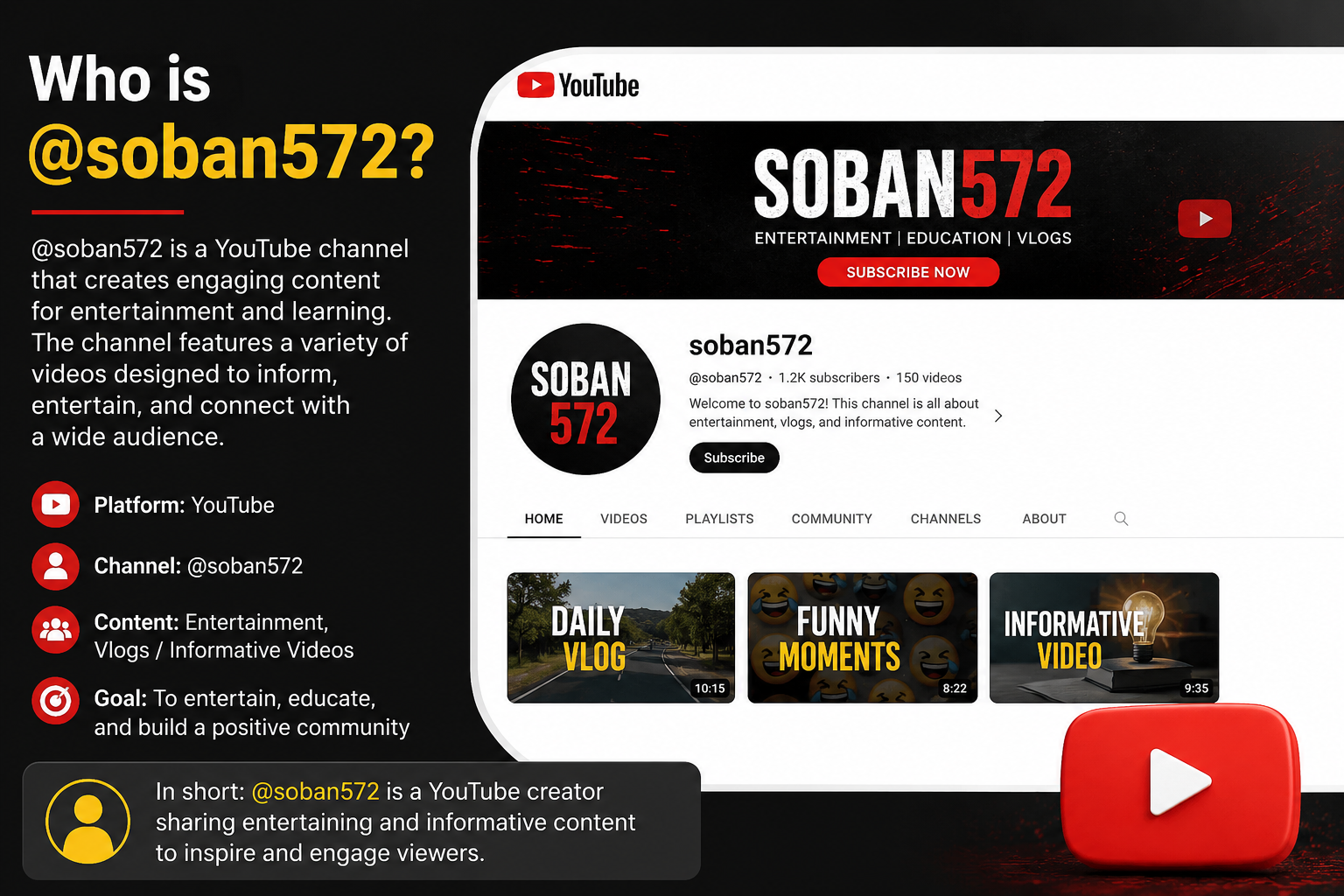
If you are searching for who is www.youtube.com/@soban572, you are likely trying to identify the person or creator behind the YouTube handle @soban572 and understand what they do online. Public search results provide limited direct information about the YouTube channel, so it is important to separate verifiable facts from assumptions.
What Is @soban572?
@soban572 is a YouTube handle that identifies a specific channel or creator on YouTube. A YouTube handle is a unique identifier that can be used to find and mention a channel.
However, the handle itself does not necessarily reveal the creator’s full name, profession, location, or background. Those details should only be attributed to the account owner when they are publicly confirmed through reliable sources.
Who Is Behind www.youtube.com/@soban572?
At present, publicly indexed search results do not provide enough reliable information to confidently establish the real-world identity of the person behind www.youtube.com/@soban572.
There is, however, a potentially relevant public reference to the username @Soban572 on Freelancer, where an account associated with Pakistan submitted a proposal for a website-design project.
This may be the same person as the YouTube creator, but there is not enough evidence to state that they are definitely the same individual.
Why the distinction matters
Online usernames can be shared or reused by different people. A matching username alone is not proof of identity.
For an accurate profile, look for information that connects the accounts directly, such as:
- A YouTube channel description linking to the person’s professional profile
- Matching social-media accounts
- A personal website listed on both profiles
- Consistent name and biography information
- Videos in which the creator identifies themselves
What Can You Learn From the YouTube Channel?
If the channel is publicly accessible, the most useful information to examine includes:
- Channel name — The displayed name may be different from the handle.
- About section — This can reveal the creator’s stated interests or profession.
- Video titles — A useful indicator of the channel’s main subject.
- Upload history — Helps establish whether the account is active.
- Featured links — These can connect the channel to other verified profiles.
- Audience engagement — Comments and recurring topics may provide additional context.
These details are more reliable than trying to identify someone solely from a username.
Is @soban572 a Freelancer or Web Designer?
There is a public Freelancer listing showing @Soban572 responding to a website-design project and describing their skills as matching the project requirements.
That provides evidence that an account using this username has presented itself in a web-design/freelancing context.
Nevertheless, it would be inaccurate to claim that this definitively identifies the owner of the YouTube channel unless the two profiles can be directly connected.
How to Verify the Creator
If you want to determine who www.youtube.com/@soban572 actually belongs to, use this verification process:
1. Check the YouTube About page
Look for a real name, business name, location, website, or social links voluntarily provided by the creator.
2. Compare external profiles
Search the exact handle on professional and social platforms. Pay particular attention to profile photos, biographies, websites, and linked accounts.
3. Check older videos
Older uploads can reveal the creator’s niche, professional interests, or publicly stated identity.
4. Look for cross-links
The strongest evidence is when the YouTube channel itself links to another account—or another account explicitly links back to the YouTube channel.
5. Avoid unsupported identity claims
Do not assume that a username, country, photograph, or similar profile proves that two accounts belong to the same person.
Quick Facts About @soban572
| Detail | What can currently be established |
|---|---|
| Platform | YouTube |
| Handle | @soban572 |
| Channel URL | www.youtube.com/@soban572 |
| Creator’s verified real name | Not established from the available public results |
| Public professional reference | A Freelancer profile using @Soban572 appears in search results |
| Possible profession | Web design/freelancing context is publicly associated with the matching username |
| Confirmed connection between profiles | Not established |
Why Search Results May Be Limited
Smaller or newer YouTube channels may have little information indexed outside YouTube. Search engines can also return unrelated pages when a username is relatively uncommon.
For that reason, the YouTube channel’s own public information should be treated as the primary source when determining its identity and purpose.
Final Verdict: Who Is www.youtube.com/@soban572?
So, who is www.youtube.com/@soban572? The account is a YouTube channel identified by the handle @soban572, but the available public evidence is not sufficient to confidently identify its owner by full name.
A matching @Soban572 username appears in public Freelancer search results in connection with website-design work, including a profile associated with Pakistan. However, this should be considered a possible connection rather than confirmed identity unless the YouTube account itself provides additional verification.

The keyword quartz events sponsor matching companies indicates a commercial investigation and guide-focused search intent. Users are likely looking for platforms, agencies, or strategies that help match Quartz events with relevant sponsors rather than simply learning what event sponsorship means.
They want practical answers:
- Which companies can help find sponsorship opportunities?
- How does sponsor-event matching work?
- What makes a sponsor partnership successful?
- How can organizers improve sponsorship revenue?
- What should brands evaluate before investing in an event?
A valuable resource must go beyond definitions and explain the decision-making process behind successful sponsor matching.
Quick Facts: Quartz Events Sponsor Matching Companies
| Factor | Key Insight |
|---|---|
| Primary purpose | Connect events with brands seeking targeted sponsorship opportunities |
| Best users | Event organizers, conference producers, associations, and marketing teams |
| Main benefit | Faster identification of relevant sponsors |
| Success driver | Strong alignment between audience, brand goals, and event objectives |
| Common mistake | Choosing sponsors based only on budget instead of strategic fit |
What Are Quartz Events Sponsor Matching Companies?
Quartz events sponsor matching companies are organizations, platforms, or service providers that help identify connections between event organizers and potential sponsors.
These companies use audience data, industry relationships, sponsorship marketplaces, and partnership strategies to create stronger matches between events and brands.
The goal is not simply finding any sponsor. The goal is finding sponsors that benefit from reaching a specific audience while providing meaningful value to attendees.
A successful match considers:
- Event audience demographics
- Brand objectives
- Industry relevance
- Sponsorship budget
- Marketing goals
- Long-term partnership potential
How Sponsor Matching Works for Quartz Events
1. Event Profile Development
The process begins by creating a detailed event profile.
Professional sponsor matching companies typically analyze:
- Event theme and industry focus
- Expected attendance
- Audience purchasing power
- Geographic reach
- Digital engagement opportunities
- Media exposure potential
A clearly defined event profile makes it easier to attract sponsors that see measurable business value.
2. Sponsor Identification and Research
Sponsor matching providers research companies that align with the event’s audience and objectives.
Strong matches often come from businesses looking to:
- Increase brand awareness
- Generate qualified leads
- Enter new markets
- Build industry authority
- Connect with decision-makers
For example, a technology conference may attract software companies, cybersecurity firms, cloud providers, or professional service organizations because the audience directly supports their marketing goals.
3. Partnership Evaluation
Not every interested company is a good sponsor.
Professional matching requires evaluating:
| Evaluation Area | Important Questions |
|---|---|
| Audience fit | Does the sponsor want to reach this audience? |
| Brand alignment | Do both organizations share compatible values? |
| Activation potential | Can the sponsor create meaningful attendee experiences? |
| Financial capability | Can the company support the sponsorship level required? |
| Long-term value | Could this become an ongoing partnership? |
Why Companies Use Quartz Events Sponsor Matching Companies
Faster Access to Qualified Sponsors
Finding sponsors manually can require months of outreach, research, and negotiation.
Matching companies reduce this workload by providing:
- Existing brand relationships
- Industry databases
- Sponsorship expertise
- Partnership recommendations
This allows event teams to focus more on event execution.
Better Sponsorship ROI
A sponsor relationship succeeds when both sides receive measurable value.
Matching specialists help improve ROI by connecting events with companies that already have a reason to participate.
Benefits include:
- Higher-quality sponsorship conversations
- Better audience relevance
- Increased renewal opportunities
- More effective sponsorship packages
Professional Sponsorship Strategy
Many events fail to maximize sponsorship revenue because they sell packages instead of solutions.
Experienced matching companies help reposition sponsorship as a business partnership.
Instead of offering:
“Logo placement on event materials”
A stronger approach becomes:
“Access to 5,000 industry professionals through targeted networking, thought leadership, and digital engagement opportunities.”
How to Choose the Right Sponsor Matching Company
Evaluate Industry Experience
The best sponsor matching provider understands your event category.
Look for experience in:
- Conferences
- Trade shows
- Corporate events
- Virtual events
- Industry summits
- Community events
A provider with relevant experience will understand sponsor expectations and market pricing.
Review Their Matching Process
Ask potential providers:
- How do they identify sponsors?
- What data do they analyze?
- How do they measure compatibility?
- Do they provide outreach support?
- How do they report results?
A transparent process usually indicates stronger expertise.
Check Their Network Quality
A large contact list does not automatically create valuable partnerships.
Quality matters more than quantity.
A strong sponsor matching company should have:
- Relevant brand relationships
- Industry-specific connections
- Decision-maker access
- Proven partnership outcomes
Common Mistakes When Finding Event Sponsors
Choosing Sponsors Based Only on Budget
A company willing to pay more is not always the best partner.
Poor alignment can create:
- Low attendee engagement
- Weak brand perception
- Difficult renewals
Strategic fit should come before sponsorship size.
Creating Generic Sponsorship Packages
Sponsors increasingly expect customized opportunities.
Avoid one-size-fits-all packages.
Instead, develop options around:
- Audience engagement
- Content partnerships
- Product demonstrations
- Networking experiences
- Digital visibility
Ignoring Post-Event Value
Many organizers focus only on securing sponsorship money.
Strong partnerships continue after the event through:
- Performance reports
- Lead summaries
- Audience insights
- Renewal discussions
Post-event measurement is often the difference between a one-time sponsor and a long-term partner.
Advanced Strategies for Better Sponsor Matching Results
Use Audience Data as Your Competitive Advantage
Sponsors want evidence that an event reaches valuable customers.
Collect and present:
- Registration demographics
- Attendee job titles
- Industry segments
- Engagement statistics
- Previous event performance
Better data creates stronger sponsorship conversations.
Build Tiered Partnership Opportunities
Modern sponsorship models should offer flexibility.
Examples include:
Premium Partnerships
Designed for major sponsors seeking maximum visibility.
Includes:
- Keynote opportunities
- Branding ownership
- Executive networking access
- Exclusive activations
Growth Partnerships
Suitable for companies testing event sponsorship.
Includes:
- Booth presence
- Content participation
- Lead generation opportunities
Community Partnerships
Designed for smaller organizations.
Includes:
- Digital visibility
- Networking access
- Supporting sponsorship recognition
Focus on Long-Term Sponsor Relationships
The strongest event sponsorship programs are relationship-driven.
Successful organizers maintain communication throughout the year through:
- Industry updates
- Sponsor performance reviews
- Early renewal discussions
- New collaboration ideas
Quartz Events Sponsor Matching Companies vs Traditional Sponsor Outreach
| Approach | Sponsor Matching Companies | Traditional Outreach |
|---|---|---|
| Research time | Lower | Higher |
| Access to contacts | Often stronger | Depends on internal network |
| Personalization | More strategic | Often inconsistent |
| Scalability | Higher | Limited |
| Expertise | Specialized | Depends on team experience |
Questions to Ask Before Hiring a Sponsor Matching Company
Before choosing a provider, ask:
- What industries do you specialize in?
- How do you determine sponsor-event compatibility?
- What results have you achieved for similar events?
- How do you measure sponsorship success?
- Do you support negotiation and partnership development?
These questions help separate experienced providers from basic lead-generation services.
The Future of Event Sponsor Matching
Sponsor matching is becoming increasingly data-driven.
Future-focused companies are using:
- Audience analytics
- Artificial intelligence-based recommendations
- Digital engagement tracking
- Predictive partnership models
The strongest sponsor relationships will come from deeper personalization rather than simple exposure-based deals.
Brands want meaningful connections with audiences, and events need partners that improve attendee experiences.
Final Thoughts on Quartz Events Sponsor Matching Companies
Finding the right sponsors requires more than sending proposals to random companies. The best quartz events sponsor matching companies help create strategic partnerships where events gain financial support and sponsors achieve measurable marketing outcomes.
By focusing on audience alignment, data-driven decisions, customized sponsorship packages, and long-term relationships, event organizers can build partnerships that deliver lasting value for everyone involved.


Yrefy Minimum Investment: Complete Investor Guide

xiaoyu’s kitchen: Recipes, Stories & Cooking Guide

W Moorcroft Pottery Marks: Identify Your Piece
-

 Fashion9 years ago
These ’90s fashion trends are making a comeback in 2017
-
Entertainment9 years ago
The final 6 ‘Game of Thrones’ episodes might feel like a full season
-
Fashion9 years ago
According to Dior Couture, this taboo fashion accessory is back
-
Entertainment9 years ago
The old and New Edition cast comes together to perform
-
Sports9 years ago
Phillies’ Aaron Altherr makes mind-boggling barehanded play
-
Entertainment9 years ago
Disney’s live-action Aladdin finally finds its stars
-
Business9 years ago
Uber and Lyft are finally available in all of New York State
-
Sports9 years ago
Steph Curry finally got the contract he deserves from the Warriors