Connect with us

Sports

Indy 500 Starting Grid: How the 33-Car Field Takes Shape

Published

on

indy 500 starting grid

The Indy 500 starting grid is more than a list of drivers arranged before the green flag. It is the final product of four-lap qualifying runs, technical inspections, changing track conditions, team decisions, and several rounds in which tiny speed differences can separate the front row from the middle of the field. This guide explains the final 2026 lineup while showing how the grid is formed, why each row matters, and what starting position can—and cannot—tell you about the race.

Quick Bio

Feature Details
Core definition The official order in which qualified cars line up for the Indianapolis 500
Historical origin Connected to the Indianapolis 500, first held in 1911
Primary use Establishing each driver’s starting position before the 500-mile race
Industry Professional motorsport, event broadcasting, sports media, and automotive entertainment
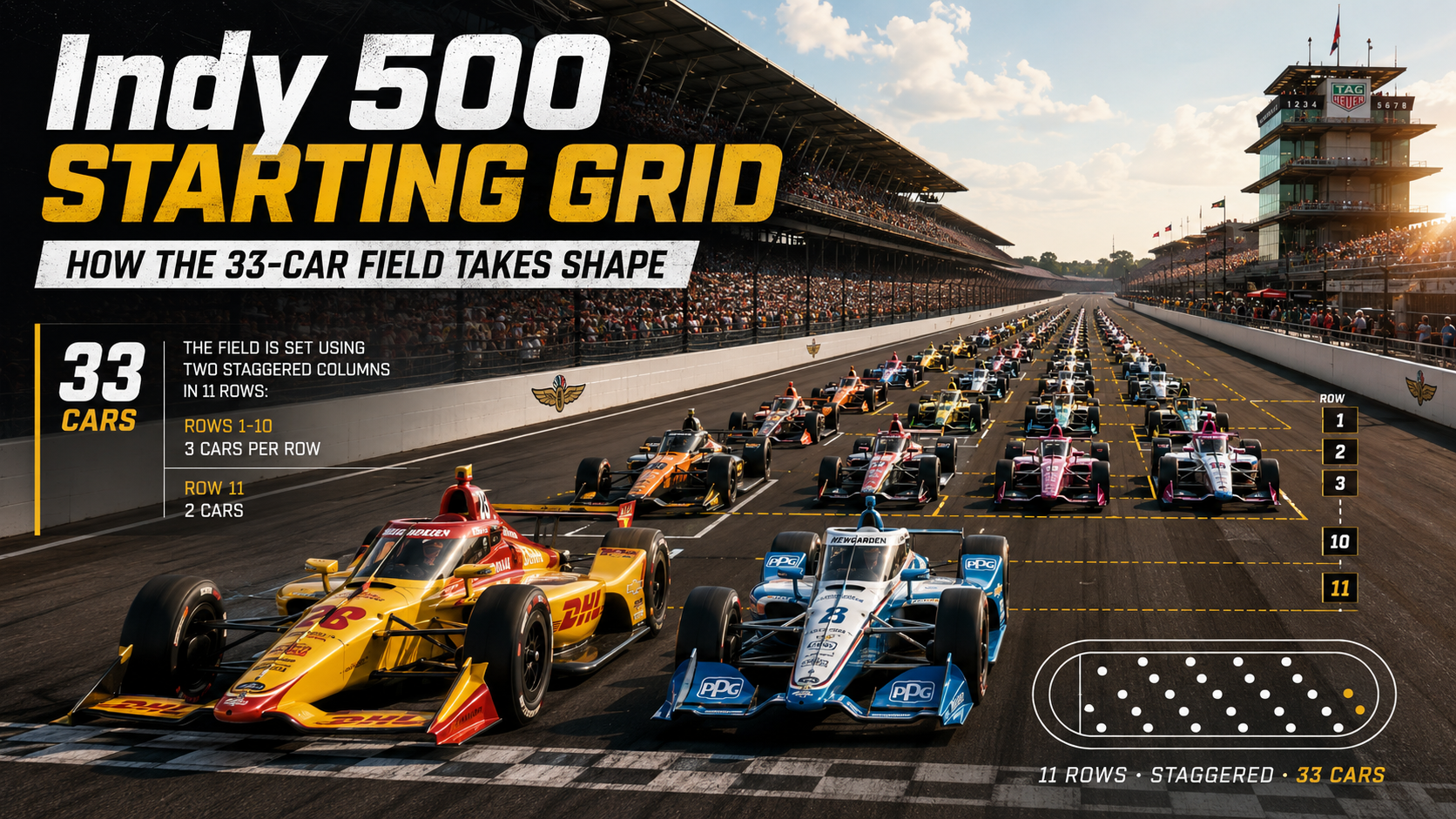
Standard structure 33 cars arranged three abreast across 11 rows
Positioning method Primarily determined through four-lap average qualifying speeds
Popular applications Official race programs, live digital grids, broadcast graphics, fan guides, team analysis, and race previews
2026 pole winner Alex Palou, with a four-lap average of 232.248 mph
2026 front row Alex Palou, Alexander Rossi, and David Malukas
Official status The order can remain provisional until inspections and qualifying penalties are completed

What the Starting Grid Actually Represents

A starting grid records the order in which the field is scheduled to begin the race, with the pole winner occupying the first position on the inside of Row 1. Indianapolis is visually distinctive because the cars line up three abreast, producing an inside, middle, and outside starter in each of the 11 rows. The structure gives the opening lap a character that differs sharply from series using conventional two-car rows.

The order is not based on practice times, championship standings, or a driver’s single fastest lap. Each completed Indianapolis qualifying attempt consists of four consecutive timed laps, and the average speed across the complete run determines the result. This format rewards a car that can remain balanced and fast throughout ten miles rather than producing one exceptional lap followed by a noticeable decline.

The published lineup should also be distinguished from a live qualifying leaderboard. A live grid changes as drivers complete runs, while the final order reflects completed qualifying rounds and any decisions made during post-session inspection. That distinction became especially important in 2026, when two qualifying results were disallowed after the original order had been reported.

Final 2026 Starting Lineup

The table below reflects the final official order for the 110th Indianapolis 500, held on May 24, 2026. Alex Palou earned pole position, Alexander Rossi qualified second, and David Malukas completed the front row. The official field contained 33 entries across 11 three-car rows.

Row Inside Middle Outside
1 1. Alex Palou, No. 10, Chip Ganassi Racing 2. Alexander Rossi, No. 20, Ed Carpenter Racing 3. David Malukas, No. 12, Team Penske
2 4. Felix Rosenqvist, No. 60, Meyer Shank Racing 5. Santino Ferrucci, No. 14, A.J. Foyt Enterprises 6. Pato O’Ward, No. 5, Arrow McLaren
3 7. Kyffin Simpson, No. 8, Chip Ganassi Racing 8. Conor Daly, No. 23, Dreyer & Reinbold Racing 9. Scott McLaughlin, No. 3, Team Penske
4 10. Scott Dixon, No. 9, Chip Ganassi Racing 11. Rinus VeeKay, No. 76, Juncos Hollinger Racing 12. Takuma Sato, No. 75, Rahal Letterman Lanigan Racing
5 13. Ed Carpenter, No. 33, Ed Carpenter Racing 14. Hélio Castroneves, No. 06, Meyer Shank Racing 15. Christian Rasmussen, No. 21, Ed Carpenter Racing
6 16. Marcus Armstrong, No. 66, Meyer Shank Racing 17. Marcus Ericsson, No. 28, Andretti Global 18. Christian Lundgaard, No. 7, Arrow McLaren
7 19. Will Power, No. 26, Andretti Global 20. Nolan Siegel, No. 6, Arrow McLaren 21. Louis Foster, No. 45, Rahal Letterman Lanigan Racing
8 22. Ryan Hunter-Reay, No. 31, Arrow McLaren 23. Josef Newgarden, No. 2, Team Penske 24. Romain Grosjean, No. 18, Dale Coyne Racing
9 25. Kyle Kirkwood, No. 27, Andretti Global 26. Katherine Legge, No. 11, HMD Motorsports with A.J. Foyt Racing 27. Mick Schumacher, No. 47, Rahal Letterman Lanigan Racing
10 28. Graham Rahal, No. 15, Rahal Letterman Lanigan Racing 29. Dennis Hauger, No. 19, Dale Coyne Racing 30. Jacob Abel, No. 51, Abel Motorsports
11 31. Sting Ray Robb, No. 77, Juncos Hollinger Racing 32. Caio Collet, No. 4, A.J. Foyt Enterprises 33. Jack Harvey, No. 24, Dreyer & Reinbold Racing

The final order differs from the first version produced immediately after qualifying. Caio Collet initially qualified 10th, while Jack Harvey had qualified 29th, but both times were disallowed following technical inspection. Collet was reassigned to 32nd and Harvey to 33rd, with the remaining affected drivers moving forward in the order.

How Qualifying Determines the Positions

Indianapolis qualifying asks each driver to complete four consecutive timed laps on the 2.5-mile oval. Officials calculate the average speed across the full run, meaning every corner and every reduction in momentum influences the result. A completed run covers ten miles and 16 corners, leaving little room for a driver to correct an unstable car without losing several positions.

Cars generally qualify one at a time, removing traffic and aerodynamic drafting from the core measurement. That clean track gives officials and teams a clearer picture of the speed a car can sustain without receiving a tow from another vehicle. Wind, temperature, track grip, engine performance, aerodynamic efficiency, tire condition, and qualifying order can still create meaningful differences between attempts.

A driver’s average speed is converted into a ranking rather than a race-time advantage. The pole winner does not receive a head start measured in seconds, and all 33 cars begin together when the race goes green. Qualifying instead provides the best-positioned drivers with cleaner air, fewer cars directly ahead, and a more favorable location for the opening corners.

Why the Four-Lap Average Matters

A single-lap format could reward a brief burst of speed, but Indianapolis requires the setup to perform consistently as the tires and mechanical systems work through four laps. A driver may begin with a particularly fast first lap before losing speed as the run progresses. Teams therefore examine both the final average and the pattern of speed loss from Lap 1 through Lap 4.

Palou’s 2026 pole run illustrates the format clearly. His four-lap average was 232.248 mph, produced by individual laps of 232.848, 232.347, 231.845, and 231.955 mph. The slight variation across those laps shows why the complete run matters more than quoting only the fastest number.

Consistency also tells teams how well a car manages aerodynamic balance while running alone. A car that becomes increasingly difficult to control may lose speed during the final portion of the attempt, even when its opening lap appears strong. Engineers study that progression to understand whether the car’s balance, drag level, tire behavior, or driver confidence changed during the run.

The 2026 Final 15, Top 12, and Fast Six Rounds

The 2026 procedure expanded the Sunday competition by introducing a Final 15 stage. Under the planned format, the six cars ranked from 10th through 15th after the opening session competed for three remaining places in the Top 12. The three fastest advanced, while the other three filled positions 13 through 15.

The Top 12 session then determined positions seven through 12 and selected the six drivers who would continue. Each participating car received another attempt, with the fastest six moving into the Firestone Fast Six. Speeds from an earlier round did not simply guarantee the same position because drivers had to perform again under the conditions present during the next session.

The Fast Six decided the first two rows and the pole winner. Cars ran in an order based on the preceding session, and the fastest final four-lap average secured first place. This layered system created separate pressure points rather than allowing one early run to settle every position near the front.

Why the Field Has 33 Cars and 11 Rows

The field traditionally consists of 33 cars, producing exactly 11 rows when three cars are placed side by side. That three-wide formation is one of the race’s most recognizable visual traditions and contributes to the intensity surrounding the opening lap. The first corner can contain multiple lines of traffic even before cars from the rear begin searching for opportunities.

The current rules permit INDYCAR to determine a different field size when necessary, but 33 remains the established standard associated with the event. When more than 33 cars attempt to qualify, the slowest entries can be eliminated through the process commonly known as bumping. When only 33 cars enter, every eligible car may reach the race, although its final position must still be earned.

A full field is not arranged arbitrarily after qualifying. The fastest driver takes Position 1, the next two complete the first row, and the sequence continues through Position 33. A technical penalty or disallowed time can move a driver backward and promote everyone originally positioned between the old and new locations.

The Value of Pole Position and the Front Row

Pole position gives a driver the cleanest initial view and control over the inside lane at the front of the formation. It also keeps the car away from the heavy congestion faced by drivers starting several rows back. Clean air can improve aerodynamic performance, although the driver must still manage the start, restarts, fuel strategy, traffic, and changing track conditions.

Historical statistics confirm that starting near the front is valuable without making victory automatic. Indianapolis Motor Speedway records show that the winner has started from pole 21 times, while no winner has come from the final row. The Speedway has also noted that nearly two-thirds of race winners have started inside the first six positions.

The 2026 race supplied a useful example of the difference between advantage and certainty. Palou began from pole, but Felix Rosenqvist won after starting fourth on the inside of Row 2. Rosenqvist’s victory demonstrated that a front-running position matters while leaving enough strategic and competitive uncertainty for another leading contender to take control.

Inside, Middle, and Outside Starting Lanes

The inside starter in each row is listed first, followed by the middle and outside cars. On paper, the inside appears attractive because it offers the shortest physical route toward Turn 1. In practice, its usefulness depends on the launch, the behavior of surrounding cars, and whether the lane remains open as the field accelerates.

A middle-row starter has cars on both sides and therefore less immediate room to adjust. The driver must maintain precise awareness of spacing while reacting to movement from the inside and outside lanes. A clean launch can preserve position, but a slow response by another car may compress the available space.

The outside lane offers more track width but also requires the driver to travel a wider line into the corner. Momentum can make that route effective when the cars ahead accelerate cleanly. There is no permanently superior lane because race starts are shaped by timing, grip, traffic, and the decisions made by more than 30 drivers at once.

Why Starting Position Matters Over 500 Miles

A position near the front reduces the number of cars a driver must pass and can lower exposure to congestion during the opening stages. It may also help the team secure a more useful pit location because qualifying results have historically influenced pit selection. These advantages allow a leading team to concentrate on race execution rather than immediately recovering lost track position.

However, the Indianapolis 500 covers 200 laps and 500 miles, making the race far longer than the qualifying run used to establish the order. Teams must handle several pit stops, tire cycles, cautions, restarts, fuel calculations, aerodynamic changes, and periods of heavy traffic. A minor error during any of those phases can erase the benefit earned during qualifying.

Drivers in the middle and rear of the field can still advance through efficient pit work and intelligent timing. A caution that appears near a planned stop may alter the competitive order, while a strong car in traffic can move forward over multiple stints. The grid is best understood as an opening advantage map rather than a final prediction.

How Teams Balance Qualifying and Race Setups

A qualifying car is prepared to produce maximum speed while running alone for four laps. Teams reduce unnecessary aerodynamic drag and search for a balance that the driver can manage at extremely high speed. The result can feel more sensitive than a race-oriented setup because small steering corrections or wind changes cost momentum.

Race conditions create a different challenge because cars spend long periods in turbulent air. A setup that is exceptionally fast alone may become difficult to follow closely behind another vehicle. Engineers therefore use practice sessions after qualifying to restore race-focused settings and evaluate the car in traffic.

The trade-off explains why the fastest qualifier is not automatically the strongest race car. One team may optimize more aggressively for the qualifying result, while another accepts a slightly slower grid position in exchange for stability during long runs. Successful teams try to avoid treating those objectives as completely separate, building a car that can qualify well and still protect its tires and balance over a full stint.

How Technical Inspections Can Change the Grid

Qualifying results remain subject to technical inspection because each car must comply with the governing regulations. Officials may examine aerodynamic components, bodywork, weight, electronics, mounting hardware, engine-related systems, and other controlled areas. A car that produced a valid speed on track can still lose the position when an inspection identifies a prohibited modification.

In 2026, officials reported unapproved modifications involving Dallara-supplied Energy Management System covers and their mounting points on the cars driven by Collet and Harvey. Both qualifying results were disallowed, and the drivers were placed at the rear according to the applicable order. Collet fell from an original 10th-place result to 32nd, while Harvey moved from 29th to 33rd.

This is why publishers should verify the field against the official grid rather than relying on the first results posted after a session. A qualifying report may accurately describe what occurred on track but become outdated after inspection. Adding a visible update date can help readers determine whether a lineup is provisional or final.

Historical Development of Indianapolis Qualifying

The Indianapolis 500 dates to 1911, when Ray Harroun won the inaugural race after starting 28th. The method used to establish positions has changed throughout the event’s history, reflecting developments in timing, safety, technology, field size, and broadcasting. The four-lap qualifying distance was introduced early in the race’s history and eventually became the established method for measuring sustained speed.

Starting position was not always settled through the modern shootout structure. Early editions used methods such as entry timing or a draw in certain years, while later eras introduced pole-day sessions, multiple attempts, bumping, Fast Nine formats, Top 12 competition, and the Fast Six. These revisions have preserved the importance of speed while creating a clearer competitive event for spectators.

The evolution also reflects changing entry totals. A large group of hopeful qualifiers makes bumping a central story because at least one driver will miss the race. A 33-car entry list removes that elimination battle, encouraging organizers to create additional competition among the fastest qualifiers for the leading rows.

Drivers, Teams, and Stories Hidden Within the Order

The lineup can reveal team-level performance that is less obvious when every driver is considered separately. Chip Ganassi Racing placed Palou on pole, Kyffin Simpson seventh, and Scott Dixon 10th in the final order. Team Penske placed David Malukas third, Scott McLaughlin ninth, and Josef Newgarden 23rd, showing that cars from the same organization can experience very different qualifying outcomes.

The field also mixed former winners, established champions, oval specialists, and rookies. Hélio Castroneves, Scott Dixon, Alexander Rossi, Takuma Sato, Josef Newgarden, Ryan Hunter-Reay, Will Power, Marcus Ericsson, and defending 2025 winner Palou brought previous Indianapolis victories into the 2026 event. Their positions ranged from the front row to the eighth row, underlining how reputation cannot replace a successful qualifying run.

Newcomers and less-experienced drivers create another layer of interest. Mick Schumacher, Dennis Hauger, Jacob Abel, and Caio Collet were among the drivers pursuing rookie recognition in 2026. Their locations toward the second half of the field reflected the difficulty of mastering Indianapolis qualifying, but a lower starting position did not remove their opportunity to learn, advance, and finish strongly.

How Fans and Publishers Should Read the Grid

Begin by identifying the pole winner and the complete front two rows because these drivers have secured the cleanest starting positions. Next, look for proven race winners or strong oval competitors beginning farther back, as they may become early movers. Team groupings are also useful because several cars from one organization near the front may indicate broadly effective qualifying preparation.

The four-lap averages add context beyond the numbered positions. Drivers can be separated by small speed margins, making a difference of several grid places appear larger than the performance gap actually was. Penalties create another complication because the final position may no longer correspond directly to the speed recorded on track.

For publication, the clearest presentation combines a three-column row table with explanatory sections. Readers should be able to locate a driver quickly, understand the qualifying process, and see whether the order was revised. A bare list answers the immediate question, but interpretation gives the page lasting value after race weekend.

Digital, Broadcast, and Commercial Uses of the Grid

Official websites use live grids to update positions as qualifying attempts are completed. Broadcasters transform the same information into row graphics, driver cards, speed comparisons, and pre-race analysis. Printed programs and spectator guides often use a compact three-wide design because it mirrors the physical formation fans see on the front straight.

Teams use the results to discuss their performance, communicate sponsor exposure, and prepare race-day strategy. Tourism organizations may add hometowns, biographies, team names, or short facts so casual visitors can recognize drivers before attending the event. News sites frequently combine the order with television details, qualifying speeds, former-winner information, and notable storylines.

The grid can also support educational explanations of mathematics, engineering, aerodynamics, and race strategy. Four-lap averages provide a straightforward example of sustained-speed measurement, while the row structure demonstrates how sporting traditions influence event presentation. These wider applications allow a well-built guide to remain useful beyond a simple results update.

What the Grid Can and Cannot Predict

The lineup is a meaningful indicator of qualifying speed and can highlight cars that perform well in clean air. Front-row drivers generally begin with less traffic and a better opportunity to control their opening laps. Strong qualifying across several teammates may also suggest that an organization has found an effective aerodynamic or engine-performance window.

It cannot fully measure race pace in traffic, pit-crew execution, fuel mileage, restart skill, reliability, or the effect of caution periods. A driver may qualify poorly after encountering difficult conditions yet possess a car that is excellent during long runs. Another may produce a superb qualifying average but struggle once turbulent air changes the car’s balance.

The most accurate interpretation combines grid position with practice performance, experience, team strength, long-run consistency, and race circumstances. Treating pole position as a guaranteed victory ignores the scale and unpredictability of a 500-mile event. Treating the order as meaningless overlooks the genuine strategic benefits earned by the fastest qualifiers.

Conclusion

  1. Confirm that the lineup is final, because post-qualifying inspection can move drivers and alter multiple rows.
  2. Read the grid three cars at a time, identifying the inside, middle, and outside starter in each of the 11 rows.
  3. Compare four-lap averages rather than isolated laps, because sustained speed determines the qualifying result.
  4. Use starting position as an advantage indicator rather than a race prediction, since strategy, traffic, cautions, and pit stops can transform the order.
  5. Review the front rows, experienced drivers farther back, and team groupings together to build a more complete picture of the field.

FAQs

Who was on pole for the 2026 Indianapolis 500?

Alex Palou won pole position for the 2026 Indianapolis 500 in the No. 10 Chip Ganassi Racing Honda. His four-lap average was 232.248 mph, placing him ahead of Alexander Rossi and David Malukas. It was Palou’s second Indianapolis 500 pole after his previous pole-winning performance in 2023.

How many cars are included in an Indianapolis 500 grid?

The traditional field contains 33 cars arranged in 11 rows of three. Each row includes an inside, middle, and outside starter, creating the event’s famous three-wide formation. INDYCAR can determine a different field size under its rules, but 33 remains the recognized standard.

How is an Indianapolis 500 qualifying speed calculated?

Each completed qualifying attempt consists of four consecutive timed laps around the 2.5-mile Indianapolis Motor Speedway oval. Officials calculate the average speed across all four laps and rank drivers according to that figure. A driver’s fastest individual lap does not determine the position unless the complete four-lap average is also fastest.

Does the pole winner usually win the Indianapolis 500?

Pole position improves a driver’s opening location, but it does not guarantee victory. Indianapolis Motor Speedway records show 21 victories from pole, while winners have emerged from many other positions throughout the field. In 2026, Palou started first, but Felix Rosenqvist won after beginning fourth.


Continue Reading
Click to comment

Leave a Reply

Your email address will not be published. Required fields are marked *

Sports

Formula 1 News After:2025-09-02: The New Era

Published

on

Formula 1 News After:2025-09-02

The search for formula 1 news after:2025-09-02 covers one of the sport’s most consequential periods in years. It begins with a dramatic conclusion to the 2025 championship and continues into a new technical era featuring different cars, new power units, an expanded grid and a completely reshaped competitive order.

Quick Bio

Feature Details
Definition A date-filtered search for Formula 1 reports published after September 2, 2025
Origin Combines the Formula 1 topic with Google’s after: date-search operator
Primary use Finding recent race results, standings, regulations, transfers and team news
Industry Motorsport, automotive engineering, sports media and entertainment
Popular applications Championship research, race previews, driver-market tracking and technical analysis
Coverage period The closing stages of the 2025 season and the opening months of the 2026 championship
Latest verified update British Grand Prix Sprint Qualifying on July 3, 2026

Why September 2, 2025 Is a Meaningful Starting Point

September 2 falls immediately after the 2025 Dutch Grand Prix and just before the Italian Grand Prix, placing the date at the beginning of the championship’s decisive final phase. Nine Grands Prix remained, and the title fight involving Lando Norris, Max Verstappen and Oscar Piastri was still capable of changing through victories, retirements and strategic errors. Verstappen subsequently won in Italy, Azerbaijan, the United States, Las Vegas, Qatar and Abu Dhabi, creating a late challenge that pushed the contest to the final race.

This cutoff also captures announcements that shaped the following season. Formula 1 confirmed the 2026 start times in September, announced a major American broadcasting partnership in October and completed preparations for the most extensive technical reset since the introduction of the ground-effect rules. That makes the period useful for readers who need more than isolated race reports: it connects one championship’s conclusion with the next era’s beginning.

Norris Survived a Three-Way Fight to Win the 2025 Title

Lando Norris became the 2025 Formula 1 World Champion by finishing third at the Abu Dhabi Grand Prix. Max Verstappen won the finale and Oscar Piastri finished second, but Norris collected enough points to secure his first drivers’ championship by only two points. The final standings placed Norris on 423 points, Verstappen on 421 and Piastri on 410, making it one of the tightest three-driver contests of the modern period.

The result carried additional significance because Verstappen’s late-season form had placed Norris under intense pressure. Norris had to recover from setbacks, including a retirement in the Netherlands and disqualification in Las Vegas, while avoiding a decisive error in Abu Dhabi. His third-place finish was not the most dramatic race result on paper, but it completed a season in which he recorded seven victories and 18 podium finishes.

McLaren also won the constructors’ championship with 833 points, comfortably ahead of Mercedes on 469, Red Bull on 451 and Ferrari on 398. That margin demonstrated the overall strength of the McLaren package even though its drivers remained locked in an unusually close individual battle. The combination of the drivers’ and constructors’ titles made 2025 a benchmark season for the Woking team before the regulations changed completely.

The 2026 Regulations Changed the Nature of Formula 1

The 2026 rules introduced smaller and lighter cars intended to be more responsive than the previous ground-effect machines. The most visible change is active aerodynamics, through which the front and rear wings adjust between corner-focused and low-drag configurations. Every driver can use the lower-drag setting on designated straights, rather than relying on the old DRS system being available only to a following car within a fixed time gap.

The power-unit formula changed just as dramatically. The MGU-H was removed, while the output of the MGU-K increased from 120kW to 350kW, giving electrical energy a much larger role in performance. Formula 1 also introduced advanced sustainable fuel designed as a drop-in replacement that does not require an entirely different combustion-engine concept.

These changes were not simply technical adjustments hidden beneath the bodywork. They changed how drivers attack straights, harvest energy, defend positions and prepare overtaking moves. Teams therefore had to develop competitive chassis, software, batteries, engines and aerodynamic systems at the same time, creating opportunities for the established order to be overturned.

Energy Management Became the Biggest Technical Debate

The heavier reliance on electrical power made energy deployment one of the defining subjects of early 2026. Drivers have sometimes needed to lift before corners, change gears on straights or harvest energy while travelling at high speed, rather than using maximum power continuously. This can create major speed differences between cars that are deploying energy and cars that are recharging their batteries.

The new formula has nevertheless produced more passing opportunities in some races. Autosport reported 149 officially recorded overtakes across the first three Grands Prix, compared with 63 at the corresponding events in 2025, although its calculation excluded first-lap changes. The quantity of overtaking therefore improved, but drivers and teams continued debating whether the racing felt natural and whether the closing speeds were sufficiently predictable.

The governing bodies have faced the difficult task of improving safety and driving quality without destabilizing investments already made by manufacturers. Any rapid rule adjustment can help struggling teams, reduce another team’s advantage or force expensive development changes. The issue is therefore sporting, technical and financial at the same time.

Mercedes and Kimi Antonelli Set the Early Standard

Mercedes entered the new rules cycle with the strongest overall package. Through the Austrian Grand Prix, Mercedes had won seven of eight races: George Russell won in Australia and Austria, while Kimi Antonelli won in China, Japan, Miami, Canada and Monaco. Ferrari’s Lewis Hamilton prevented a clean Mercedes sweep by winning the Barcelona-Catalunya Grand Prix.

Antonelli leads the drivers’ championship with 171 points, followed by Russell on 131 and Hamilton on 125. Mercedes also holds a commanding constructors’ lead with 302 points, compared with Ferrari’s 204 and McLaren’s 159. Those numbers show that Mercedes has combined outright performance with stronger consistency than its main rivals.

The rise of Antonelli is particularly important because he entered 2026 in only his second Formula 1 season. His results indicate that the team is no longer dependent on one experienced leader and now has two genuine championship contenders. That creates a potential internal contest, especially if Russell begins reducing the 40-point gap during the European phase of the season.

Hamilton Has Turned Ferrari Into a Serious Threat

Lewis Hamilton’s first Ferrari season ended with sixth place in the 2025 standings and 156 points, a considerable distance behind the championship contenders. His 2026 campaign has been more competitive, placing him third with 125 points after eight completed Grands Prix. His victory in Barcelona-Catalunya delivered Ferrari’s first main-race win of the new regulations and interrupted Mercedes’ dominance.

Ferrari remains second in the constructors’ championship, but it has not matched Mercedes over a complete sequence of circuits. The team has shown a competitive chassis and strong starting performance, while its power-unit characteristics and race-long energy deployment have remained major development areas. Charles Leclerc sits sixth in the standings on 79 points, meaning Ferrari will need stronger contributions from both cars to challenge Mercedes consistently.

The latest evidence of Ferrari’s progress arrived at Silverstone, where Hamilton secured pole for the British Grand Prix Sprint. His lap of 1:28.376 beat Antonelli by only 0.011 seconds, with Verstappen third and Leclerc fourth. Because the Sprint and main Grand Prix had not been completed at the time of this update, that result should be treated as the latest verified session rather than the final outcome of the weekend.

McLaren’s Title Defence Has Been Disrupted

McLaren entered 2026 as the reigning drivers’ and constructors’ champion, but its opening months were affected by reliability problems and inconsistent energy deployment. Oscar Piastri failed to convert the Australian weekend into a result, while neither McLaren started the Chinese Grand Prix because of battery-related issues. The team gradually improved, yet it lost substantial ground while Mercedes accumulated victories.

Piastri currently holds fourth place with 80 points, while Norris is fifth with 79. McLaren’s 159 constructors’ points leave it 143 behind Mercedes, making another teams’ championship increasingly difficult unless the balance changes sharply. The narrow one-point difference between its drivers may also require careful management if both begin fighting for the same podium positions.

McLaren’s position is not hopeless because the underlying Mercedes power unit has demonstrated race-winning capability. Its challenge is extracting that performance while controlling reliability, aerodynamic balance and battery use. The team that dominated the 2025 constructors’ standings is now being measured by how quickly it can adapt rather than how efficiently it can protect an existing advantage.

Red Bull Faces Its Hardest Reset in Years

Red Bull’s 2026 project includes its first campaign with the Red Bull Ford Powertrains programme, making the team responsible for a much larger portion of its technical package. Early analysis suggested that the new power unit was closer to the established manufacturers than some observers expected. The larger weakness appeared to be a difficult chassis that lacked balance and cornering performance.

The standings underline the scale of the decline. Red Bull is fourth with 115 points, while Max Verstappen is seventh with 73 and Isack Hadjar eighth with 42. That position is especially striking because Verstappen finished only two points behind Norris in the 2025 championship.

The team must now manage development and speculation surrounding Verstappen’s future simultaneously. Transfer stories involving Mercedes or McLaren attract attention, but performance remains the decisive factor: a competitive car gives Red Bull its strongest argument for retaining its lead driver. Until a driver, team or official announcement confirms a move, reports about a potential switch should be treated as speculation rather than completed news.

Cadillac and Audi Expanded the Competitive Landscape

The 2026 grid contains 11 teams and 22 drivers, with Cadillac joining as an entirely new entrant. Cadillac selected Sergio Pérez and Valtteri Bottas, giving the project two experienced race winners with more than 500 combined starts entering the season. The team has yet to score a point, but its first campaign is also about building operations, reliability and development systems capable of supporting a long-term works programme.

Audi entered through its acquisition and transformation of Sauber. Nico Hülkenberg and Gabriel Bortoleto remained as the driver pairing, while the operation became Audi’s first full works Formula 1 team. Bortoleto has scored the manufacturer’s first two points, placing Audi ninth in the constructors’ championship ahead of Aston Martin and Cadillac.

Neither manufacturer should be judged solely by its first months. New teams must establish production processes, recruit specialists, understand tyre behaviour and coordinate upgrades while competing against organizations with decades of accumulated data. Their commercial value is already clear, however, because Audi and Cadillac bring two major automotive identities into a championship seeking deeper global reach.

The Midfield Has Produced Winners and Losers

Alpine leads the group behind the four largest points scorers with 57 points, followed by Racing Bulls on 44 and Haas on 21. Pierre Gasly is ninth in the drivers’ table, while Liam Lawson, Oliver Bearman, Franco Colapinto and rookie Arvid Lindblad have all contributed to a closely matched midfield. A relatively small upgrade or reliability improvement can therefore change several constructors’ positions.

Williams has collected 11 points after finishing fifth in the 2025 constructors’ championship with 137. Early-season reports identified excessive weight and difficulty optimizing energy deployment as major problems, illustrating how quickly progress under one technical formula can disappear under another. Carlos Sainz and Alexander Albon have scored six and five points respectively.

Aston Martin has faced an even more difficult start, scoring one point from eight races. The new Honda partnership experienced reliability and vibration problems, while the car also lacked the expected pace despite substantial investment and Adrian Newey’s involvement. A significant upgrade planned for Hungary is intended to reduce weight and improve the chassis, suspension and aerodynamics, with Fernando Alonso’s 2027 decision potentially influenced by the team’s progress.

Formula 1’s Media Business Also Changed

One of the most commercially important announcements after September 2025 was Formula 1’s agreement with Apple. The five-year partnership makes Apple TV the exclusive United States broadcast home of Formula 1 from 2026, covering every practice session, qualifying session, Sprint and Grand Prix. Select races and all practice sessions are also scheduled to receive free availability through the Apple TV app.

The deal matters beyond a change of channel. Apple can promote Formula 1 through a wider entertainment and technology ecosystem, while the championship gains access to audiences that may not regularly use traditional sports television. The arrangement follows the commercial success of F1 The Movie and shows how the sport increasingly combines live competition, streaming, film, social content and lifestyle marketing.

The sporting calendar remains equally ambitious, with 24 Grand Prix weekends and six Sprint events scheduled for 2026. That volume creates continuous demand for live reporting, but it also increases the risk of outdated articles remaining visible after standings or driver situations change. Every news-focused page should therefore show a clear update date and distinguish completed results from sessions still in progress.

How to Follow Formula 1 News Accurately

The most reliable research process begins with official classifications. Formula1.com provides race results, drivers’ standings and constructors’ standings, while FIA documents contain formal classifications, decisions and regulations. These sources should be checked before relying on a headline, especially when a penalty, disqualification or appeal could alter the published outcome.

Readers should then use reputable motorsport publications for technical explanation and paddock reporting. A strong article separates confirmed facts, attributable comments and informed analysis from unsupported transfer speculation. Publication time also matters during a race weekend because a qualifying report can become outdated within hours when the Sprint, main qualifying session or Grand Prix takes place.

The after: search operator is useful for restricting results by date, but it does not guarantee that every displayed page has been substantially updated. Some websites refresh metadata or add small sections to older content. Checking the publication date, update timestamp, championship round and cited standings prevents a recent-looking result from being mistaken for current information.

What to Watch During the Rest of 2026

The central championship question is whether Antonelli can convert his 40-point lead into a world title while managing pressure from Russell and Hamilton. Mercedes has the largest points reserve and the strongest victory record, but Ferrari’s Barcelona win and Silverstone Sprint pole show that the performance gap is not fixed. McLaren also has enough underlying potential to influence both championships even if retaining its titles becomes difficult.

Technical development will be just as important as race execution. Teams are still learning how active wings, electrical deployment, cooling requirements and sustainable fuel interact across different circuits. The coming rounds at Spa-Francorchamps and Budapest will test contrasting qualities, while Aston Martin’s planned Hungarian upgrade could provide an important indication of whether its season can be recovered.

The driver market will remain active as teams evaluate contracts for 2027. Verstappen’s position, Alonso’s future, pressure on lower-scoring drivers and the development of rookies can all reshape the grid. Confirmed contracts should remain clearly separated from rumours, especially when stories rely on anonymous discussions rather than official statements.

Conclusion

  1. Lando Norris won the 2025 championship by two points, completing a three-driver battle that remained undecided until Abu Dhabi.
  2. Mercedes has established the early 2026 benchmark, winning seven of the first eight completed Grands Prix and leading both championships.
  3. Active aerodynamics and increased electrical power have transformed racing, but energy harvesting and closing speeds remain important technical concerns.
  4. Cadillac and Audi have expanded the grid, although both manufacturers are still building the performance and reliability required to challenge established teams.
  5. Readers should verify every breaking story through official results and dated reporting, particularly during live race weekends and transfer negotiations.

FAQs

What happened in Formula 1 after September 2, 2025?

The final nine races of 2025 produced a close championship battle between Norris, Verstappen and Piastri. Norris ultimately secured the title by finishing third in Abu Dhabi, ending the year two points ahead of Verstappen, while McLaren won the constructors’ championship. The sport then moved into its new 2026 technical era with active aerodynamics, redesigned hybrid systems, sustainable fuel and an expanded 11-team grid.

Who won the 2025 Formula 1 World Championship?

Lando Norris won the 2025 drivers’ championship with 423 points. Max Verstappen finished second with 421, while Oscar Piastri took third with 410. Norris became champion after placing third in the Abu Dhabi finale behind race winner Verstappen and runner-up Piastri.

Who is leading the 2026 Formula 1 championship?

Kimi Antonelli leads with 171 points after the first eight completed Grands Prix. George Russell is second on 131, Lewis Hamilton is third on 125 and Oscar Piastri is fourth on 80. Mercedes leads the constructors’ championship with 302 points, ahead of Ferrari and McLaren.

What are the biggest changes to the 2026 F1 cars?

The cars are smaller and lighter and use adjustable front and rear wings through an active-aerodynamics system. The MGU-H has been removed, MGU-K output has increased substantially, and electrical energy now contributes a much larger portion of overall power. The cars also run on advanced sustainable fuel designed to replace fossil-based racing fuel without sacrificing Formula 1 performance.

Continue Reading

Sports

Pragmatic Juara100.org Medal Rewards System Explained

Published

on

pragmatic juara100.org medal

Introduction & Hook

The pragmatic juara100.org medal system is often discussed in online gaming communities as part of reward-based mechanics linked with slot-style platforms and promotional ecosystems. It blends branded game content with achievement-style incentives that users associate with progression and engagement. Understanding the pragmatic juara100.org medal structure helps clarify how reward layers, game providers, and platform-specific bonuses interact.


Quick Bio

Feature Details
Concept Name pragmatic juara100.org medal
Category Online gaming reward system
Associated Provider Pragmatic Play
Platform Context juara100.org
Primary Use Reward tracking, engagement incentives
Game Type Link Slot games, promotional events
Core Function Player achievement and reward progression system

Understanding the Core Concept of Pragmatic Juara100.org Medal

The pragmatic juara100.org medal concept is tied to reward-based engagement systems commonly found in online gaming platforms. It represents a symbolic or structured achievement layer where users earn recognition through gameplay milestones. These medals are typically linked with in-game performance or participation in promotional campaigns.

In most systems influenced by providers like Pragmatic Play, reward mechanics are integrated to increase player interaction and retention. The pragmatic juara100.org medal is therefore not just cosmetic but part of a broader engagement strategy.


Role of Juara100.org in the Medal System

The platform juara100.org acts as the environment where the pragmatic juara100.org medal structure is implemented. It typically hosts branded slot games, tournaments, and reward-based events where medals may be assigned.

These medals function as digital achievements that reflect user activity, loyalty, or success within specific game modes. The system is designed to encourage repeated interaction through visible progression indicators.


Connection Between Pragmatic Play and Medal Mechanics

The influence of Pragmatic Play is central to understanding how the pragmatic juara100.org medal operates. Pragmatic Play is known for designing slot games with layered bonus features, including free spins, jackpots, and achievement-style triggers.

Medal systems are often layered on top of these mechanics by platforms using their games. This means the medal is not part of the base game alone but integrated into the platform’s reward interpretation system.


How Medal Progression Systems Typically Work

The pragmatic juara100.org medal structure usually follows a tiered progression model. Players unlock medals by completing specific actions such as reaching spin milestones, triggering bonus rounds, or participating in events.

These systems often include multiple levels of achievement, where higher tiers represent greater engagement or success. The purpose is to maintain long-term user interest through visible progression markers.


Types of Rewards Linked with Medals

Medals in systems like the pragmatic juara100.org medal framework may be associated with various reward types. These include bonus credits, free spins, leaderboard positions, or access to exclusive events.

The reward structure is typically designed to reinforce continued engagement rather than provide standalone value. This makes medals an important psychological and structural component of retention strategies.


Gamification Strategy Behind Medal Systems

The pragmatic juara100.org medal concept is part of a larger gamification strategy used in online gaming ecosystems. By introducing achievement markers, platforms transform standard gameplay into progression-based experiences.

This strategy increases user retention by creating short-term and long-term goals. Players are encouraged to continue interacting with the system to unlock higher-level medals and associated benefits.


Psychological Impact of Medal-Based Rewards

Medal systems like the pragmatic juara100.org medal leverage psychological reinforcement techniques. The visual representation of achievement triggers a sense of accomplishment and progression.

This creates a feedback loop where players are motivated to continue engaging with the platform. Even small milestones contribute to a perception of continuous progress.


Integration with Slot Game Mechanics

In many cases, the pragmatic juara100.org medal is directly tied to slot game mechanics provided by Pragmatic Play. Features like scatter wins, bonus rounds, and jackpot triggers often contribute to medal progression.

The integration ensures that gameplay outcomes are not only financially rewarding but also structurally rewarding through achievement tracking.


Event-Based Medal Distribution

Platforms such as juara100.org may distribute pragmatic juara100.org medal rewards during limited-time events. These events encourage increased participation by offering time-sensitive goals.

Event-based distribution often includes leaderboard competitions or milestone challenges that reset periodically.


Differences Between Medals and Traditional Bonuses

Unlike standard bonuses, the pragmatic juara100.org medal is more symbolic and progression-oriented. While bonuses provide immediate value, medals represent long-term achievement tracking.

This distinction helps platforms separate instant rewards from engagement-based recognition systems.


User Engagement and Retention Effects

The pragmatic juara100.org medal system significantly enhances user engagement by introducing structured goals. Players are more likely to return to the platform to complete unfinished progression paths.

Retention is improved because medals create a sense of incomplete achievement, encouraging repeat visits.


Risks and Responsible Usage Awareness

While the pragmatic juara100.org medal system adds engagement value, it is important to understand the entertainment-focused nature of such mechanics. Users should approach these systems with awareness of their behavioral design.

Platforms like juara100.org typically operate under entertainment models where outcomes are based on chance-driven systems.


Future of Medal-Based Gaming Systems

The evolution of the pragmatic juara100.org medal concept points toward more advanced gamification layers. Future systems may include cross-platform achievement tracking, NFT-based rewards, or AI-driven personalization.

Providers like Pragmatic Play are already exploring deeper engagement models that combine reward systems with immersive gameplay experiences.


Conclusion

  1. The pragmatic juara100.org medal is a gamified reward concept tied to online gaming engagement systems.
  2. Platforms such as juara100.org use medals to track user progression and activity.
  3. Game providers like Pragmatic Play influence how reward mechanics are structured.
  4. Medal systems enhance user retention by introducing achievement-based motivation.
  5. The future of such systems will likely involve more advanced, personalized gamification models.

FAQs

What is pragmatic juara100.org medal?

The pragmatic juara100.org medal is a reward-based achievement system linked to gaming platforms, representing user progress or milestones within gameplay ecosystems.

Is the medal part of Pragmatic Play games?

It is not a built-in feature of Pragmatic Play games but is often layered by platforms using their content.

How do players earn the medal?

Players typically earn the pragmatic juara100.org medal by completing game actions, participating in events, or reaching specific milestones on platforms like juara100.org.

Does the medal give real money rewards?

In most systems, the medal itself is symbolic or linked to promotional rewards rather than direct financial payouts, depending on platform rules.

Continue Reading

Sports

Mariano Iduba: Biography, Career & Digital Impact

Published

on

mariano iduba

Mariano Iduba: Biography, Career, Digital Innovation, and Modern Influence

Mariano Iduba has become a searched name across online biography, technology, business, and social-impact content because his profile sits between digital innovation, personal branding, and reported community-focused entrepreneurship. The available web results describe him in different ways, so the most useful approach is to study the public narrative carefully, separate strong claims from uncertain ones, and understand why the name is gaining attention.

Quick Bio

Feature Details
Full Name Mariano Iduba
Core Identity Publicly described as a product manager, innovator, entrepreneur, mentor, and digital-impact figure
Reported Origin Several sources report Rosario, Argentina, though some online profiles conflict or remain unverified
Primary Industry Technology, digital transformation, EdTech, social innovation, and personal-brand publishing
Main Public Themes Digital inclusion, ethical AI, education access, sustainable technology, entrepreneurship, and leadership
Reported Projects CodeRoot Africa, GreenNet Solutions, and education-focused innovation programs are mentioned in multiple online profiles
Popular Search Angles Biography, career journey, net worth, social impact, innovation philosophy, and digital brand strategy
Source Confidence Public information is mixed, so claims should be treated as reported unless independently confirmed

Who Is Mariano Iduba?

Mariano Iduba is most commonly presented online as a modern technology and social-impact figure whose name appears in content about product management, digital inclusion, education technology, and entrepreneurial leadership. Some sources call him an Argentine product manager and innovator, while others describe him more broadly as a professional associated with digital transformation and community development. Because many pages use similar claims without deep sourcing, the strongest content strategy is to present his profile with careful wording rather than making unsupported statements.

The public interest around Mariano Iduba comes from more than one search intent. Some readers want a straightforward biography, while others search for his career milestones, business ventures, income sources, or influence in social innovation. This makes the keyword useful for a wide guide because it connects biography, brand identity, tech leadership, and online reputation. A better article should therefore answer not only “who is he?” but also “why are people searching his name?”

Why Mariano Iduba Is Becoming a Search Trend

The phrase Mariano Iduba is gaining visibility because it appears across several content formats: biography pages, technology profiles, entrepreneur stories, net worth articles, and personal-brand strategy guides. This spread creates curiosity because searchers see the same name attached to different themes, from AI ethics to STEM education and digital-business growth. When a name appears in multiple industries, Google users often want one complete page that explains the full picture without forcing them to open five similar articles.

Another reason the keyword attracts clicks is the uncertainty around the public record. Some articles describe Mariano Iduba as a product manager, while others present him as a founder, mentor, or social entrepreneur. These differences create a content gap because most pages repeat praise but do not explain what is confirmed, what is reported, and what remains unclear. A stronger guide should reduce confusion, give context, and organize the available information in a reader-friendly way.

Historical Origins of the Mariano Iduba Online Profile

The online profile of Mariano Iduba appears to have developed through biography-style content, career summaries, and articles about innovation leadership. Several ranking pages discuss his early background, education, and professional development, although they often use general language and do not always provide independent proof. Some sources specifically report Rosario, Argentina, as his origin, while other web pages frame his story around African tech development or community empowerment.

This mixed origin story matters because readers searching Mariano Iduba may be looking for accurate biographical data. Instead of treating every online claim as fact, a reliable article should explain that the name is currently supported mostly by public web mentions rather than major institutional profiles. That does not make the topic irrelevant, but it does require careful framing. The smartest SEO angle is to present the story as an evolving digital profile shaped by repeated mentions across technology, education, and leadership websites.

Reported Early Life and Education

Most competitor pages describe Mariano Iduba as someone shaped by curiosity, learning, and exposure to technology from an early stage. These pages often connect his background to practical education, problem-solving, and a desire to use technology for communities that lack access to digital tools. Some mention formal technical learning, software engineering, or product-management development, but details vary across sources.

The safer interpretation is that Mariano Iduba is being positioned online as a figure whose education supports both technical and social goals. That means the story is not only about coding, software, or business systems. It is also about how technology can be applied to real human problems such as learning access, digital literacy, and opportunity gaps. This is a more useful angle than simply repeating generic claims about ambition or success.

Career Journey and Professional Positioning

The public career narrative around Mariano Iduba usually begins with technical or consulting work, then moves toward leadership, digital transformation, and social-impact projects. MarianoIduba.com describes early roles connected with software engineering, consulting, product management, and mission-driven organizations. Other sources present him as someone who moved from professional development into broader innovation leadership.

This positioning gives Mariano Iduba a flexible identity in search results. He can be understood as a digital strategist, a product-focused innovator, or an entrepreneur-style public figure depending on the page a reader opens. From an SEO perspective, this flexibility is important because it allows one complete guide to cover biography, career, projects, philosophy, net worth questions, and business relevance together. Readers do not want scattered fragments; they want a clear map of the public profile.

Product Management and Digital Transformation

A major theme connected with Mariano Iduba is product management, especially the idea of building tools that solve practical problems rather than technology for its own sake. Some profiles describe his work as moving from backend systems and consulting into broader product leadership. This makes sense within the public narrative because product managers often sit between users, developers, business goals, and long-term strategy.

The strongest interpretation is that Mariano Iduba represents a product-minded approach to innovation. That approach focuses on user needs, reliable systems, ethical growth, and practical adoption. In fields like EdTech, FinTech, and community platforms, product thinking matters because tools must be easy enough for real users, not just impressive to technical teams. This is where the profile becomes more commercially relevant.

Social Impact and Digital Inclusion

Many pages connect Mariano Iduba with digital inclusion, which means expanding access to technology for people who may be excluded by cost, location, infrastructure, or education gaps. Several profiles mention education access, STEM learning, underserved communities, and digital literacy as part of his reported work. One page specifically links him to CodeRoot Africa and describes it as focused on coding, app development, AI, data science, and blockchain education.

This social-impact angle is one of the most important reasons people search Mariano Iduba. It gives the name a purpose-driven identity rather than a purely business-focused one. Readers are not only looking for career facts; they want to understand whether his work connects technology with real-world benefit. A high-ranking article should therefore explain the social mission clearly while avoiding exaggerated claims that cannot be verified.

Reported Projects: CodeRoot Africa and GreenNet Solutions

Two names appear repeatedly in the public narrative around Mariano Iduba: CodeRoot Africa and GreenNet Solutions. Some sources describe CodeRoot Africa as an education-focused initiative connected with coding, STEM, and digital training, while GreenNet Solutions is described as a sustainable technology or digital-infrastructure project. These claims appear in multiple online profiles, but readers should treat specific numbers, awards, and impact figures as reported unless confirmed by independent organizational records.

The reason these projects matter is that they help define the commercial and social meaning of Mariano Iduba. If the public profile centers on digital education and sustainable infrastructure, then the keyword is not only a biography term. It also belongs to broader clusters such as ethical technology, green innovation, startup leadership, STEM education, and digital access. These clusters help search engines understand topical depth.

Mariano Iduba and Ethical AI

A modern guide on Mariano Iduba should include ethical AI because several ranking pages connect his work with responsible technology, privacy, AI literacy, and human-centered innovation. The strongest competitor content does not simply say he likes AI; it frames AI as a tool that must serve communities rather than exploit users. This topic is especially useful because AI ethics has become a serious concern for businesses, educators, and policymakers.

The ethical AI angle also helps explain why Mariano Iduba is positioned differently from a standard entrepreneur profile. The story is less about chasing hype and more about building systems that remain accountable, useful, and accessible. Whether the reader is a student, founder, or business owner, this lesson is practical. Technology earns trust when it solves problems without creating avoidable harm.

Mariano Iduba as a Digital Brand

One ranking article treats Mariano Iduba almost as a digital-brand concept rather than only a personal biography. That article connects the name with personal branding, content authority, online visibility, SEO strategy, and identity-driven business growth. This is a valuable content gap because most biography pages ignore how the name itself functions as a search asset.

From a branding point of view, Mariano Iduba shows how a person’s name can become a content hub. Articles about career, net worth, philosophy, methodology, projects, and future plans all expand the same entity across search results. This is how many public figures, founders, creators, and consultants build visibility online. A name becomes easier to find when it is consistently attached to clear topics and repeated authority signals.

Personal Branding Lessons

The first branding lesson from Mariano Iduba is consistency. When a name appears across biography, innovation, education, and entrepreneurship content, search engines begin to associate it with a defined subject area. This does not happen from one article; it happens through repeated signals, structured information, and topic coverage. A personal brand grows when every page strengthens the same core identity.

The second lesson is positioning. Mariano Iduba is not usually described as a random internet personality; he is positioned around technology, impact, education, and leadership. That positioning gives the name a cleaner reputation footprint. For founders and professionals, the lesson is simple: choose a narrow set of themes and build around them until the market remembers your name for something specific.

Commercial Applications of the Mariano Iduba Keyword

The keyword Mariano Iduba can support several types of commercial content because it sits at the intersection of biography, tech entrepreneurship, mentorship, and brand strategy. A website can use this topic to build traffic around informational intent, then connect readers to related categories such as business leadership, startup guides, EdTech, ethical AI, and digital inclusion. This makes the keyword useful even if search volume is smaller than broader celebrity terms. Smaller entity keywords often convert well because the reader intent is specific.

Commercial variations of Mariano Iduba include biography pages, career timelines, net worth explainers, project breakdowns, leadership lessons, and personal-brand case studies. A publisher could also create supporting articles such as “Mariano Iduba net worth,” “Mariano Iduba career,” “Mariano Iduba entrepreneur story,” or “Mariano Iduba digital innovation.” These long-tail variations help build topical authority. They also capture readers at different stages of curiosity.

Net Worth and Income Questions

Search results show that some users want to know about Mariano Iduba net worth, income sources, and financial success. Competitor pages mention estimated ranges and income streams such as startups, speaking, advisory roles, and investments, but they also acknowledge that no official public audit is available. That distinction is important because private entrepreneurs do not normally publish verified personal balance sheets.

A trustworthy article should never present Mariano Iduba net worth as a guaranteed figure unless official documentation exists. The better wording is to explain that online estimates are speculative and usually based on visible ventures, public reputation, and assumed business activity. This builds reader trust because it avoids fake certainty. For SEO, a careful net worth section can still rank while staying honest.

Achievements and Recognition

Many competitor pages mention achievements connected with Mariano Iduba, including innovation work, mentorship, education projects, social impact, and leadership recognition. Some references discuss reported awards or rankings, but the available search results do not always provide independent verification. A high-quality guide should therefore use phrases like “reported achievements” or “online profiles describe” when discussing awards, student counts, or large-scale impact claims.

The strongest achievement theme is not a single award. It is the repeated association of Mariano Iduba with technology for access, education improvement, and responsible innovation. That pattern appears across different pages and gives the public profile a consistent direction. Readers searching the name are likely to remember that broader mission more than a list of titles.

Public Trust, Verification, and Online Reputation

The most overlooked topic in competitor content is verification. Search results for Mariano Iduba include useful profiles, but they also contain conflicting claims, repeated phrasing, and limited primary-source evidence. This does not mean the entire profile is false; it means readers should separate public reputation from fully documented biography. That level of caution improves content quality and protects the website publishing the article.

For online reputation, this matters because trust is built through clarity. If a page admits that some information is reported rather than independently verified, readers are more likely to believe the rest of the article. This is especially important for Mariano Iduba because the search landscape includes biography sites, business blogs, and brand-style content rather than only official institutional sources. A transparent article can outperform competitors by being more useful, not just longer.

Modern Applications of the Mariano Iduba Story

The Mariano Iduba story has modern value because it reflects several real trends in business and technology. These trends include personal branding, AI ethics, creator-led authority, social entrepreneurship, sustainable infrastructure, and education access. Even if a reader is not researching him personally, the profile can work as a case study in how digital influence is built around a clear mission. That gives the topic wider usefulness.

For students, Mariano Iduba represents a learning path shaped by technology and purpose. For founders, the name connects to product thinking and mission-led growth. For marketers, it shows how entity-based SEO can create a search footprint around one person or brand. For social-impact teams, it highlights the value of connecting innovation with communities that need practical access.

Content Gaps Competitors Missed

Most pages ranking for Mariano Iduba cover biography, early life, career, and achievements, but many miss deeper search-intent mapping. They do not clearly explain why the keyword ranks, how the public profile differs across sources, or what commercial keyword variations can support a full content cluster. They also tend to use broad praise without enough verification language. This creates an opportunity for a more balanced guide.

Another gap is the lack of practical lessons. Readers do not only want to know who Mariano Iduba is; they want to understand what his story teaches about innovation, digital identity, education, and leadership. A stronger article should connect the name to lessons people can apply. That added usefulness increases dwell time and improves the chance of earning featured snippets.

Future Outlook

The future of Mariano Iduba as a search topic depends on whether more verifiable sources, official profiles, interviews, project pages, or media appearances become available. If those assets grow, the name may become easier to understand as a confirmed public figure. If the web remains dominated by secondary biography content, the keyword will continue to need careful explanation. Either way, search demand can grow because the topic connects with technology, identity, and impact.

For publishers, the best long-term strategy is to update Mariano Iduba content whenever stronger sources appear. That includes official project pages, conference bios, LinkedIn updates, public interviews, company registrations, or verified press coverage. A living article can maintain rankings better than a one-time biography. Search engines reward pages that stay current, especially for emerging names.

Conclusion

  1. Mariano Iduba is best understood as an emerging online profile connected with technology, product thinking, social innovation, and digital-brand authority.
  2. The strongest content angle is not only biography; it is the connection between digital inclusion, ethical AI, education access, and purpose-driven entrepreneurship.
  3. Several details about Mariano Iduba remain reported rather than independently verified, so trustworthy content should avoid fake certainty.
  4. The keyword has useful commercial variations, including biography, net worth, career, entrepreneur story, social impact, and personal-brand strategy.
  5. A high-ranking guide should be deeper than competitor pages by adding verification notes, search-intent mapping, practical lessons, and future-update context.

FAQs

Who is Mariano Iduba?

Mariano Iduba is publicly described across several web sources as a product manager, innovator, entrepreneur, mentor, and digital-impact figure. The most common themes attached to his name are technology, digital inclusion, EdTech, ethical AI, social innovation, and personal branding. Some pages report that he is from Rosario, Argentina, while other claims across the web are less consistent. Because of that, the safest answer is that he is an emerging online profile whose public identity is strongly linked with innovation and social impact.

What is Mariano Iduba known for?

Mariano Iduba is known online for reported work connected with digital transformation, education access, social entrepreneurship, and responsible technology. Several sources mention projects such as CodeRoot Africa and GreenNet Solutions, usually in the context of STEM learning, off-grid internet, sustainable infrastructure, or digital inclusion. He is also discussed as a personal-brand and business-strategy example because his name appears across multiple content clusters. The most repeated theme is using technology to create practical opportunity rather than only commercial growth.

Is Mariano Iduba’s net worth verified?

No fully verified public net worth for Mariano Iduba appears in the accessible search results reviewed for this article. Some websites publish estimated ranges and discuss possible income sources such as startups, advisory work, speaking, and investments, but those estimates should be treated as speculative. Private entrepreneurs and digital figures often do not disclose audited financial records. A reliable article should explain the net worth question without presenting online estimates as confirmed facts.

Why is Mariano Iduba trending online?

Mariano Iduba is trending in search because his name appears in biography articles, career profiles, tech-innovation content, social-impact stories, and digital-brand discussions. This creates curiosity because different pages frame him in slightly different ways, and readers want one clear explanation. The topic also benefits from related themes such as ethical AI, EdTech, entrepreneurship, and personal branding. As more people search the name, publishers create more content, which increases visibility further.

Continue Reading

Trending

Copyright © 2017 Zox News Theme. Theme by MVP Themes, powered by WordPress.