
Sports
Indy 500 Starting Grid: How the 33-Car Field Takes Shape

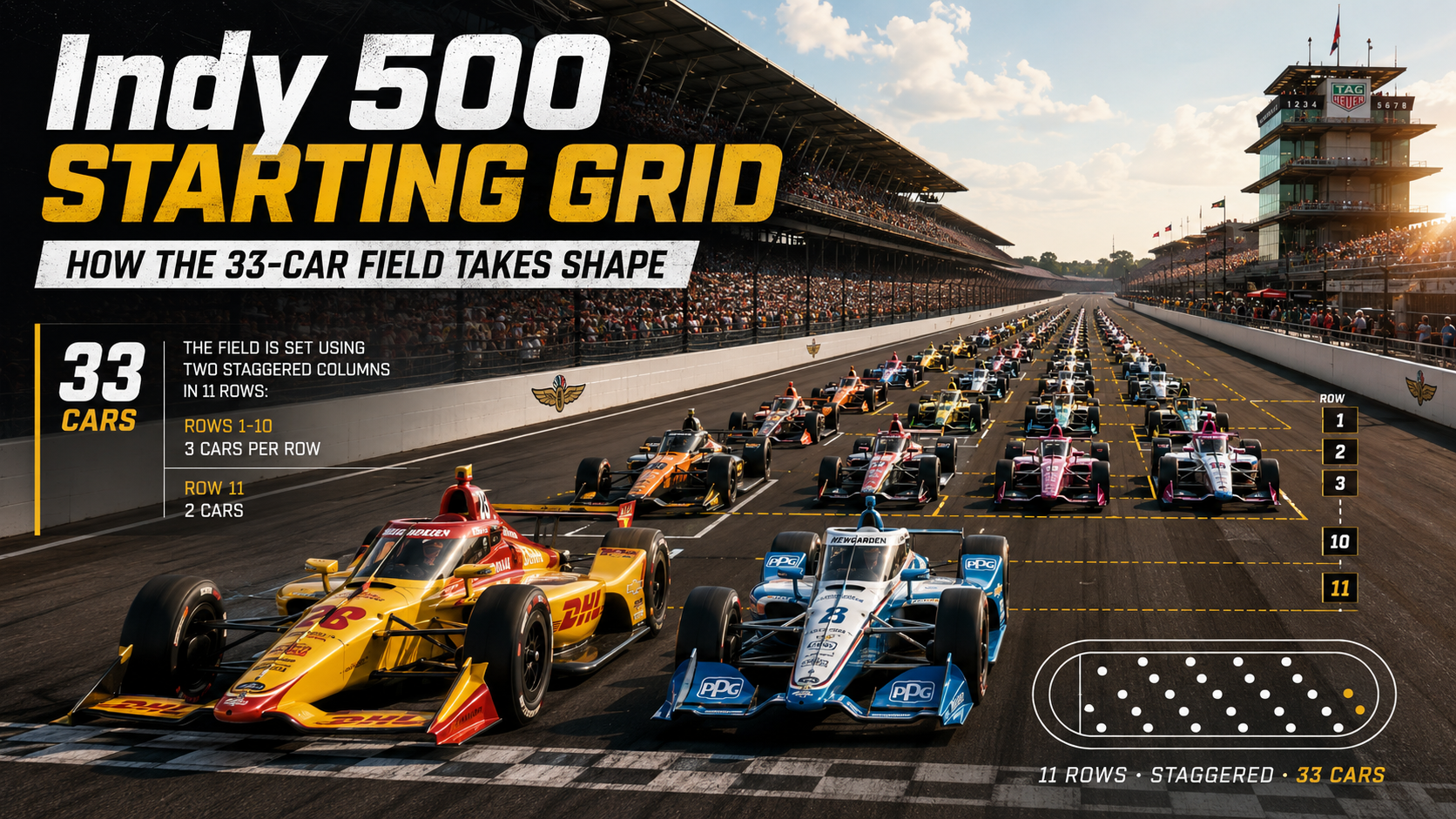
The Indy 500 starting grid is more than a list of drivers arranged before the green flag. It is the final product of four-lap qualifying runs, technical inspections, changing track conditions, team decisions, and several rounds in which tiny speed differences can separate the front row from the middle of the field. This guide explains the final 2026 lineup while showing how the grid is formed, why each row matters, and what starting position can—and cannot—tell you about the race.
Quick Bio
| Feature | Details |
|---|---|
| Core definition | The official order in which qualified cars line up for the Indianapolis 500 |
| Historical origin | Connected to the Indianapolis 500, first held in 1911 |
| Primary use | Establishing each driver’s starting position before the 500-mile race |
| Industry | Professional motorsport, event broadcasting, sports media, and automotive entertainment |
| Standard structure | 33 cars arranged three abreast across 11 rows |
| Positioning method | Primarily determined through four-lap average qualifying speeds |
| Popular applications | Official race programs, live digital grids, broadcast graphics, fan guides, team analysis, and race previews |
| 2026 pole winner | Alex Palou, with a four-lap average of 232.248 mph |
| 2026 front row | Alex Palou, Alexander Rossi, and David Malukas |
| Official status | The order can remain provisional until inspections and qualifying penalties are completed |
What the Starting Grid Actually Represents
A starting grid records the order in which the field is scheduled to begin the race, with the pole winner occupying the first position on the inside of Row 1. Indianapolis is visually distinctive because the cars line up three abreast, producing an inside, middle, and outside starter in each of the 11 rows. The structure gives the opening lap a character that differs sharply from series using conventional two-car rows.
The order is not based on practice times, championship standings, or a driver’s single fastest lap. Each completed Indianapolis qualifying attempt consists of four consecutive timed laps, and the average speed across the complete run determines the result. This format rewards a car that can remain balanced and fast throughout ten miles rather than producing one exceptional lap followed by a noticeable decline.
The published lineup should also be distinguished from a live qualifying leaderboard. A live grid changes as drivers complete runs, while the final order reflects completed qualifying rounds and any decisions made during post-session inspection. That distinction became especially important in 2026, when two qualifying results were disallowed after the original order had been reported.
Final 2026 Starting Lineup
The table below reflects the final official order for the 110th Indianapolis 500, held on May 24, 2026. Alex Palou earned pole position, Alexander Rossi qualified second, and David Malukas completed the front row. The official field contained 33 entries across 11 three-car rows.
| Row | Inside | Middle | Outside |
| 1 | 1. Alex Palou, No. 10, Chip Ganassi Racing | 2. Alexander Rossi, No. 20, Ed Carpenter Racing | 3. David Malukas, No. 12, Team Penske |
| 2 | 4. Felix Rosenqvist, No. 60, Meyer Shank Racing | 5. Santino Ferrucci, No. 14, A.J. Foyt Enterprises | 6. Pato O’Ward, No. 5, Arrow McLaren |
| 3 | 7. Kyffin Simpson, No. 8, Chip Ganassi Racing | 8. Conor Daly, No. 23, Dreyer & Reinbold Racing | 9. Scott McLaughlin, No. 3, Team Penske |
| 4 | 10. Scott Dixon, No. 9, Chip Ganassi Racing | 11. Rinus VeeKay, No. 76, Juncos Hollinger Racing | 12. Takuma Sato, No. 75, Rahal Letterman Lanigan Racing |
| 5 | 13. Ed Carpenter, No. 33, Ed Carpenter Racing | 14. Hélio Castroneves, No. 06, Meyer Shank Racing | 15. Christian Rasmussen, No. 21, Ed Carpenter Racing |
| 6 | 16. Marcus Armstrong, No. 66, Meyer Shank Racing | 17. Marcus Ericsson, No. 28, Andretti Global | 18. Christian Lundgaard, No. 7, Arrow McLaren |
| 7 | 19. Will Power, No. 26, Andretti Global | 20. Nolan Siegel, No. 6, Arrow McLaren | 21. Louis Foster, No. 45, Rahal Letterman Lanigan Racing |
| 8 | 22. Ryan Hunter-Reay, No. 31, Arrow McLaren | 23. Josef Newgarden, No. 2, Team Penske | 24. Romain Grosjean, No. 18, Dale Coyne Racing |
| 9 | 25. Kyle Kirkwood, No. 27, Andretti Global | 26. Katherine Legge, No. 11, HMD Motorsports with A.J. Foyt Racing | 27. Mick Schumacher, No. 47, Rahal Letterman Lanigan Racing |
| 10 | 28. Graham Rahal, No. 15, Rahal Letterman Lanigan Racing | 29. Dennis Hauger, No. 19, Dale Coyne Racing | 30. Jacob Abel, No. 51, Abel Motorsports |
| 11 | 31. Sting Ray Robb, No. 77, Juncos Hollinger Racing | 32. Caio Collet, No. 4, A.J. Foyt Enterprises | 33. Jack Harvey, No. 24, Dreyer & Reinbold Racing |
The final order differs from the first version produced immediately after qualifying. Caio Collet initially qualified 10th, while Jack Harvey had qualified 29th, but both times were disallowed following technical inspection. Collet was reassigned to 32nd and Harvey to 33rd, with the remaining affected drivers moving forward in the order.
How Qualifying Determines the Positions
Indianapolis qualifying asks each driver to complete four consecutive timed laps on the 2.5-mile oval. Officials calculate the average speed across the full run, meaning every corner and every reduction in momentum influences the result. A completed run covers ten miles and 16 corners, leaving little room for a driver to correct an unstable car without losing several positions.
Cars generally qualify one at a time, removing traffic and aerodynamic drafting from the core measurement. That clean track gives officials and teams a clearer picture of the speed a car can sustain without receiving a tow from another vehicle. Wind, temperature, track grip, engine performance, aerodynamic efficiency, tire condition, and qualifying order can still create meaningful differences between attempts.
A driver’s average speed is converted into a ranking rather than a race-time advantage. The pole winner does not receive a head start measured in seconds, and all 33 cars begin together when the race goes green. Qualifying instead provides the best-positioned drivers with cleaner air, fewer cars directly ahead, and a more favorable location for the opening corners.
Why the Four-Lap Average Matters
A single-lap format could reward a brief burst of speed, but Indianapolis requires the setup to perform consistently as the tires and mechanical systems work through four laps. A driver may begin with a particularly fast first lap before losing speed as the run progresses. Teams therefore examine both the final average and the pattern of speed loss from Lap 1 through Lap 4.
Palou’s 2026 pole run illustrates the format clearly. His four-lap average was 232.248 mph, produced by individual laps of 232.848, 232.347, 231.845, and 231.955 mph. The slight variation across those laps shows why the complete run matters more than quoting only the fastest number.
Consistency also tells teams how well a car manages aerodynamic balance while running alone. A car that becomes increasingly difficult to control may lose speed during the final portion of the attempt, even when its opening lap appears strong. Engineers study that progression to understand whether the car’s balance, drag level, tire behavior, or driver confidence changed during the run.
The 2026 Final 15, Top 12, and Fast Six Rounds
The 2026 procedure expanded the Sunday competition by introducing a Final 15 stage. Under the planned format, the six cars ranked from 10th through 15th after the opening session competed for three remaining places in the Top 12. The three fastest advanced, while the other three filled positions 13 through 15.
The Top 12 session then determined positions seven through 12 and selected the six drivers who would continue. Each participating car received another attempt, with the fastest six moving into the Firestone Fast Six. Speeds from an earlier round did not simply guarantee the same position because drivers had to perform again under the conditions present during the next session.
The Fast Six decided the first two rows and the pole winner. Cars ran in an order based on the preceding session, and the fastest final four-lap average secured first place. This layered system created separate pressure points rather than allowing one early run to settle every position near the front.
Why the Field Has 33 Cars and 11 Rows
The field traditionally consists of 33 cars, producing exactly 11 rows when three cars are placed side by side. That three-wide formation is one of the race’s most recognizable visual traditions and contributes to the intensity surrounding the opening lap. The first corner can contain multiple lines of traffic even before cars from the rear begin searching for opportunities.
The current rules permit INDYCAR to determine a different field size when necessary, but 33 remains the established standard associated with the event. When more than 33 cars attempt to qualify, the slowest entries can be eliminated through the process commonly known as bumping. When only 33 cars enter, every eligible car may reach the race, although its final position must still be earned.
A full field is not arranged arbitrarily after qualifying. The fastest driver takes Position 1, the next two complete the first row, and the sequence continues through Position 33. A technical penalty or disallowed time can move a driver backward and promote everyone originally positioned between the old and new locations.
The Value of Pole Position and the Front Row
Pole position gives a driver the cleanest initial view and control over the inside lane at the front of the formation. It also keeps the car away from the heavy congestion faced by drivers starting several rows back. Clean air can improve aerodynamic performance, although the driver must still manage the start, restarts, fuel strategy, traffic, and changing track conditions.
Historical statistics confirm that starting near the front is valuable without making victory automatic. Indianapolis Motor Speedway records show that the winner has started from pole 21 times, while no winner has come from the final row. The Speedway has also noted that nearly two-thirds of race winners have started inside the first six positions.
The 2026 race supplied a useful example of the difference between advantage and certainty. Palou began from pole, but Felix Rosenqvist won after starting fourth on the inside of Row 2. Rosenqvist’s victory demonstrated that a front-running position matters while leaving enough strategic and competitive uncertainty for another leading contender to take control.
Inside, Middle, and Outside Starting Lanes
The inside starter in each row is listed first, followed by the middle and outside cars. On paper, the inside appears attractive because it offers the shortest physical route toward Turn 1. In practice, its usefulness depends on the launch, the behavior of surrounding cars, and whether the lane remains open as the field accelerates.
A middle-row starter has cars on both sides and therefore less immediate room to adjust. The driver must maintain precise awareness of spacing while reacting to movement from the inside and outside lanes. A clean launch can preserve position, but a slow response by another car may compress the available space.
The outside lane offers more track width but also requires the driver to travel a wider line into the corner. Momentum can make that route effective when the cars ahead accelerate cleanly. There is no permanently superior lane because race starts are shaped by timing, grip, traffic, and the decisions made by more than 30 drivers at once.
Why Starting Position Matters Over 500 Miles
A position near the front reduces the number of cars a driver must pass and can lower exposure to congestion during the opening stages. It may also help the team secure a more useful pit location because qualifying results have historically influenced pit selection. These advantages allow a leading team to concentrate on race execution rather than immediately recovering lost track position.
However, the Indianapolis 500 covers 200 laps and 500 miles, making the race far longer than the qualifying run used to establish the order. Teams must handle several pit stops, tire cycles, cautions, restarts, fuel calculations, aerodynamic changes, and periods of heavy traffic. A minor error during any of those phases can erase the benefit earned during qualifying.
Drivers in the middle and rear of the field can still advance through efficient pit work and intelligent timing. A caution that appears near a planned stop may alter the competitive order, while a strong car in traffic can move forward over multiple stints. The grid is best understood as an opening advantage map rather than a final prediction.
How Teams Balance Qualifying and Race Setups
A qualifying car is prepared to produce maximum speed while running alone for four laps. Teams reduce unnecessary aerodynamic drag and search for a balance that the driver can manage at extremely high speed. The result can feel more sensitive than a race-oriented setup because small steering corrections or wind changes cost momentum.
Race conditions create a different challenge because cars spend long periods in turbulent air. A setup that is exceptionally fast alone may become difficult to follow closely behind another vehicle. Engineers therefore use practice sessions after qualifying to restore race-focused settings and evaluate the car in traffic.
The trade-off explains why the fastest qualifier is not automatically the strongest race car. One team may optimize more aggressively for the qualifying result, while another accepts a slightly slower grid position in exchange for stability during long runs. Successful teams try to avoid treating those objectives as completely separate, building a car that can qualify well and still protect its tires and balance over a full stint.
How Technical Inspections Can Change the Grid
Qualifying results remain subject to technical inspection because each car must comply with the governing regulations. Officials may examine aerodynamic components, bodywork, weight, electronics, mounting hardware, engine-related systems, and other controlled areas. A car that produced a valid speed on track can still lose the position when an inspection identifies a prohibited modification.
In 2026, officials reported unapproved modifications involving Dallara-supplied Energy Management System covers and their mounting points on the cars driven by Collet and Harvey. Both qualifying results were disallowed, and the drivers were placed at the rear according to the applicable order. Collet fell from an original 10th-place result to 32nd, while Harvey moved from 29th to 33rd.
This is why publishers should verify the field against the official grid rather than relying on the first results posted after a session. A qualifying report may accurately describe what occurred on track but become outdated after inspection. Adding a visible update date can help readers determine whether a lineup is provisional or final.
Historical Development of Indianapolis Qualifying
The Indianapolis 500 dates to 1911, when Ray Harroun won the inaugural race after starting 28th. The method used to establish positions has changed throughout the event’s history, reflecting developments in timing, safety, technology, field size, and broadcasting. The four-lap qualifying distance was introduced early in the race’s history and eventually became the established method for measuring sustained speed.
Starting position was not always settled through the modern shootout structure. Early editions used methods such as entry timing or a draw in certain years, while later eras introduced pole-day sessions, multiple attempts, bumping, Fast Nine formats, Top 12 competition, and the Fast Six. These revisions have preserved the importance of speed while creating a clearer competitive event for spectators.
The evolution also reflects changing entry totals. A large group of hopeful qualifiers makes bumping a central story because at least one driver will miss the race. A 33-car entry list removes that elimination battle, encouraging organizers to create additional competition among the fastest qualifiers for the leading rows.
Drivers, Teams, and Stories Hidden Within the Order
The lineup can reveal team-level performance that is less obvious when every driver is considered separately. Chip Ganassi Racing placed Palou on pole, Kyffin Simpson seventh, and Scott Dixon 10th in the final order. Team Penske placed David Malukas third, Scott McLaughlin ninth, and Josef Newgarden 23rd, showing that cars from the same organization can experience very different qualifying outcomes.
The field also mixed former winners, established champions, oval specialists, and rookies. Hélio Castroneves, Scott Dixon, Alexander Rossi, Takuma Sato, Josef Newgarden, Ryan Hunter-Reay, Will Power, Marcus Ericsson, and defending 2025 winner Palou brought previous Indianapolis victories into the 2026 event. Their positions ranged from the front row to the eighth row, underlining how reputation cannot replace a successful qualifying run.
Newcomers and less-experienced drivers create another layer of interest. Mick Schumacher, Dennis Hauger, Jacob Abel, and Caio Collet were among the drivers pursuing rookie recognition in 2026. Their locations toward the second half of the field reflected the difficulty of mastering Indianapolis qualifying, but a lower starting position did not remove their opportunity to learn, advance, and finish strongly.
How Fans and Publishers Should Read the Grid
Begin by identifying the pole winner and the complete front two rows because these drivers have secured the cleanest starting positions. Next, look for proven race winners or strong oval competitors beginning farther back, as they may become early movers. Team groupings are also useful because several cars from one organization near the front may indicate broadly effective qualifying preparation.
The four-lap averages add context beyond the numbered positions. Drivers can be separated by small speed margins, making a difference of several grid places appear larger than the performance gap actually was. Penalties create another complication because the final position may no longer correspond directly to the speed recorded on track.
For publication, the clearest presentation combines a three-column row table with explanatory sections. Readers should be able to locate a driver quickly, understand the qualifying process, and see whether the order was revised. A bare list answers the immediate question, but interpretation gives the page lasting value after race weekend.
Digital, Broadcast, and Commercial Uses of the Grid
Official websites use live grids to update positions as qualifying attempts are completed. Broadcasters transform the same information into row graphics, driver cards, speed comparisons, and pre-race analysis. Printed programs and spectator guides often use a compact three-wide design because it mirrors the physical formation fans see on the front straight.
Teams use the results to discuss their performance, communicate sponsor exposure, and prepare race-day strategy. Tourism organizations may add hometowns, biographies, team names, or short facts so casual visitors can recognize drivers before attending the event. News sites frequently combine the order with television details, qualifying speeds, former-winner information, and notable storylines.
The grid can also support educational explanations of mathematics, engineering, aerodynamics, and race strategy. Four-lap averages provide a straightforward example of sustained-speed measurement, while the row structure demonstrates how sporting traditions influence event presentation. These wider applications allow a well-built guide to remain useful beyond a simple results update.
What the Grid Can and Cannot Predict
The lineup is a meaningful indicator of qualifying speed and can highlight cars that perform well in clean air. Front-row drivers generally begin with less traffic and a better opportunity to control their opening laps. Strong qualifying across several teammates may also suggest that an organization has found an effective aerodynamic or engine-performance window.
It cannot fully measure race pace in traffic, pit-crew execution, fuel mileage, restart skill, reliability, or the effect of caution periods. A driver may qualify poorly after encountering difficult conditions yet possess a car that is excellent during long runs. Another may produce a superb qualifying average but struggle once turbulent air changes the car’s balance.
The most accurate interpretation combines grid position with practice performance, experience, team strength, long-run consistency, and race circumstances. Treating pole position as a guaranteed victory ignores the scale and unpredictability of a 500-mile event. Treating the order as meaningless overlooks the genuine strategic benefits earned by the fastest qualifiers.
Conclusion
- Confirm that the lineup is final, because post-qualifying inspection can move drivers and alter multiple rows.
- Read the grid three cars at a time, identifying the inside, middle, and outside starter in each of the 11 rows.
- Compare four-lap averages rather than isolated laps, because sustained speed determines the qualifying result.
- Use starting position as an advantage indicator rather than a race prediction, since strategy, traffic, cautions, and pit stops can transform the order.
- Review the front rows, experienced drivers farther back, and team groupings together to build a more complete picture of the field.
FAQs
Who was on pole for the 2026 Indianapolis 500?
Alex Palou won pole position for the 2026 Indianapolis 500 in the No. 10 Chip Ganassi Racing Honda. His four-lap average was 232.248 mph, placing him ahead of Alexander Rossi and David Malukas. It was Palou’s second Indianapolis 500 pole after his previous pole-winning performance in 2023.
How many cars are included in an Indianapolis 500 grid?
The traditional field contains 33 cars arranged in 11 rows of three. Each row includes an inside, middle, and outside starter, creating the event’s famous three-wide formation. INDYCAR can determine a different field size under its rules, but 33 remains the recognized standard.
How is an Indianapolis 500 qualifying speed calculated?
Each completed qualifying attempt consists of four consecutive timed laps around the 2.5-mile Indianapolis Motor Speedway oval. Officials calculate the average speed across all four laps and rank drivers according to that figure. A driver’s fastest individual lap does not determine the position unless the complete four-lap average is also fastest.
Does the pole winner usually win the Indianapolis 500?
Pole position improves a driver’s opening location, but it does not guarantee victory. Indianapolis Motor Speedway records show 21 victories from pole, while winners have emerged from many other positions throughout the field. In 2026, Palou started first, but Felix Rosenqvist won after beginning fourth.


If you are searching for case battle wtfd, you are likely looking for a detailed guide explaining how case battles work, how players compete, and how to improve their chances of getting better outcomes. Case battles have become a popular format in online gaming communities because they combine competition, strategy, and the excitement of opening digital cases.
Unlike traditional case openings where one player opens items alone, a case battle creates a head-to-head or group competition. Multiple players open similar cases, compare item values, and the player with the strongest final result wins.
This guide explains the mechanics behind case battles, practical strategies, risk management techniques, and the mistakes that often cost players their balance.
What Is Case Battle WTfD?
A case battle wtfd experience generally refers to a competitive case-opening format where participants open virtual cases against other players. The goal is simple: achieve a higher total value than your opponents.
The format usually follows these steps:
- Players join a battle room or create a match.
- Each participant selects or receives the same case lineup.
- Cases are opened simultaneously or in rounds.
- Item values are compared after each opening.
- The player with the highest combined value wins.
The appeal comes from the competitive element. A low-value opening can still become exciting if an opponent receives an even worse result, while a rare item can instantly change the outcome.
How Case Battles Work Step by Step
1. Choosing a Battle Format
Most case battle platforms offer different match styles, including:
- One-on-one battles – Two players compete directly.
- Team battles – Groups combine their case values.
- Free-for-all battles – Multiple players compete in the same room.
- Custom battles – Players select specific case combinations.
Choosing the right format depends on your budget, risk tolerance, and experience level.
2. Opening Cases Against Opponents
The main difference between regular case openings and battles is comparison.
A case worth a small amount may still be valuable strategically if it beats another player’s opening. The objective is not only getting expensive items but maximizing your expected performance against competitors.
3. Calculating the Winner
The winner is typically determined by:
- Total item value
- Number of winning rounds
- Final combined score
- Specific platform rules
Always check the battle rules before entering because different systems may calculate results differently.
Key Strategies for Better Case Battle Results
Winning case battles is never guaranteed because outcomes depend heavily on probability. However, smart decisions can improve your overall approach.
1. Understand Case Value Before Playing
One of the biggest mistakes beginners make is choosing cases based only on appearance or popularity.
Evaluate:
- Average return value
- Possible high-tier rewards
- Cost compared with expected outcomes
- Variance between low and high results
A flashy case with expensive items may still perform poorly if most openings produce weak results.
2. Manage Your Bankroll Carefully
Professional players focus on longevity rather than one lucky win.
A practical bankroll approach includes:
- Set a fixed entertainment budget.
- Avoid increasing stakes after losses.
- Do not use money needed for essential expenses.
- Treat every battle as a risk-based activity.
Good bankroll management allows you to continue playing without emotional decisions.
3. Choose Battles Based on Risk Level
Different battles create different levels of volatility.
| Battle Type | Risk Level | Best For |
|---|---|---|
| Low-cost cases | Lower | Beginners learning mechanics |
| Balanced cases | Medium | Regular players |
| Premium cases | High | Experienced users comfortable with swings |
Higher risk can create larger rewards, but it also increases the chance of losing quickly.
4. Avoid Chasing Losses
A common mistake in case battles is trying to recover losses immediately.
This usually leads to:
- Larger unnecessary bets
- Poor case selection
- Emotional decisions
- Faster balance depletion
A disciplined player knows when to stop.
Common Mistakes Players Make in Case Battles
Ignoring Probability
Many players focus only on the biggest possible reward. However, rare drops are rare for a reason.
A better approach is evaluating the entire reward distribution rather than one attractive item.
Playing Without a Strategy
Entering random battles without understanding case combinations can reduce your chances of making informed decisions.
Before joining:
- Review the cases included.
- Understand possible outcomes.
- Compare different battle options.
Assuming Past Results Predict Future Wins
Case battles are based on random outcomes. Winning several battles in a row does not mean the next battle is more likely to succeed.
Avoid the gambler’s fallacy and make decisions based on information, not emotions.
Case Battle WTfD: Pros and Cons
| Pros | Cons |
|---|---|
| Competitive experience compared with solo openings | Outcomes depend heavily on randomness |
| More engaging than standard case openings | Losses can happen quickly |
| Multiple battle formats available | Requires strong spending discipline |
| Social and interactive gameplay | Rare rewards are difficult to obtain |
Advanced Tips for Experienced Players
Analyze Battle Efficiency
Experienced users often compare:
- Cost per battle
- Average expected return
- Opponent difficulty
- Case combinations
The goal is finding formats that provide better entertainment value and controlled risk.
Focus on Decision Quality, Not Individual Results
A good decision can still produce a bad result because randomness affects every battle.
Evaluate your choices over many sessions instead of judging yourself by one opening.
Track Your Results
Keeping records can reveal patterns in your gameplay.
Useful tracking metrics include:
- Total money spent
- Total value received
- Win percentage
- Average battle size
- Favorite case combinations
This helps separate real strategy from short-term luck.
Is Case Battle WTfD Worth Trying?
Case battles can be entertaining for players who enjoy competition and digital item openings. The experience is most enjoyable when approached as a form of entertainment rather than a guaranteed way to make money.
Before participating, consider:
- Your personal budget
- Platform reliability
- Withdrawal rules
- Responsible gaming practices
- Your expectations about outcomes
Final Thoughts on Case Battle WTfD
Case Battle WTfD represents the competitive side of digital case openings, combining chance, strategy, and player-versus-player excitement. Understanding battle formats, managing risk, and making informed choices can create a better experience.
The strongest players do not rely only on luck. They understand probabilities, control their spending, and approach every battle with a clear strategy.


As online entertainment continues to attract more users, platforms that prioritize accessibility, performance, and ease of use remain highly valued. NK88.COM offers a modern environment with a responsive interface, allowing visitors to navigate its features effortlessly. Whether using a desktop computer, tablet, or smartphone, users can enjoy a smooth browsing experience designed for convenience and consistent performance across multiple devices.
Modern Interface with Easy Navigation
The platform features a clean and organized layout that helps users move between different sections quickly. Responsive menus and thoughtfully arranged categories make it easy for both new and returning visitors to explore available features without unnecessary complexity. The intuitive design enhances usability and contributes to a seamless digital experience.
Quick Account Creation Through Đăng Ký NK88
Users can conveniently create a new account through Đăng Ký NK88, where the registration process is designed to be straightforward and efficient. The responsive interface guides users through each step with simplicity, making it easy to complete account setup while enjoying a smooth experience on desktop computers, tablets, and smartphones.
Optimized Performance Across Devices
NK88.COM is built to perform consistently across a wide range of devices, delivering responsive navigation and fast-loading pages. Regular platform updates help improve stability and usability, ensuring visitors can access the platform comfortably whether they are at home or on the go. This optimized performance contributes to a reliable digital experience.
A Dependable Platform for Modern Entertainment
By focusing on user convenience, responsive technology, and continuous improvements, NK88.COM continues to provide a dependable online entertainment platform. Its combination of modern design, intuitive navigation, and compatibility across multiple devices makes it an excellent choice for users seeking a smooth and accessible digital entertainment experience.

As digital entertainment continues to attract a growing audience, users value platforms that combine convenience, performance, and accessibility. QS 88 offers a modern environment with an intuitive interface, allowing users to explore its features effortlessly. Whether accessed from a desktop computer, tablet, or smartphone, the platform is designed to provide a reliable and enjoyable experience while maintaining responsive performance across multiple devices.
Modern Design with Simple Navigation
The platform features a clean layout that helps users move between different sections quickly and efficiently. Thoughtful organization and responsive functionality make browsing straightforward, ensuring that both new and returning visitors can enjoy a seamless digital experience. The intuitive interface makes it easy to locate different entertainment categories without unnecessary complexity.
Convenient Transactions Through Rút Tiền QS88
Users can conveniently manage account withdrawals through Rút Tiền QS88, where the withdrawal process is designed for simplicity and efficiency. The responsive interface helps users navigate transaction options quickly while providing a smooth experience across desktop computers, tablets, and smartphones. Its organized structure allows visitors to complete withdrawal requests comfortably while maintaining easy access to the platform’s entertainment features.
Optimized Performance Across Devices
QS 88 is built to perform consistently across multiple devices, delivering fast loading speeds and responsive navigation. Regular platform updates help improve stability and usability, allowing users to enjoy uninterrupted access wherever they choose to connect. Whether browsing from home or while traveling, visitors can expect reliable performance and a consistent digital experience.
A Dependable Platform for Modern Entertainment
By focusing on user convenience, reliable performance, and continuous improvements, QS 88 continues to establish itself as a trusted online entertainment platform. Its combination of accessibility, modern design, and responsive technology makes it an excellent choice for users seeking a high-quality digital entertainment experience across a variety of devices.


who is www.youtube.com/@soban572: Everything You Need to Know

Quartz Events Sponsor Matching Companies: Find Ideal Partners Fast

Milomagazine.co.uk: Explore Inspiring Stories & Insights
-

 Fashion9 years ago
These ’90s fashion trends are making a comeback in 2017
-
Entertainment9 years ago
The final 6 ‘Game of Thrones’ episodes might feel like a full season
-
Fashion9 years ago
According to Dior Couture, this taboo fashion accessory is back
-
Entertainment9 years ago
The old and New Edition cast comes together to perform
-
Sports9 years ago
Phillies’ Aaron Altherr makes mind-boggling barehanded play
-
Entertainment9 years ago
Disney’s live-action Aladdin finally finds its stars
-
Business9 years ago
Uber and Lyft are finally available in all of New York State
-
Sports9 years ago
Steph Curry finally got the contract he deserves from the Warriors