
Sports
Drag Race Simulator: Master Speed, Tuning, and Timing

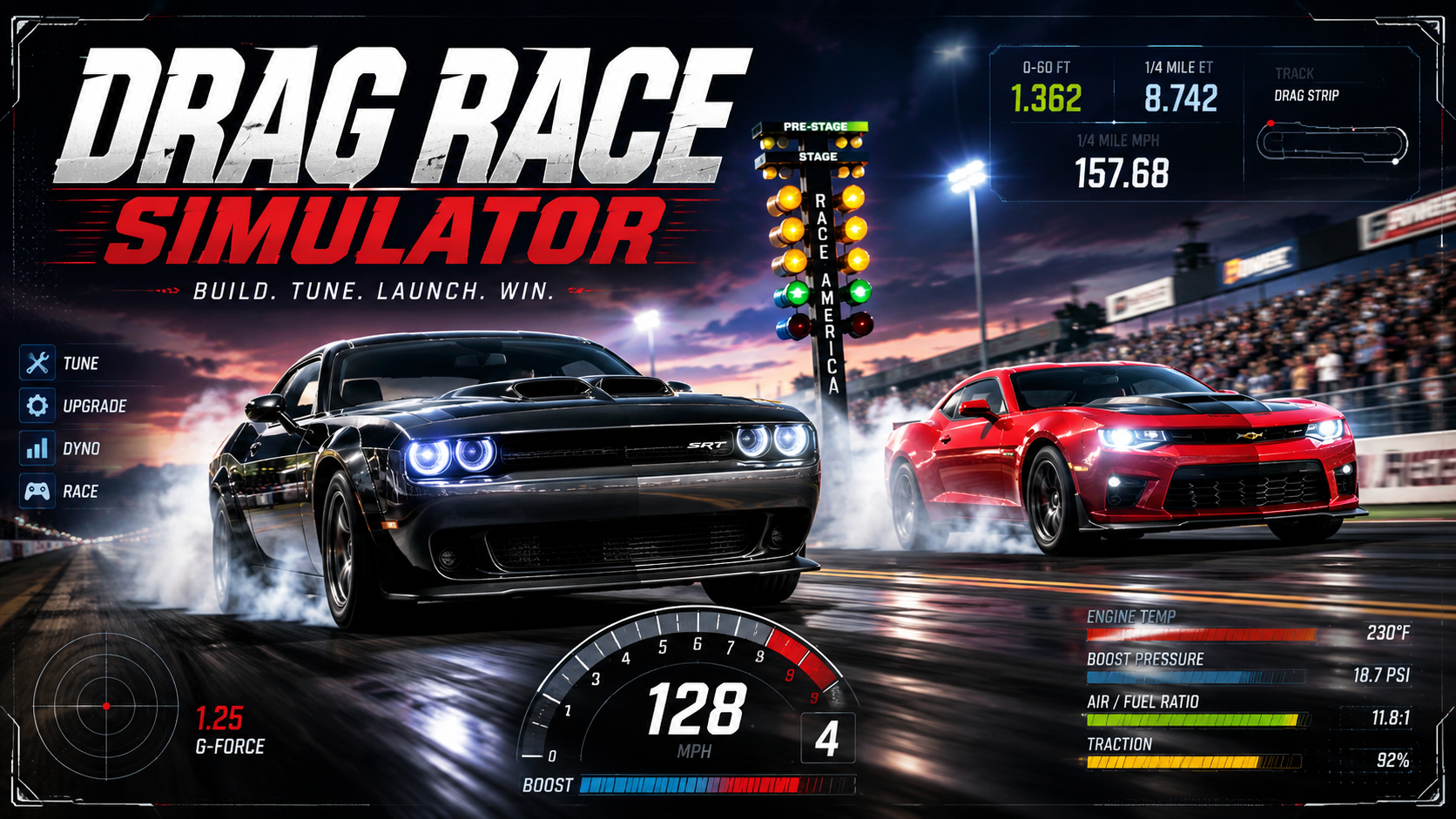
A drag race simulator turns a straight-line sprint into a detailed test of reaction, traction, gearing, power delivery, and setup decisions. The best tools do more than display two animated cars; they help users understand why one vehicle launches harder, shifts more efficiently, or reaches the finish line first. Whether you want quick entertainment or meaningful performance analysis, knowing how the simulation works is the key to getting useful results.
Quick Bio
| Feature | Details |
|---|---|
| Core definition | A digital tool or game that models a head-to-head straight-line acceleration race. |
| Origin | Early computer drag racing titles appeared during the 1980s, followed by more detailed licensed PC simulations in the 1990s and 2000s. |
| Primary use | Entertainment, vehicle comparison, tuning experiments, reaction-time practice, and motorsport education. |
| Industry | Video games, automotive software, esports, vehicle data platforms, and driver training. |
| Popular applications | Browser simulations, mobile racing games, PC titles, online multiplayer races, and performance calculators. |
Early computer titles already included head-to-head racing, professional classes, reaction timing, and driver-controlled outcomes. By the late 1990s, PC releases were modeling burnouts, launches, traction management, multiple racing classes, tuning decisions, and finish-line procedures.
What Is a Drag Race Simulator?
A drag race simulator is software that recreates some or all of a drag race, usually from staging to the finish line. It may model the launch, gear changes, tire grip, engine output, aerodynamic resistance, vehicle weight, reaction time, and track distance. Simple versions behave like arcade games, while advanced versions use mathematical models and large vehicle databases to estimate real performance.
Simulation generally means creating a virtual representation of a real or proposed system so its behavior can be examined under different conditions. In automotive racing software, that virtual representation may be highly detailed or deliberately simplified depending on whether the product is intended for engineering-style comparison, education, or entertainment.
The phrase also has a second search meaning: some websites use it for fantasy competition-season generators inspired by television formats. Current search results mix those entertainment generators with automotive racing tools, which explains why users often see very different pages for the same query. This guide focuses on the automotive meaning because it supports deeper questions about physics, tuning, timing, and performance.
How a Drag Race Simulator Calculates a Run
Every drag race simulator begins with a model, even when that model is hidden behind simple controls. The software receives inputs such as horsepower, torque, mass, gearing, tire grip, and drivetrain layout, then estimates how quickly the vehicle can accelerate over a fixed distance. More advanced programs repeatedly update speed, wheel force, drag, traction, and engine behavior in small time steps until the simulated run is complete.
The quality of the output depends on both the formulas and the input data. A polished interface cannot compensate for an unrealistic torque curve, a missing traction limit, or a vehicle weight that excludes important variables. Two simulators can therefore produce different quarter-mile times for the same car without either result being obviously broken.
Some comparison tools prioritize a large database and fast head-to-head results, while dedicated games prioritize driving input, progression, customization, and competition. Motor Matchup, for example, markets physics-based simulations and comparisons across more than 50,000 real vehicles.
Core Inputs That Shape Performance
Power is important, but a drag race simulator should not treat peak horsepower as the only deciding factor. A broad torque curve can produce stronger acceleration through more of the run, while a narrow power band may demand precise gearing and shift timing. The simulator also needs to consider engine speed, transmission ratios, drivetrain losses, and the amount of power that actually reaches the driven tires.
Vehicle mass changes how much force is needed to accelerate, and weight distribution affects how effectively that force can be applied. Tire grip, track preparation, suspension behavior, and drivetrain layout influence whether the car launches cleanly or wastes power through wheelspin. A credible simulation should distinguish between an all-wheel-drive launch, a rear-wheel-drive competition setup, and a high-powered street vehicle running on limited-grip tires.
Aerodynamic resistance becomes increasingly important as speed rises, especially near the far end of the track. Air density, frontal area, drag coefficient, wind, temperature, and elevation may all affect performance in a detailed model. Many casual games simplify these factors, while technical calculators may allow users to adjust atmospheric conditions or view corrected estimates.
Input accuracy remains essential regardless of how advanced the software appears. Incorrect vehicle weight, unrealistic grip, inaccurate gear ratios, or an exaggerated modification can create a believable-looking but misleading result. Users should inspect the underlying specifications whenever the platform makes them available.
Reaction Time, ET, Trap Speed, and the Finish
A realistic drag race simulator separates the driver’s reaction from the vehicle’s elapsed time. Reaction time measures how quickly the vehicle clears the staging beam after the green signal, while elapsed time measures the actual run after the car leaves the starting line. The NHRA defines a perfect reaction time as .000, although the exact timing convention can vary between racing systems and simulator designs.
This distinction matters because the quickest vehicle does not automatically win every head-to-head race. A driver can cross the finish line first with a slower elapsed time by gaining enough advantage at the starting line, producing what drag racing calls a holeshot win.
Trap speed shows how fast the vehicle is moving near the finish and often reveals information that elapsed time alone cannot. A car with strong power but a weak launch may record a high trap speed and an unimpressive time, while a well-launched lower-powered car may run a quicker elapsed time at a lower speed. The 60-foot time is especially useful because early traction problems normally influence every later section of the pass.
Red-light starts should also be modeled clearly. Leaving before the permitted starting signal may produce a fast-looking run, but it remains a foul in competition. A good drag race simulator reports reaction time, elapsed time, trap speed, split times, and the final race outcome separately so users do not confuse vehicle pace with winning the matchup.
Arcade Games vs Physics-Based Simulation
An arcade-style drag race simulator is designed to feel immediate and rewarding. It may emphasize perfect shift zones, nitrous boosts, upgrades, currency, visual customization, boss races, and short progression loops rather than strict mechanical accuracy. These games are accessible because players can understand the objective within seconds, even when the underlying performance figures are heavily simplified.
A physics-based simulator places more weight on realistic vehicle behavior and repeatable calculations. It may use real specifications, detailed torque curves, gearing data, traction limits, environmental variables, and calculated modification effects. The experience can feel less dramatic, but it is usually more useful for comparing setups or understanding why a change helps during one section of the run and hurts during another.
Neither category is automatically better. The right choice depends on whether the user wants entertainment, garage progression, multiplayer competition, data exploration, or technical experimentation. The strongest products often combine both approaches by presenting believable calculations through a clear and enjoyable interface.
Marketing language alone does not prove that a game contains realistic physics. Players should examine whether changes to tires, weight, gearing, power delivery, and launch settings produce logical and consistent effects. Realism comes from the relationship between variables, not simply from detailed graphics or the word “simulator” in a title.
From Early PC Titles to Modern Online Tools
Computer drag racing has existed for decades, with early titles focusing on reaction, shifting, and short head-to-head competition. Drag Race Eliminator, released for home computers in the 1980s, included professional racing classes, a starting tree, reaction times, elapsed times, and results measured to fractions of a second. Later PC games expanded the concept with more advanced setup screens, vehicle classes, weather conditions, sound, camera choices, and race procedures.
These releases established the idea that a straight track could still support deep strategy. The challenge was not steering through corners but controlling power, preparing the vehicle, reacting to the starting tree, selecting the correct setup, and completing a consistent pass. That structure continues to influence modern racing games.
Modern tools have expanded in two major directions. Mobile and browser games favor fast access, upgrades, customization, and online competition, while data-driven websites allow users to compare large numbers of real vehicles or test hypothetical modifications. A current browser platform promotes simulations across more than 50,000 vehicles, demonstrating how far the category has moved beyond a small roster of fictional cars.
Commercial PC titles still serve players who want a dedicated game experience. Racing Classics: Drag Race Simulator combines classic-car progression, parts upgrades, story stages, customization, and online leaderboards. Its Steam listing describes 16 classic cars, more than 45 story stages, upgradeable components, and competition-focused features.
Where These Simulators Are Used Today
Entertainment remains the largest use case for a drag race simulator. Players enjoy building a garage, earning upgrades, perfecting shifts, defeating rivals, and climbing leaderboards without managing the long circuits and steering demands found in other racing genres. The short race format also works well on mobile devices because a complete attempt can be finished quickly.
Vehicle comparison is another major application. Enthusiasts can match cars that may never meet in real life, compare factory specifications, or test how weight, tires, power, and gearing could change the result. This form of virtual bench racing is most useful when the software explains its assumptions instead of presenting a single unexplained winner.
Training and education form a smaller but valuable category. A drag race simulator can help users understand staging, reaction time, shift consistency, and the relationship between traction and elapsed time in a controlled environment. It cannot replace professional instruction or practice at a sanctioned facility, but it can make technical concepts easier to visualize before they are encountered in real motorsport.
Multiplayer competition has also become a major selling point. Current mobile releases advertise live head-to-head racing, rankings, vehicle customization, shifting mechanics, and tuning systems. These features can create long-term engagement, although their realism and fairness depend on matchmaking, progression balance, and how paid upgrades affect performance.
Features That Separate Good Tools From Weak Ones
The first sign of a strong drag race simulator is transparent data. Users should be able to see the vehicle specifications, race distance, surface assumptions, modification effects, and timing results that influence the outcome. When a tool hides every input, it becomes difficult to determine whether a surprising result reflects physics, game balancing, or incomplete information.
A useful simulator should also offer meaningful control rather than cosmetic choice alone. Gear ratios, tire selection, launch settings, power delivery, vehicle mass, and drivetrain behavior can change performance in ways users can test and understand. Visual customization is enjoyable, but it should not be confused with a genuine tuning system.
Consistency matters just as much as complexity. Repeating the same run under the same conditions should produce similar results unless the product intentionally models driver variation, changing weather, mechanical uncertainty, or random events. A reliable drag race simulator identifies those sources of variation so users can separate genuine setup improvements from luck.
Detailed timing information is another sign of quality. Reaction time, 60-foot performance, intermediate splits, elapsed time, and trap speed help explain where a vehicle gains or loses ground. A simple winner screen offers entertainment, but it provides little value for diagnosis or tuning.
Other useful features include saved setups, side-by-side comparisons, replay data, controller support, multiplayer matchmaking, leaderboards, realistic race procedures, and accessible explanations. The ideal feature set depends on the audience, but the interface should not bury essential information under confusing menus. Good design helps beginners learn while giving experienced users enough depth to experiment.
How to Use a Drag Race Simulator Step by Step
Start by deciding what you want to learn from the run. You may be comparing two stock vehicles, testing a modification, practicing reaction consistency, or trying to win a game event. A clear goal prevents you from changing several variables at once and then guessing which change affected the result.
Next, verify the baseline setup in the drag race simulator. Check vehicle weight, power, drivetrain, transmission, tires, race distance, driving assists, and environmental settings before making modifications. Run several baseline passes and record reaction time, 60-foot time, elapsed time, and trap speed so you have a stable reference.
Change only one major variable during each test cycle. Adjust the launch setting, final-drive ratio, tire grip, shift point, or vehicle mass, then repeat the run under the same conditions. This controlled approach reveals cause and effect more clearly than installing every available upgrade at once.
Compare the full timing slip rather than looking only at the winner. A quicker 60-foot time combined with a lower trap speed tells a different story from a weak launch followed by powerful top-end acceleration. Each result reveals which section of the run improved and where performance is still being lost.
Save a setup only after the improvement has appeared consistently. A single exceptional pass may reflect a better reaction, a random variation, or a temporary condition rather than a genuinely stronger tune. Multiple controlled runs provide a more dependable basis for comparison.
How to Tune Without Guessing
Launch tuning is usually the first place to investigate because a weak start damages the entire pass. Too much applied torque can overwhelm the available grip, while too little can leave the engine below its strongest operating range. In a detailed drag race simulator, the best launch setting balances engine speed, power delivery, tire traction, and drivetrain stress rather than simply maximizing throttle.
Gear ratios should keep the engine within a productive section of its power band without forcing unnecessary shifts. Short gearing can improve early acceleration but may require an additional shift or cause the vehicle to reach its limiter before the finish. Tall gearing may reduce wheel torque and soften the launch, yet it can work well for a powerful engine with a broad torque curve.
Shift points should be chosen by considering what happens after the shift, not simply by waiting for the highest possible engine speed. If the next gear drops the engine below its useful range, delaying the shift may help; if power falls sharply near redline, an earlier shift may be quicker. A strong simulator provides split times that reveal where each strategy gains or loses performance.
Weight reduction, power upgrades, tires, and aerodynamic changes should be evaluated as a complete package. More power may produce little benefit if the tires cannot use it, while extra grip can expose unsuitable gearing or weak drivetrain components. The most effective drag race simulator tuning process improves the factor that currently limits the vehicle.
Avoid assuming that the most expensive upgrade must provide the largest gain. A modest tire or gearing adjustment can sometimes improve elapsed time more than a major power increase because it allows existing output to be used effectively. Performance depends on how the parts work together rather than on one impressive specification.
Free, Premium, Browser, Mobile, and PC Options
A browser-based drag race simulator is convenient because it usually requires no installation and works well for quick comparisons. These tools may use real vehicle databases, basic modification controls, or instant head-to-head results. Their common limitations include reduced control detail, an internet requirement, and simplified graphics or driving procedures.
Mobile games focus on accessibility, collection systems, visual customization, and short competitive sessions. Some current titles advertise real-time multiplayer, grip calculations, shifting mechanics, licensed vehicles, official tracks, or numerous customization options. The depth varies greatly, however, and free-to-play progression may place vehicles or upgrades behind extended play or optional purchases.
PC software generally offers the greatest opportunity for detailed inputs, controller support, advanced graphics, and extensive tuning. Premium titles may provide specialized racing classes, online leagues, realistic procedures, or deeper vehicle setup systems. Older free products can still be enjoyable, but players should check whether multiplayer servers, updates, and community support remain active.
Before installing any drag race simulator, review its update history, system requirements, user feedback, privacy terms, payment model, and advertised features. An inactive online game may still be worthwhile for single-player use, but buyers should not assume that every old multiplayer or leaderboard feature remains operational. Steam, for example, warns when Early Access information or development timelines may no longer be current.
Accuracy, Limitations, and Responsible Use
No drag race simulator can reproduce every detail of a real pass. Tire temperature, track preparation, suspension movement, component wear, wind, fuel load, driver input, manufacturing differences, and changing weather can create outcomes that are difficult to model perfectly. Even a sophisticated calculation remains an estimate built from assumptions and available data.
Users should therefore treat simulated times as comparative guidance rather than guaranteed real-world performance. A tool may accurately show that one setup is likely to launch better than another while still missing the exact elapsed time recorded by a real vehicle. The safest interpretation is to study patterns, sensitivity, and relative gains instead of treating the displayed number as a certified prediction.
Another limitation is the quality of modification modeling. A game may assign every upgrade a fixed performance bonus, while a technical simulator may attempt to calculate how the new part changes power, grip, weight, or gearing. Users should understand which method is being used before drawing conclusions about a real vehicle.
A drag race simulator should never be treated as encouragement to race on public roads. Real acceleration testing belongs at a legal, supervised, purpose-built facility with appropriate safety procedures, vehicle inspection, and qualified guidance. The simulation is valuable precisely because it permits experimentation without exposing drivers, passengers, or bystanders to real-world danger.
Where the Technology Is Heading
Future simulators are likely to combine larger vehicle databases with improved telemetry, tire models, weather calculations, and setup recommendations. Cloud processing can make detailed calculations accessible through a browser, while cross-platform accounts can connect mobile progression, desktop analysis, and online competition. Better explanations will be equally important because accurate numbers are most valuable when users understand why they changed.
Hardware integration may deepen the experience through pedals, shifters, haptic feedback, and dedicated starting-light accessories. Virtual and augmented reality could improve staging practice and spatial awareness, although straight-line racing depends more heavily on timing and vehicle behavior than on a wide field of view. The equipment will matter most when it improves feedback rather than merely adding visual spectacle.
Licensed events and tracks may also become more common. One current mobile listing already promotes officially licensed NHRA tracks and several recognizable drag racing vehicle categories. Similar partnerships could provide more accurate environments, recognizable competition structures, and stronger connections between virtual and real motorsport.
The best future drag race simulator will not simply look more realistic. It will connect believable physics, understandable data, fair competition, accessible controls, and responsible learning. That combination can serve casual players, motorsport fans, vehicle researchers, and competitive sim racers without forcing every user into the same experience.
Conclusion
- Choose a drag race simulator according to your goal, whether that is entertainment, vehicle comparison, tuning analysis, or reaction practice.
- Establish a repeatable baseline before changing parts, settings, or environmental conditions.
- Read reaction time, 60-foot time, elapsed time, and trap speed together instead of judging a run by one number.
- Improve the factor that currently limits performance, such as traction, gearing, shift strategy, or usable power.
- Treat every simulated result as an informed estimate and keep all real-world testing on legal, supervised racing facilities.
FAQs
What is the most realistic drag race simulator?
The most realistic option is the one that models the variables relevant to your purpose and clearly shows its assumptions. Look for torque curves, vehicle mass, drivetrain losses, traction limits, gear ratios, weather conditions, split times, and repeatable results rather than relying on graphics alone. A professional-style calculator may be more useful for vehicle comparison, while a complete PC title may be better for staging, controls, and immersive racing procedures.
Can a drag race simulator predict quarter-mile times accurately?
A drag race simulator can estimate quarter-mile performance when its vehicle data, formulas, and conditions are accurate, but it cannot guarantee an exact real-world time. Differences in tires, surface preparation, weather, driver behavior, fuel load, and vehicle condition can change the outcome. It is best used to compare setups and identify performance trends rather than promise a specific timing slip.
What do ET and reaction time mean in drag racing?
ET means elapsed time, which measures how long the vehicle takes to travel the racing distance after leaving the starting beam. Reaction time measures how quickly the vehicle leaves after the starting signal, and it influences who reaches the finish line first even though it is normally reported separately from ET. A quicker reaction can therefore defeat a car with a faster elapsed time when the starting-line advantage is large enough.
Are free drag race simulator games worth using?
Free options can be excellent for casual play, basic comparisons, and learning common timing terms. Their value depends on data quality, update support, advertising, progression balance, and whether important tuning features are available without payment. Test the baseline results, examine the feature descriptions carefully, and choose a product that matches your goal rather than assuming the most complex-looking game is automatically the most accurate.


If you are searching for case battle wtfd, you are likely looking for a detailed guide explaining how case battles work, how players compete, and how to improve their chances of getting better outcomes. Case battles have become a popular format in online gaming communities because they combine competition, strategy, and the excitement of opening digital cases.
Unlike traditional case openings where one player opens items alone, a case battle creates a head-to-head or group competition. Multiple players open similar cases, compare item values, and the player with the strongest final result wins.
This guide explains the mechanics behind case battles, practical strategies, risk management techniques, and the mistakes that often cost players their balance.
What Is Case Battle WTfD?
A case battle wtfd experience generally refers to a competitive case-opening format where participants open virtual cases against other players. The goal is simple: achieve a higher total value than your opponents.
The format usually follows these steps:
- Players join a battle room or create a match.
- Each participant selects or receives the same case lineup.
- Cases are opened simultaneously or in rounds.
- Item values are compared after each opening.
- The player with the highest combined value wins.
The appeal comes from the competitive element. A low-value opening can still become exciting if an opponent receives an even worse result, while a rare item can instantly change the outcome.
How Case Battles Work Step by Step
1. Choosing a Battle Format
Most case battle platforms offer different match styles, including:
- One-on-one battles – Two players compete directly.
- Team battles – Groups combine their case values.
- Free-for-all battles – Multiple players compete in the same room.
- Custom battles – Players select specific case combinations.
Choosing the right format depends on your budget, risk tolerance, and experience level.
2. Opening Cases Against Opponents
The main difference between regular case openings and battles is comparison.
A case worth a small amount may still be valuable strategically if it beats another player’s opening. The objective is not only getting expensive items but maximizing your expected performance against competitors.
3. Calculating the Winner
The winner is typically determined by:
- Total item value
- Number of winning rounds
- Final combined score
- Specific platform rules
Always check the battle rules before entering because different systems may calculate results differently.
Key Strategies for Better Case Battle Results
Winning case battles is never guaranteed because outcomes depend heavily on probability. However, smart decisions can improve your overall approach.
1. Understand Case Value Before Playing
One of the biggest mistakes beginners make is choosing cases based only on appearance or popularity.
Evaluate:
- Average return value
- Possible high-tier rewards
- Cost compared with expected outcomes
- Variance between low and high results
A flashy case with expensive items may still perform poorly if most openings produce weak results.
2. Manage Your Bankroll Carefully
Professional players focus on longevity rather than one lucky win.
A practical bankroll approach includes:
- Set a fixed entertainment budget.
- Avoid increasing stakes after losses.
- Do not use money needed for essential expenses.
- Treat every battle as a risk-based activity.
Good bankroll management allows you to continue playing without emotional decisions.
3. Choose Battles Based on Risk Level
Different battles create different levels of volatility.
| Battle Type | Risk Level | Best For |
|---|---|---|
| Low-cost cases | Lower | Beginners learning mechanics |
| Balanced cases | Medium | Regular players |
| Premium cases | High | Experienced users comfortable with swings |
Higher risk can create larger rewards, but it also increases the chance of losing quickly.
4. Avoid Chasing Losses
A common mistake in case battles is trying to recover losses immediately.
This usually leads to:
- Larger unnecessary bets
- Poor case selection
- Emotional decisions
- Faster balance depletion
A disciplined player knows when to stop.
Common Mistakes Players Make in Case Battles
Ignoring Probability
Many players focus only on the biggest possible reward. However, rare drops are rare for a reason.
A better approach is evaluating the entire reward distribution rather than one attractive item.
Playing Without a Strategy
Entering random battles without understanding case combinations can reduce your chances of making informed decisions.
Before joining:
- Review the cases included.
- Understand possible outcomes.
- Compare different battle options.
Assuming Past Results Predict Future Wins
Case battles are based on random outcomes. Winning several battles in a row does not mean the next battle is more likely to succeed.
Avoid the gambler’s fallacy and make decisions based on information, not emotions.
Case Battle WTfD: Pros and Cons
| Pros | Cons |
|---|---|
| Competitive experience compared with solo openings | Outcomes depend heavily on randomness |
| More engaging than standard case openings | Losses can happen quickly |
| Multiple battle formats available | Requires strong spending discipline |
| Social and interactive gameplay | Rare rewards are difficult to obtain |
Advanced Tips for Experienced Players
Analyze Battle Efficiency
Experienced users often compare:
- Cost per battle
- Average expected return
- Opponent difficulty
- Case combinations
The goal is finding formats that provide better entertainment value and controlled risk.
Focus on Decision Quality, Not Individual Results
A good decision can still produce a bad result because randomness affects every battle.
Evaluate your choices over many sessions instead of judging yourself by one opening.
Track Your Results
Keeping records can reveal patterns in your gameplay.
Useful tracking metrics include:
- Total money spent
- Total value received
- Win percentage
- Average battle size
- Favorite case combinations
This helps separate real strategy from short-term luck.
Is Case Battle WTfD Worth Trying?
Case battles can be entertaining for players who enjoy competition and digital item openings. The experience is most enjoyable when approached as a form of entertainment rather than a guaranteed way to make money.
Before participating, consider:
- Your personal budget
- Platform reliability
- Withdrawal rules
- Responsible gaming practices
- Your expectations about outcomes
Final Thoughts on Case Battle WTfD
Case Battle WTfD represents the competitive side of digital case openings, combining chance, strategy, and player-versus-player excitement. Understanding battle formats, managing risk, and making informed choices can create a better experience.
The strongest players do not rely only on luck. They understand probabilities, control their spending, and approach every battle with a clear strategy.


As online entertainment continues to attract more users, platforms that prioritize accessibility, performance, and ease of use remain highly valued. NK88.COM offers a modern environment with a responsive interface, allowing visitors to navigate its features effortlessly. Whether using a desktop computer, tablet, or smartphone, users can enjoy a smooth browsing experience designed for convenience and consistent performance across multiple devices.
Modern Interface with Easy Navigation
The platform features a clean and organized layout that helps users move between different sections quickly. Responsive menus and thoughtfully arranged categories make it easy for both new and returning visitors to explore available features without unnecessary complexity. The intuitive design enhances usability and contributes to a seamless digital experience.
Quick Account Creation Through Đăng Ký NK88
Users can conveniently create a new account through Đăng Ký NK88, where the registration process is designed to be straightforward and efficient. The responsive interface guides users through each step with simplicity, making it easy to complete account setup while enjoying a smooth experience on desktop computers, tablets, and smartphones.
Optimized Performance Across Devices
NK88.COM is built to perform consistently across a wide range of devices, delivering responsive navigation and fast-loading pages. Regular platform updates help improve stability and usability, ensuring visitors can access the platform comfortably whether they are at home or on the go. This optimized performance contributes to a reliable digital experience.
A Dependable Platform for Modern Entertainment
By focusing on user convenience, responsive technology, and continuous improvements, NK88.COM continues to provide a dependable online entertainment platform. Its combination of modern design, intuitive navigation, and compatibility across multiple devices makes it an excellent choice for users seeking a smooth and accessible digital entertainment experience.

As digital entertainment continues to attract a growing audience, users value platforms that combine convenience, performance, and accessibility. QS 88 offers a modern environment with an intuitive interface, allowing users to explore its features effortlessly. Whether accessed from a desktop computer, tablet, or smartphone, the platform is designed to provide a reliable and enjoyable experience while maintaining responsive performance across multiple devices.
Modern Design with Simple Navigation
The platform features a clean layout that helps users move between different sections quickly and efficiently. Thoughtful organization and responsive functionality make browsing straightforward, ensuring that both new and returning visitors can enjoy a seamless digital experience. The intuitive interface makes it easy to locate different entertainment categories without unnecessary complexity.
Convenient Transactions Through Rút Tiền QS88
Users can conveniently manage account withdrawals through Rút Tiền QS88, where the withdrawal process is designed for simplicity and efficiency. The responsive interface helps users navigate transaction options quickly while providing a smooth experience across desktop computers, tablets, and smartphones. Its organized structure allows visitors to complete withdrawal requests comfortably while maintaining easy access to the platform’s entertainment features.
Optimized Performance Across Devices
QS 88 is built to perform consistently across multiple devices, delivering fast loading speeds and responsive navigation. Regular platform updates help improve stability and usability, allowing users to enjoy uninterrupted access wherever they choose to connect. Whether browsing from home or while traveling, visitors can expect reliable performance and a consistent digital experience.
A Dependable Platform for Modern Entertainment
By focusing on user convenience, reliable performance, and continuous improvements, QS 88 continues to establish itself as a trusted online entertainment platform. Its combination of accessibility, modern design, and responsive technology makes it an excellent choice for users seeking a high-quality digital entertainment experience across a variety of devices.


who is www.youtube.com/@soban572: Everything You Need to Know

Quartz Events Sponsor Matching Companies: Find Ideal Partners Fast

Milomagazine.co.uk: Explore Inspiring Stories & Insights
-

 Fashion9 years ago
These ’90s fashion trends are making a comeback in 2017
-
Entertainment9 years ago
The final 6 ‘Game of Thrones’ episodes might feel like a full season
-
Fashion9 years ago
According to Dior Couture, this taboo fashion accessory is back
-
Entertainment9 years ago
The old and New Edition cast comes together to perform
-
Sports9 years ago
Phillies’ Aaron Altherr makes mind-boggling barehanded play
-
Entertainment9 years ago
Disney’s live-action Aladdin finally finds its stars
-
Business9 years ago
Uber and Lyft are finally available in all of New York State
-
Sports9 years ago
Steph Curry finally got the contract he deserves from the Warriors