
news
sirbserbica Explained: Meaning, Uses and Risks


sirbserbica is one of those unusual online terms that makes people stop, search, and wonder whether they have discovered a hidden brand, a cultural idea, or a made-up keyword. The most useful way to understand the term is not to pretend it has one ancient or official definition, but to examine how it is being used across search results, branding conversations, and digital culture. When handled honestly, the keyword becomes a strong example of how modern internet language can turn a strange phrase into a searchable identity.
Quick Bio
| Feature | Details |
|---|---|
| Core Definition | A coined online term with no single verified official meaning, often interpreted as a digital identity, branding phrase, cultural-style keyword, or search curiosity. |
| Likely Origin | Recent internet usage rather than an old dictionary word, historical term, or confirmed institutional name. |
| Primary Use | Online identity, creative naming, SEO discussion, personal branding, niche content topics, and experimental digital storytelling. |
| Industry Fit | Branding, content marketing, creator identity, digital culture, community building, design, and online safety education. |
| Popular Applications | Username ideas, fictional project names, cultural-style branding, SEO case studies, blog topics, social handles, and creative media concepts. |
| Trust Level | Interpretive and emerging; readers should avoid claims that present it as a verified company, ancient tradition, or official cultural movement without evidence. |
What Is sirbserbica?
sirbserbica is best understood as a coined digital term that has gained attention because it sounds distinctive, mysterious, and brandable. It does not currently behave like a standard dictionary word with one fixed meaning, so its value comes from context rather than formal definition. Some writers frame it as a creative identity marker, others connect it to Serbian-sounding language patterns, and a few use it as a warning sign for low-quality search content.
The safest definition is simple: sirbserbica is an emerging online keyword that people use to discuss digital identity, creative branding, and the way strange terms become visible through search. That definition avoids the biggest mistake found in weak articles, which is turning guesses into facts. A strong explanation should say what the word might suggest while also admitting what has not been proven.
Why Search Intent Around sirbserbica Is Confusing
People searching this keyword usually arrive with one of four intentions. Some want the meaning of the word, some want to know whether it is connected to Serbia or Slavic culture, some are checking whether it is a real platform, and others are trying to understand why so many similar articles suddenly appear online. Because the term is unusual, search intent is curiosity-led rather than product-led.
That creates a challenge for content creators. If an article only says the word is “mysterious,” it feels thin; if it invents a full backstory, it becomes unreliable. The better approach is to answer each likely search intent in one place: meaning, origin, cultural association, digital use, branding value, SEO behavior, and safety concerns.
Possible Origins and Word Structure of sirbserbica
The structure of sirbserbica gives it a memorable rhythm because it repeats similar sounds without looking like a common English word. That sound pattern makes it useful for branding because people often remember names that feel unfamiliar but still pronounceable. The term also appears to carry a European or Slavic flavor, which explains why many readers instinctively connect it with Serbian identity.
Still, sound is not proof of origin. A word can feel cultural without being an authentic cultural term, and a brand-style phrase can borrow familiar language patterns without belonging to a real tradition. For that reason, sirbserbica should be treated as a modern coined expression unless stronger evidence connects it to a documented source.
The Serbian-Sounding Element
The middle of the word resembles “Serb” or “Srb,” which naturally points readers toward Serbia, Serbian people, or Balkan identity. The ending also has a style that feels close to names and words from Slavic-language environments. These clues explain why cultural interpretations appear often in search results.
However, responsible writing should not claim that the term is an official Serbian word unless a reliable linguistic source proves it. A better phrasing is that the term has Serbian-inspired sound associations. That keeps the article respectful to real Serbian language and culture while still explaining why the connection feels plausible to readers.
Cultural Interpretation Without Overclaiming
When people connect sirbserbica with culture, they are usually responding to its sound, mood, and visual shape. It can be imagined as a cultural-style brand for Balkan-inspired design, heritage storytelling, music, fashion, or digital art. This type of interpretation can be useful for creative projects because it gives the word emotional texture.
The risk appears when writers turn imagination into history. A coined term can be inspired by a region without being a historical movement, official identity, or traditional phrase. The strongest content keeps both sides in balance: the word can carry a cultural feeling, but its exact cultural authority is not confirmed.
Why sirbserbica Became Visible Online
Unusual keywords can become visible quickly because they have low competition and high curiosity. When a strange term appears in multiple blog posts, search engines begin to collect more pages around that exact phrase. Readers then search it to understand what it means, which gives publishers another reason to write about it.
This loop is common with internet-born keywords. A phrase does not need a clear origin to gain visibility; it only needs repetition, curiosity, and enough content for search systems to recognize demand. The keyword fits that pattern because the term is rare, flexible, and open to interpretation.
sirbserbica as a Digital Identity Marker
As a digital identity marker, the word works because it is not crowded by older meanings. A creator could use it as a username, a project title, a studio name, or a fictional universe without fighting many established associations. That blank-space quality gives it strong identity potential.
Names like this are especially useful in creator culture because originality helps people stand out across search, social media, and communities. A simple name can disappear among thousands of similar results, while a distinctive coined word can become easier to track. For this reason, the term has potential as a recognizable online signature.
Branding Value and Commercial Potential
The commercial value of sirbserbica lies in its flexibility. It could fit a design studio, cultural blog, indie fashion label, music project, AI art collection, digital magazine, or storytelling platform. Because it does not lock itself into one category, it gives a founder room to define the brand over time.
That flexibility is also a responsibility. Before anyone uses the name as a serious brand name, they should check trademarks, domain history, social handles, and audience confusion. A distinctive name is powerful only when it is legally safe, reputation-safe, and easy for real users to trust.
Naming Advantages for Creators
The name has three naming advantages: memorability, search distinctiveness, and mood. It is unusual enough to stand apart, but not so random that it feels impossible to pronounce. That gives it a stronger chance of becoming associated with one clear project if the owner builds consistent content around it.
The name also leaves room for visual identity. It could be paired with modern typography, Balkan-inspired patterns, editorial photography, abstract symbols, or minimalist web design. The key is consistency because a flexible name needs a clear visual system to avoid feeling vague.
SEO Lessons Behind sirbserbica
The keyword shows how search visibility can form around a term before the term has a stable public meaning. This matters for SEO because low-competition keywords can attract fast attention, but they can also produce shallow copy when writers chase rankings without adding value. The best article should not simply repeat the word; it should explain why the term exists, how it is being interpreted, and what readers should do with that information.
This keyword also demonstrates why Google-style quality signals matter. Pages that rely only on repetition, vague claims, and recycled wording may get indexed, but they rarely satisfy careful readers. A stronger page earns trust by using precise definitions, clear warnings, practical examples, and honest limits.
Safety, Trust, and Misinformation Risks
Any unfamiliar keyword can become risky when websites use it to attract clicks without offering reliable information. If a page claims that sirbserbica is a powerful software platform, investment opportunity, secret community, or official movement, readers should look for evidence before trusting it. Unsupported claims can be used to collect emails, push downloads, or make low-quality sites look more authoritative than they are.
A safer reader checklist is simple:
- Check whether the article names a real organization, founder, source, or product page.
- Search whether the same claims appear across unrelated websites with identical wording.
- Avoid downloads, sign-up forms, or payment prompts attached to vague explanations.
- Treat dramatic promises as marketing language until independent proof appears.
- Compare several sources before accepting any strong claim about the term.
Practical Uses for sirbserbica
For creators, sirbserbica can work as a concept for originality, identity, and niche storytelling. A writer could use it as the name of a fictional world, a design theme, a cultural commentary series, or a creative portfolio. A business could use it as a working title for a brand, but only after proper legal and reputation checks.
For content marketers, the keyword is useful as a case study in how unfamiliar search terms behave. It can teach lessons about keyword discovery, content quality, search intent, and the difference between helpful explanation and empty ranking content. Used this way, it becomes more than a strange word; it becomes a practical example of online meaning-making.
How to Build a Brand Around sirbserbica
If someone wants to build a serious brand around the name, the first step is positioning. The owner should decide whether the name stands for culture, technology, fashion, education, art, or community. Without a defined angle, the word remains interesting but vague.
The second step is proof. A brand should publish an about page, founder information, product details, policies, and clear contact channels. Those trust signals help transform the word from a mysterious keyword into a real entity that people can understand, remember, and recommend.
Visual Identity and Content Strategy
A strong visual identity should match the meaning the owner wants to build. If the angle is cultural, the design could use heritage-inspired patterns with modern restraint. If the angle is technology, the identity could lean toward clean interfaces, abstract geometry, and precise language.
The content strategy should be equally clear. Instead of publishing repetitive posts that only define the word, the site should cover related topics such as naming strategy, creative identity, Balkan-inspired aesthetics, digital trust, online reputation, and keyword research. This creates a broader topical map while keeping the main keyword naturally present.
Common Myths About sirbserbica
The first myth is that sirbserbica has one confirmed ancient meaning. At the moment, the stronger evidence points to a recent online term rather than a historic phrase. That does not make the word useless; it simply means writers should avoid pretending it has a documented past.
The second myth is that it must be a real software product or platform. Some pages describe it that way, but a reader should not accept that claim unless there is a verified company, working product, official documentation, and transparent ownership. The third myth is that the word is meaningless just because it is new. In online culture, new terms can still become useful if communities give them consistent meaning.
Future Outlook for sirbserbica
The future of sirbserbica depends on whether people continue using it with clarity. If creators attach the word to a real project, it could become a brand, media property, or cultural-style identity. If publishers only use it for low-value search traffic, it may fade as another temporary curiosity.
The strongest path is intentional definition. A word becomes durable when people connect it to useful experiences, not just repeated paragraphs. If the name is developed with clear positioning, trustworthy information, and original creative work, it can move from mystery keyword to meaningful digital asset.
Conclusion
- The term should be described as a coined online term unless reliable evidence proves a more official origin.
- The keyword has branding value because it is distinctive, flexible, and easy to associate with a unique digital identity.
- Cultural interpretations are possible, but they should be presented as sound-based associations rather than confirmed Serbian history.
- Anyone using the name commercially should check trademarks, domains, social handles, and past web reputation before investing in it.
- The best content about the keyword should prioritize clarity, originality, safety, and practical use instead of repeating vague claims.
FAQs
What does sirbserbica mean?
sirbserbica does not have one universally verified meaning. The best current explanation is that it is a coined online term used around digital identity, creative branding, cultural-style interpretation, and search curiosity. Its meaning depends on context, so readers should be cautious with articles that present one dramatic definition without proof.
Is sirbserbica a real brand or company?
The word may be used as a brand-style word, but that does not automatically make it a verified company or product. To confirm whether any business using the name is real, check for official registration details, a credible website, transparent ownership, customer information, and consistent public records. Without those signals, it is safer to treat it as an emerging keyword rather than a proven organization.
Why is the term connected with Serbian culture?
The connection comes mainly from how the word sounds. Parts of it resemble “Serb” or “Srb,” which makes readers think of Serbia, Serbian identity, and Slavic language patterns. That association can inspire creative branding, but it should not be described as an official Serbian term unless strong linguistic evidence supports the claim.
Can sirbserbica be useful for SEO?
sirbserbica can be useful for SEO as a low-competition keyword and a case study in how unfamiliar terms gain attention. Its real value comes from answering search intent better than competing pages: define the term clearly, explain possible origins, discuss branding uses, warn about misinformation, and provide practical next steps. Repeating the keyword without adding insight may attract clicks briefly, but it will not build lasting trust.


If you searched for anguage taiwan speak, you are probably trying to find out what language people speak in Taiwan. The short answer is Mandarin Chinese, which is the dominant language used in schools, government, business, television, and everyday communication.
Taiwan is far more linguistically diverse than that simple answer suggests. Taiwanese Taigi, also commonly called Taiwanese Hokkien, Hakka, Indigenous languages, Taiwan Sign Language, and several foreign languages all form part of the island’s modern linguistic landscape.
Quick Facts About Languages in Taiwan
| Feature | Details |
|---|---|
| Most widely used language | Mandarin Chinese |
| Common local language | Taiwanese Taigi/Hokkien |
| Traditional regional language | Hakka |
| Indigenous languages | Multiple Taiwan Indigenous languages |
| Sign language | Taiwan Sign Language |
| Chinese writing system | Traditional Chinese characters |
| Common foreign language | English |
| Language visitors should prioritize | Mandarin |
What Language Does Taiwan Speak?
Mandarin Chinese is the language you are most likely to hear when dealing with government offices, universities, businesses, transportation systems, restaurants, hotels, and mainstream media.
Taiwan’s Tourism Administration describes Mandarin as the official language while also noting the widespread use of Taiwanese, Hakka, and Indigenous languages. Taiwan’s language legislation takes a broader approach by protecting the natural and sign languages used by the country’s different ethnic communities as national languages.
That means asking “What language does Taiwan speak?” does not have a completely one-language answer.
Is Mandarin the Main Language in Taiwan?
Yes. Mandarin is the most practical language for communicating across different regions and communities in Taiwan.
Someone traveling between Taipei, Taichung, Tainan, Kaohsiung, and smaller cities can generally rely on Mandarin more consistently than any other spoken language.
Taiwan’s Mandarin is sometimes informally called Taiwan Mandarin. It shares its basic grammar and core vocabulary with Mandarin spoken elsewhere but has developed differences in pronunciation, vocabulary, expressions, and conversational style.
Does Taiwan Speak Chinese?
Yes, but “Chinese” is a broad label rather than the name of one single spoken variety.
When people say that Taiwanese people speak Chinese, they usually mean Mandarin Chinese. However, Taiwanese Taigi and Hakka are also Sinitic languages with their own pronunciation systems, vocabulary, histories, and cultural identities.
This distinction is important when researching anguage taiwan speak, because “Chinese” alone does not fully explain Taiwan’s linguistic environment.
What Is Taiwanese Hokkien?
Taiwanese Hokkien, increasingly referred to officially as Taiwanese Taigi, is one of Taiwan’s most culturally significant languages.
Its historical development is strongly connected to varieties originating in southern Fujian. Taiwan’s Tourism Administration notes that Taiwanese is widely spoken because many Taiwanese families have historical roots in southern Fujian.
You may hear Taigi in homes, traditional markets, local television programs, political events, temples, neighborhood businesses, and conversations involving older generations.
Is Taiwanese a Separate Language From Mandarin?
Yes. Taiwanese Taigi and Mandarin are not simply different accents of the same spoken language.
A person who speaks only Mandarin cannot automatically understand a conversation spoken entirely in Taigi. Their pronunciation, vocabulary, sound systems, and grammatical features differ substantially.
Many Taiwanese people, however, speak or understand more than one language, making multilingual conversations common.
Is Hakka Spoken in Taiwan?
Yes. Hakka has a long history in Taiwan and remains an important community and cultural language.
The government recognizes Taiwan Hakka as one of Taiwan’s national languages and supports policies intended to preserve and develop it.
Hakka-speaking communities can be found in several parts of the country, particularly in areas with historically large Hakka populations.
Language preservation matters because younger generations may increasingly use Mandarin as their primary everyday language.
What Indigenous Languages Are Spoken in Taiwan?
Taiwan is also home to numerous Indigenous languages, sometimes collectively called Formosan languages.
Official educational information about Taiwan lists Mandarin, Taiwanese Hokkien, Hakka, and Indigenous languages among the languages spoken in the country.
These languages are especially important to Taiwan’s cultural and linguistic history because they belong to the Austronesian language family rather than the Sinitic language family.
Why Are Taiwan’s Indigenous Languages Important?
Language carries oral history, traditional knowledge, family identity, songs, ceremonies, place names, and cultural concepts that can be difficult to preserve through translation alone.
Some Indigenous languages have experienced declining everyday usage, which has led to government-led education, documentation, revitalization, and preservation programs.
Taiwan’s broader national-language policy is designed partly to help protect languages that could otherwise become increasingly endangered.
Does Taiwan Use Traditional or Simplified Chinese?
Taiwan primarily uses Traditional Chinese characters.
You will see Traditional Chinese on road signs, menus, government documents, websites, newspapers, textbooks, store signs, public transportation information, and advertisements.
This is one of the most noticeable differences for learners who previously studied Mandarin using Simplified Chinese characters.
Traditional Chinese vs Simplified Chinese
| Feature | Taiwan | Mainland China |
|---|---|---|
| Main written system | Traditional Chinese | Simplified Chinese |
| Spoken standard | Taiwan Mandarin | Standard Mandarin |
| Basic communication | Highly mutually understandable | Highly mutually understandable |
| Vocabulary | Some Taiwan-specific terms | Some mainland-specific terms |
| Pronunciation | Regional Taiwan features | Regional mainland features |
The underlying written language shares substantial vocabulary and grammar, but individual characters and common expressions may differ.
For travelers, recognizing even a few Traditional Chinese characters can make transportation, restaurant menus, and directions easier to understand.
How Is Taiwan Mandarin Different?
Taiwan Mandarin and standard Mandarin used in mainland China are mutually intelligible, but experienced speakers can often notice the difference quickly.
Differences may appear in pronunciation, vocabulary choices, borrowed words, sentence particles, tone patterns, and everyday expressions.
For example, certain technology, transportation, food, and daily-life terms used naturally in Taiwan may differ from the vocabulary preferred elsewhere.
Accent and Pronunciation
Taiwan Mandarin is often associated with pronunciation patterns influenced by Taiwan’s local linguistic environment.
Not every Taiwanese speaker sounds the same, though. Age, family background, education, hometown, and whether someone also speaks Taigi or Hakka can influence speech.
Treating every Taiwanese accent as identical is therefore a common mistake.
Can You Speak English in Taiwan?
English is the most widely studied foreign language and is part of regular education, according to Taiwan’s Tourism Administration.
Visitors are more likely to find English speakers in major cities, universities, international hotels, airports, popular attractions, and businesses serving overseas customers.
However, English ability varies considerably.
You should not assume that every taxi driver, restaurant worker, shopkeeper, or older resident will be comfortable holding a detailed conversation in English.
Useful Mandarin Phrases for Taiwan
Learning a few basic phrases can make traveling considerably easier.
| English | Mandarin | Pinyin |
|---|---|---|
| Hello | 你好 | Nǐ hǎo |
| Thank you | 謝謝 | Xièxie |
| Excuse me | 不好意思 | Bù hǎoyìsi |
| How much? | 多少錢? | Duōshǎo qián? |
| Where is this? | 這個在哪裡? | Zhège zài nǎlǐ? |
| I don’t understand | 我聽不懂 | Wǒ tīng bù dǒng |
| Do you speak English? | 你會說英文嗎? | Nǐ huì shuō Yīngwén ma? |
Perfect pronunciation is not necessary for every simple interaction. Clear speech, patience, and showing written Chinese on your phone can often help.
Which Language Should Tourists Learn Before Visiting Taiwan?
Start with Mandarin.
Even learning numbers, greetings, directions, food-related words, and transportation vocabulary can improve your experience significantly.
Useful areas to practice include:
- Numbers and prices
- Greetings and polite expressions
- Food and drink vocabulary
- Directions
- Hotel terminology
- Train and metro vocabulary
- Emergency expressions
- Shopping phrases
You do not need to become fluent before traveling.
A small working vocabulary combined with translation apps can handle most common situations.
Should You Learn Taiwanese Taigi Instead?
For most first-time visitors, Mandarin should come first.
Taigi becomes especially valuable if you plan to live in Taiwan long term, study local culture, communicate with certain communities, research Taiwanese history, or build deeper relationships with families who regularly speak it.
Learning even a few Taigi expressions can also provide a deeper appreciation of Taiwan’s local identity.
What Language Is Used in Taipei?
Mandarin dominates everyday public communication in Taipei.
You will hear it in metro stations, universities, shopping districts, cafés, offices, government buildings, restaurants, and most mainstream social situations.
English is also more visible in Taipei than in many smaller communities because the city receives international tourists, students, expatriates, and business travelers.
Taigi and other languages remain present, but Mandarin is the safest choice for general communication.
What Language Is Spoken in Southern Taiwan?
Mandarin remains widely understood throughout southern Taiwan, including major cities such as Tainan and Kaohsiung.
However, visitors may encounter Taiwanese Taigi more frequently in family conversations, traditional communities, markets, temples, and interactions involving older residents.
The exact language balance varies from one household and neighborhood to another.
There is no clean linguistic boundary where Mandarin suddenly stops and Taigi begins.
Do Taiwanese People Speak Japanese?
Some Japanese influence remains visible in Taiwan because of the island’s historical experience under Japanese rule.
Taiwan’s Tourism Administration notes that some elderly Taiwanese people can speak Japanese because they received Japanese-language education during the period of Japanese rule before 1945.
Japanese is also studied as a foreign language by some younger Taiwanese people.
Still, visitors should not assume Japanese can replace Mandarin for everyday communication across Taiwan.
Taiwan’s Language Diversity Is More Important Than It Looks
One mistake people make when researching anguage taiwan speak is reducing Taiwan’s linguistic identity to “they speak Chinese.”
Mandarin is unquestionably central to contemporary communication, but Taiwan also contains communities connected to Taigi, Hakka, Indigenous languages, Taiwan Sign Language, and other linguistic traditions.
In 2019, Taiwan’s National Languages Development Act established broader protections for the natural languages and sign languages used by the country’s different ethnic groups. The policy focuses on preservation, revitalization, educational access, and linguistic equality rather than treating Taiwan as culturally monolingual.
Common Mistakes Visitors Make About Taiwan’s Languages
Assuming Everyone Speaks English
English can be useful, especially in major tourist areas, but it should not be treated as universally available.
Keeping your hotel’s name and destination written in Traditional Chinese can be particularly useful for taxis.
Calling Taiwanese Taigi an Accent
Taigi is not simply Mandarin spoken with a Taiwanese accent.
It has a distinct linguistic structure and historical development.
Assuming Taiwan Uses Simplified Chinese
Taiwan primarily uses Traditional Chinese characters.
Language learners planning to live or study there should become familiar with Traditional Chinese.
Assuming Everyone Speaks the Same Language at Home
A Taiwanese person’s home language can depend on family background, generation, region, and community.
Someone may speak Mandarin publicly while using Taigi, Hakka, or another language with relatives.
Best Language Strategy for Living in Taiwan
If you are moving to Taiwan, prioritize practical Mandarin before worrying about perfect grammar.
Learn vocabulary connected to the situations you will face most often, such as renting an apartment, ordering food, receiving packages, visiting clinics, shopping, banking, and using public transportation.
Then expand based on your surroundings.
If friends, coworkers, or family members regularly use Taigi or Hakka, learning basic expressions in that language can make communication more meaningful.
Frequently Asked Questions
What is the main language spoken in Taiwan?
Mandarin Chinese is the main language used for education, government, business, media, and communication between people from different linguistic backgrounds.
Does Taiwan speak Mandarin or Cantonese?
Taiwan primarily speaks Mandarin, not Cantonese. Cantonese may be spoken by some individuals, but it is not one of the dominant languages of everyday life in Taiwan.
Is Taiwanese the same as Chinese?
The term “Taiwanese” can refer to different things depending on context. Taiwanese Taigi is a Sinitic language distinct from Mandarin, while most Taiwanese people also use Mandarin.
Can I visit Taiwan without speaking Chinese?
Yes. Travelers can visit Taiwan without speaking Mandarin, particularly when staying in major cities and tourist destinations. Learning basic Mandarin phrases and keeping addresses written in Traditional Chinese will make many situations easier.
What writing system does Taiwan use?
Taiwan primarily uses Traditional Chinese characters rather than the Simplified Chinese character system commonly used in mainland China.
Is English widely spoken in Taiwan?
English is taught in schools and is commonly encountered in major tourist and international settings, but proficiency varies significantly. Mandarin remains more reliable for everyday communication.
Conclusion
For anyone searching anguage taiwan speak, the simplest answer is that Mandarin Chinese is the main language used across Taiwan. It is the most useful language for travelers, international students, professionals, and anyone planning to live there.
But Taiwan is not linguistically one-dimensional. Taiwanese Taigi, Hakka, Indigenous languages, Taiwan Sign Language, English, and other languages contribute to its cultural identity, while Traditional Chinese remains the dominant writing system. Understanding that diversity gives you a much more accurate picture of how people actually communicate in Taiwan.


When people search for flyjanuary.org, they are usually trying to understand what the website offers, whether its information is reliable, and whether it is safe to browse. Despite its travel-inspired name, Fly January is not an airline, flight-booking platform, or dedicated travel service.
Instead, flyjanuary.org operates as a general-interest content website covering subjects such as finance, technology, education, lifestyle, travel, and general information. Its published articles range from cryptocurrency guides and productivity advice to sports, entertainment, household products, and cultural topics.
This review examines the website’s content, usability, editorial transparency, strengths, limitations, and the precautions readers should take before relying on its information.
flyjanuary.org Quick Facts
| Feature | Current Observation |
|---|---|
| Website type | General-interest informational blog |
| Main visible categories | Education, Finance, General, Lifestyle, Tech, and Travel |
| Most populated sections | Finance and General |
| Content format | Articles, guides, explanations, and product-related posts |
| Main author shown | Dipti |
| Latest visible article | Ripple purchasing guide published June 11, 2025 |
| Publishing platform | WordPress |
| Best suited for | Casual reading and introductory research |
| Main concern | Limited editorial and author transparency |
| Recommended approach | Verify important claims through authoritative sources |
The site’s homepage currently highlights articles about Ripple, Bitcoin, American football, humorous insults, balloon rides, branded products, social media personalities, and food.
What Is flyjanuary.org?
flyjanuary.org is a multi-topic blog designed to attract readers searching for explanations, guides, product information, and general-interest content. It does not appear to focus on one clearly defined industry or audience.
The website presents six navigation categories:
- Education
- Finance
- General
- Lifestyle
- Tech
- Travel
However, the visible archive is concentrated heavily in the Finance and General categories. Several other categories currently display a “Nothing Found” message rather than published articles.
This difference between the navigation structure and the available content suggests that the site may have been created with a broader editorial plan that has not yet been fully developed.
What Type of Content Does flyjanuary.org Publish?
The website covers a wide selection of subjects rather than building authority around one specialist topic. Its content can broadly be divided into the following areas.
Finance and Cryptocurrency
The Finance section includes articles about Bitcoin, Ripple, cryptocurrency purchasing, blockchain technology, and changes within the financial industry.
One of the newest visible posts is a step-by-step guide to buying Ripple, also known as XRP. It discusses selecting an exchange, reviewing security measures, enabling two-factor authentication, and considering regulatory compliance.
These subjects can be useful for beginners, but cryptocurrency information can become outdated quickly. Exchange availability, regulations, fees, security policies, and asset risks may change after an article is published.
Readers should therefore treat flyjanuary.org finance articles as introductory material rather than personalised financial advice.
General Knowledge and Lifestyle Topics
A large part of the archive falls under the General category. Published subjects include productivity, small dishwashers, seasonal celebrations, navigation tools, footwear, food, online games, and entertainment characters.
This variety may appeal to casual readers, but it also makes the website’s core purpose difficult to define. A narrowly focused website can usually demonstrate expertise more clearly than a publication covering unrelated subjects.
Sports and Entertainment
The site includes articles about quarterback sacks, basketball games, online humour, social media personalities, and fictional characters.
These posts appear intended for informational or entertainment-driven searches. They may provide quick explanations, although readers looking for detailed analysis may need more specialised sources.
Travel-Related Content
Although “Travel” appears in the main navigation and the brand name includes the word “fly,” the dedicated Travel category currently shows no published posts.
Visitors should therefore not assume that flyjanuary.org is primarily a travel website or that it provides flight reservations, airline comparisons, visa guidance, or official tourism services.
Is flyjanuary.org a Flight-Booking Website?
No evidence on the visible homepage suggests that flyjanuary.org functions as an airline or online travel agency.
The website does not prominently display common booking-platform features such as:
- Flight-search forms
- Departure and arrival selectors
- Fare comparisons
- Airline schedules
- Reservation management
- Passenger account dashboards
- Hotel or package-booking tools
Its name may create a travel-related impression, but its actual content is closer to a general blog. Users looking for airfare should use an airline’s official website or an established flight-comparison service instead.
How Fresh Is the Content?
Content freshness is mixed.
The homepage currently shows a Ripple article dated June 11, 2025 and a Bitcoin article dated November 30, 2024. Many other visible posts were published on May 27, 2024. The archive shown on the site lists June 2025, November 2024, and May 2024.
This indicates that publishing has been irregular rather than continuous.
Older publication dates are not automatically a problem for evergreen topics such as humour, household appliances, or fictional characters. They matter more for subjects that change frequently, including:
- Cryptocurrency
- Financial services
- Technology
- Product specifications
- Software
- Online platforms
- Regulations
- Prices and availability
Before acting on a time-sensitive article, readers should check its publication date and compare its claims with newer information.
Editorial Quality and Content Consistency
The site uses readable article titles, short previews, categories, author names, publication dates, archives, and a search function. These features make basic navigation straightforward.
However, some content patterns raise questions about editorial consistency.
For example, the archive contains closely related articles with similar titles, including two posts about humorous insults and two posts about balloon experiences. The second archive page also contains similar pairs about north arrows and productivity.
Closely overlapping articles are not necessarily inaccurate, but they can create several problems:
- Readers may struggle to identify the most complete version.
- Similar pages may repeat information without adding meaningful value.
- Search engines may find it difficult to determine which page is the primary resource.
- The website’s topical structure can feel less carefully curated.
A stronger editorial approach would consolidate overlapping posts, update the best-performing version, and redirect weaker duplicates where appropriate.
Author and Ownership Transparency
The visible articles are primarily attributed to an author named Dipti. The author archive lists numerous posts across finance, sports, lifestyle, entertainment, household products, and general knowledge.
However, the visible author archive does not provide detailed credentials, professional experience, subject expertise, or links to external profiles.
This matters most for high-impact topics. Readers do not need extensive credentials for a light entertainment article, but they should expect stronger expertise and sourcing for finance, health, legal, or safety-related content.
The website would benefit from publishing:
- A detailed About page
- Author biographies
- Editorial standards
- Fact-checking procedures
- A corrections policy
- Clear contact information
- Topic-specific author credentials
- Sources and references within articles
These additions would make it easier for users to evaluate who created the content and why it should be trusted.
Does flyjanuary.org Demonstrate E-E-A-T?
E-E-A-T refers to experience, expertise, authoritativeness, and trustworthiness. It is especially important when content could influence a reader’s finances, health, safety, or major decisions.
Experience
Some articles use an explanatory, beginner-friendly style, but the visible pages do not consistently demonstrate firsthand testing, personal experience, original photographs, case studies, or documented experiments.
Expertise
The site covers numerous unrelated topics under the same author name. Without detailed biographies or qualifications, it is difficult to confirm specialised expertise in every covered subject.
Authoritativeness
Authority usually develops through focused coverage, reputable citations, expert contributors, recognition from other established websites, and consistently updated resources.
flyjanuary.org has a broad archive, but its wide topical range makes it harder to establish strong authority in one specific field.
Trustworthiness
The website uses HTTPS and presents publication dates, author attribution, categories, and a conventional WordPress layout. Nevertheless, users would have greater confidence if ownership details, editorial policies, contact information, and article-level sourcing were more prominent.
Is flyjanuary.org Safe to Browse?
There is no basis from the visible content alone to label flyjanuary.org as malicious or fraudulent. It appears to function as a standard informational WordPress blog.
However, “safe to browse” and “safe to trust completely” are different questions.
A website may load normally without providing enough evidence to support every statement it publishes. Readers should evaluate each article according to its subject, evidence, date, and potential consequences.
Use extra caution when an article involves:
- Investments or cryptocurrency purchases
- Health conditions or treatments
- Legal rights or obligations
- Downloads and software
- Personal information
- Product purchases
- Financial accounts
- External payment pages
Never share passwords, seed phrases, banking details, identification documents, or cryptocurrency wallet credentials based solely on instructions from an unfamiliar content website.
How to Evaluate an Article on flyjanuary.org
Check the Publication Date
First, determine when the article was published or updated. A 2024 explanation of an evergreen concept may still be useful, while a 2024 exchange recommendation could already be outdated.
Look for Named Sources
Reliable articles should explain where important facts originated. For financial or technical topics, look for links to official documentation, regulators, recognised institutions, or primary research.
Verify the Author
Check whether the author has relevant qualifications or demonstrated experience. A general biography is less persuasive than topic-specific credentials.
Separate Explanation From Recommendation
An article explaining what XRP is carries less risk than one telling readers where, when, or how much to invest.
Treat specific purchasing or investment suggestions more cautiously than general educational content.
Confirm Claims Independently
Before making a decision, compare the information with at least two reliable sources. Prioritise official organisations, recognised experts, academic institutions, regulators, and direct product documentation.
Inspect External Links Carefully
Check the destination before clicking unfamiliar links. Be especially cautious when a page directs you to create an account, install a file, transfer money, or connect a digital wallet.
Strengths of flyjanuary.org
The website has several practical strengths for casual visitors.
Straightforward Navigation
The main menu, search feature, archive, categories, recent posts, and article previews make the website relatively easy to explore.
Broad Subject Coverage
Readers interested in varied topics may appreciate the combination of finance, sports, entertainment, lifestyle, and general information.
Beginner-Friendly Topics
Many titles suggest introductory explanations rather than highly technical material. This can help users gain basic familiarity before consulting more specialised resources.
Visible Publication Information
Articles display an author name, date, and category, which is more useful than publishing anonymous content without any context.
Limitations and Potential Concerns
Unclear Topical Focus
The site moves between cryptocurrency, household products, entertainment, food, sports, and productivity. This broad approach makes its expertise difficult to assess.
Empty Navigation Categories
Education, Lifestyle, Tech, and Travel currently lead to category pages with no available posts.
Limited Author Information
The visible author page lists posts but does not provide a detailed professional biography or topic-specific qualifications.
Irregular Publishing Schedule
Most visible articles were published during a limited number of periods, with many appearing on the same date in May 2024.
Overlapping Topics
Several article pairs have closely related titles and subject matter, which may indicate duplication or insufficient content consolidation.
Limited Visible Sourcing
Readers should not assume that every claim has been independently fact-checked, especially when an article does not clearly cite primary sources.
Who May Find flyjanuary.org Useful?
flyjanuary.org may be useful for:
- Readers seeking quick introductions to general topics
- Users exploring lightweight entertainment or lifestyle content
- Beginners collecting initial ideas for further research
- Visitors who understand how to verify online information independently
It is less suitable as the sole source for:
- Investment decisions
- Medical treatment
- Legal action
- High-value purchases
- Academic research
- Professional technical implementation
- Security-sensitive instructions
How flyjanuary.org Could Improve
The website could become more useful and credible by narrowing its editorial focus or creating clearly defined expert-led content sections.
It should also consider the following improvements:
- Publish detailed author biographies and credentials.
- Add a clear About page explaining ownership and editorial purpose.
- Provide contact, corrections, privacy, and editorial-policy pages.
- Cite primary sources within financial and technical articles.
- Review older posts and display meaningful update dates.
- Remove, merge, or redirect overlapping articles.
- Populate or remove empty categories from the navigation.
- Add original examples, testing, expert commentary, and firsthand insights.
- Clearly distinguish educational content from professional advice.
- Improve internal linking between genuinely related resources.
These changes would strengthen user confidence while helping search engines understand the website’s topical identity.
Frequently Asked Questions About flyjanuary.org
What is flyjanuary.org used for?
flyjanuary.org is a general informational blog publishing articles on finance, lifestyle, sports, entertainment, technology-related subjects, travel themes, and general knowledge.
Is flyjanuary.org an airline?
No. The visible website functions as a content blog rather than an airline, travel agency, or flight-booking platform.
Does flyjanuary.org sell flight tickets?
The website does not prominently display flight-search or ticket-booking features. Visitors looking for flights should use established booking services or official airline websites.
Is the information on flyjanuary.org reliable?
Some articles may provide helpful introductory information, but reliability should be evaluated page by page. Check publication dates, author expertise, evidence, and external sources before relying on important claims.
Is flyjanuary.org a scam?
The visible content does not provide sufficient evidence to make that accusation. It appears to be a general WordPress blog. However, users should still verify sensitive financial, technical, or purchasing information independently.
Who writes for flyjanuary.org?
Most visible posts are attributed to an author named Dipti. The author archive covers a wide range of topics but provides limited background information about qualifications or professional experience.
Is flyjanuary.org suitable for financial advice?
Its finance articles may help readers understand basic concepts, but they should not replace guidance from a qualified financial professional or current information from regulated and authoritative sources.
Final Verdict on flyjanuary.org
flyjanuary.org is a broad informational website rather than a flight-booking service. It offers accessible articles across finance, sports, lifestyle, entertainment, household topics, and general knowledge, making it potentially useful for casual browsing and early-stage research.
Its main weaknesses are limited author transparency, irregular publishing, empty categories, overlapping article topics, and a lack of clearly demonstrated specialist authority. These issues do not automatically make the website unsafe, but they do mean readers should avoid treating every article as definitive.
The most sensible approach is to use flyjanuary.org as a starting point. Read its explanations, identify useful ideas, and then verify important information through recent, authoritative, and topic-specific sources before taking action.
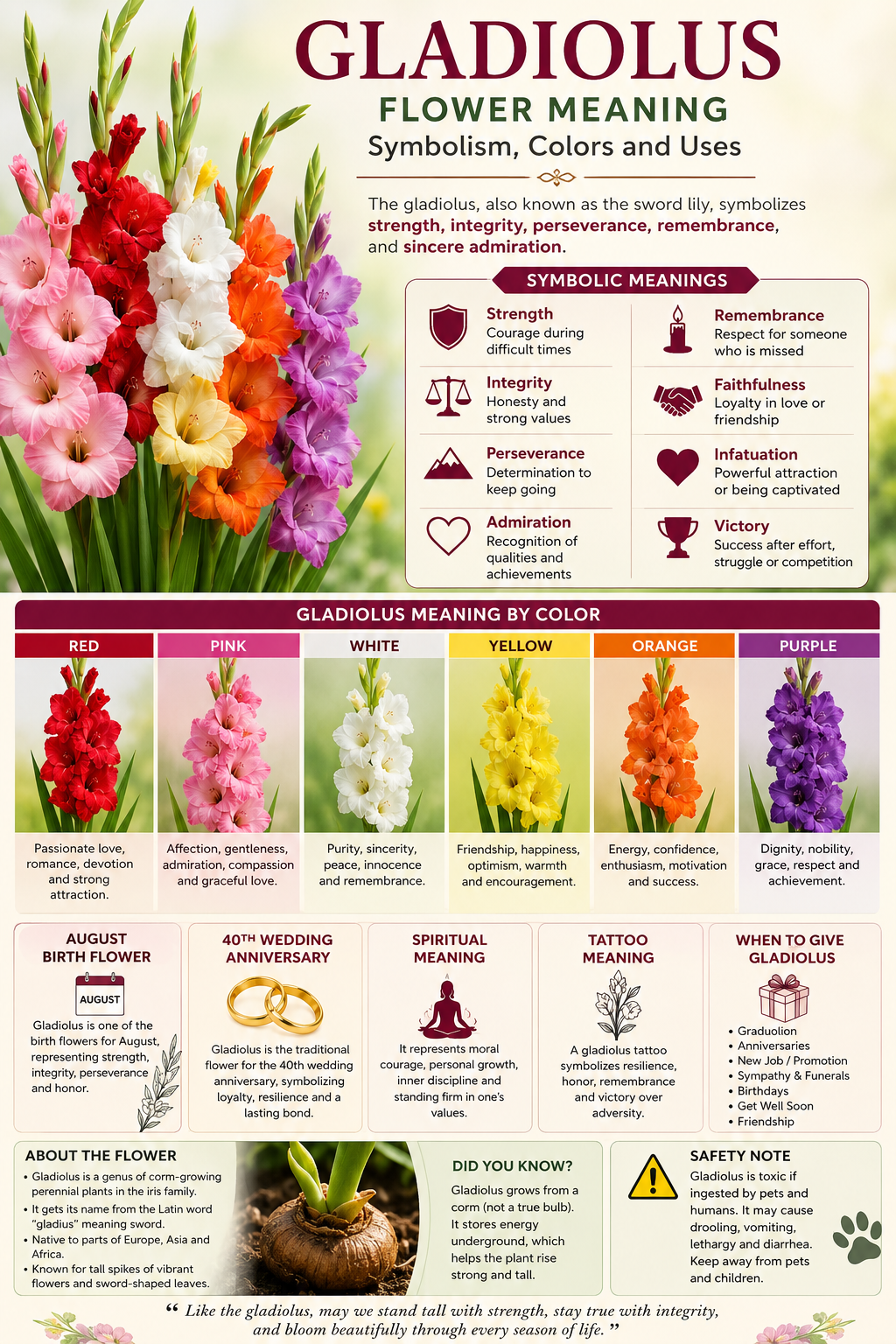
The gladiolus flower meaning is most closely connected with strength, integrity, perseverance, remembrance, and sincere admiration. Its tall stem and sword-shaped leaves give it a bold appearance, while its colorful flowers add softer meanings such as love, friendship, purity, and celebration.
Gladiolus can therefore communicate different messages depending on its color and the occasion. A red stem may express passionate love, while a white gladiolus can honor someone’s memory. Yellow flowers are commonly associated with friendship, and purple varieties often represent dignity and achievement.
Gladiolus Meaning at a Glance
| Symbolic meaning | What it communicates |
|---|---|
| Strength | Courage during difficult circumstances |
| Integrity | Honesty, strong values, and good character |
| Perseverance | Determination to continue despite challenges |
| Remembrance | Respect for someone who has died or is deeply missed |
| Admiration | Recognition of someone’s qualities or achievements |
| Faithfulness | Loyalty in a relationship or friendship |
| Infatuation | Powerful attraction or being emotionally captivated |
| Victory | Success after effort, struggle, or competition |
These meanings make gladiolus suitable for romantic bouquets, memorial arrangements, graduation gifts, birthdays, anniversaries, and messages of encouragement. Strength, moral character, remembrance, and infatuation are among the most frequently repeated associations in modern flower guides.
Why Does the Gladiolus Symbolize Strength?
The symbolism begins with the flower’s name.
“Gladiolus” comes from the Latin word gladius, meaning sword. The Latin diminutive gladiolus can be translated as “small sword,” referring to the plant’s narrow, pointed leaves. This connection also explains the common name sword lily, although the plant is not a true lily. It belongs to the iris family, Iridaceae.
Its physical form reinforces its symbolic meaning. Gladiolus flower spikes grow upright rather than spreading close to the ground. Even when covered with blooms, the stem maintains a strong vertical shape. For many people, this appearance suggests confidence, discipline, resilience, and the ability to stand firm under pressure.
The words gladiolus and gladiator also share the Latin root associated with a sword. This linguistic connection has encouraged stories linking the flower with Roman warriors and victory. However, authoritative botanical and etymological sources clearly confirm the name’s sword reference but do not establish every commonly repeated story about gladiators as historical fact. It is therefore more accurate to treat some gladiator traditions as symbolic legends rather than proven Roman customs.
The Historical Meaning of Gladiolus Flowers
The symbolic language of flowers did not come from one universal dictionary. Different cultures, writers, and historical periods gave plants their own associations.
Floriography—the practice of communicating through flowers—became especially popular in nineteenth-century Europe and North America. Victorian flower books combined botanical features with poetry, religion, mythology, folklore, morality, and personal emotions. Flowers could be used to express feelings that social conventions made difficult to say directly.
Within this tradition, the sword-like gladiolus gained meanings related to:
- Strength of character
- Moral integrity
- Faithfulness
- Admiration
- Infatuation
- A heart “pierced” by love
The romantic interpretation turns the sword image into a metaphor. Instead of physically wounding someone, the flower’s beauty symbolically pierces the admirer’s heart.
It is important to remember that flower meanings change over time and across cultures. Even Victorian guidebooks did not always agree. Modern gladiolus symbolism should therefore be treated as a meaningful tradition, not a fixed rule that every recipient will interpret in exactly the same way.
Gladiolus Flower Meaning by Color
The general meaning of gladiolus remains strength and integrity, but color can make its message more specific.
Red Gladiolus Meaning
Red gladiolus represents passionate love, romance, devotion, and strong attraction. It combines the flower’s natural symbolism of loyalty with the emotional intensity traditionally associated with red.
A red gladiolus bouquet can be given for:
- Valentine’s Day
- A romantic anniversary
- A marriage proposal
- A declaration of love
- A long-term relationship milestone
Its message is stronger and more dramatic than that of a soft pink arrangement. It may communicate, “My feelings for you are powerful,” or “You have captured my heart.”
Pink Gladiolus Meaning
Pink gladiolus commonly symbolizes affection, gentleness, admiration, compassion, and graceful love. It feels warm and personal without always appearing intensely romantic.
Pink flowers work well for:
- Mother’s Day
- A sister or close friend
- Birthday celebrations
- Thank-you bouquets
- Welcoming a new baby
- Expressing quiet affection
Deeper pink shades may suggest stronger admiration, while pale pink flowers communicate tenderness and kindness.
White Gladiolus Meaning
White gladiolus represents purity, sincerity, peace, innocence, remembrance, and spiritual respect. Its clean appearance makes it suitable for both joyful and solemn events.
White gladioli are often chosen for:
- Weddings
- Funerals
- Memorial services
- Religious ceremonies
- Sympathy arrangements
- New beginnings
At a funeral, the flower does not simply mean death. It honors the deceased person’s character and communicates respect, remembrance, and emotional support for the family.
Yellow Gladiolus Meaning
Yellow gladiolus symbolizes friendship, happiness, optimism, warmth, and encouragement. It is generally one of the safest colors for a non-romantic gift.
Yellow flowers are suitable for:
- Celebrating a friendship
- Congratulating a colleague
- Brightening someone’s day
- Sending get-well wishes
- Welcoming someone to a new home
- Celebrating a personal achievement
The combination of yellow and the flower’s upright shape creates a message of hope: remain positive, stay strong, and continue moving forward.
Orange Gladiolus Meaning
Orange gladiolus represents energy, confidence, enthusiasm, motivation, and success. It is particularly effective when celebrating progress or encouraging someone to take a bold new step.
An orange bouquet can mark:
- A business achievement
- A new job
- Graduation
- A creative accomplishment
- Recovery after a difficult period
- The beginning of a new project
Purple Gladiolus Meaning
Purple gladiolus is associated with dignity, nobility, grace, respect, admiration, and personal accomplishment. Its regal appearance makes it appropriate for formal celebrations.
Purple varieties can be given for:
- Graduation
- Promotion
- Retirement
- Leadership recognition
- A major birthday
- An artistic achievement
Its message is less about romance and more about respect: “I admire who you are and what you have achieved.”
Modern floral guides generally agree on the main interpretations of red, pink, white, yellow, orange, and purple gladioli, although individual meanings can still vary between sources.
What Does It Mean When Someone Gives You Gladiolus?
Receiving gladiolus usually means the giver respects your strength, character, or determination. However, the complete message depends on three details: color, relationship, and occasion.
A red stem from a romantic partner may express passion and faithfulness. Yellow gladioli from a friend are more likely to communicate happiness and support. White flowers sent after a loss represent sympathy and remembrance. Purple gladioli presented at graduation recognize hard work and achievement.
The message written on the card matters more than any traditional flower dictionary. Because floral symbolism is not completely standardized, a short personal note prevents confusion.
Examples include:
- “Your strength inspires me.”
- “Congratulations on everything you have achieved.”
- “Your memory will always remain with us.”
- “Thank you for standing beside me.”
- “May this new chapter bring you confidence and success.”
Gladiolus as the August Birth Flower
Gladiolus is one of the birth flowers associated with August, alongside the poppy. Its symbolism makes it particularly suitable for August birthdays because it represents confidence, perseverance, honor, and strength of character.
An August birthday bouquet can be personalized by choosing a color that reflects the recipient:
- Yellow for a cheerful friend
- Purple for an ambitious person
- Pink for someone caring and gentle
- Orange for an energetic personality
- Red for a romantic partner
- White for someone known for sincerity
A living gladiolus plant, botanical print, birth-flower necklace, or gladiolus-themed journal can also make a meaningful August birthday gift.
Gladiolus and the 40th Wedding Anniversary
Gladiolus is traditionally associated with the 40th wedding anniversary. A marriage lasting four decades requires loyalty, resilience, honesty, patience, and continued commitment—all qualities connected with this flower.
Red gladioli can complement the ruby theme of a 40th anniversary. Pink and red mixed together create a softer romantic arrangement, while white flowers can represent the sincerity and integrity that helped the relationship endure.
Spiritual Meaning of the Gladiolus Flower
The spiritual meaning of gladiolus is often connected with moral courage, personal growth, inner discipline, and remaining faithful to one’s values.
Its upright stem can be interpreted as standing firmly in truth. The flowers opening gradually along the spike may represent personal development occurring one stage at a time. The sword-shaped leaves can symbolize cutting through confusion, fear, or dishonesty.
These are modern spiritual interpretations rather than doctrines shared by every religion. For personal reflection, gladiolus can represent:
- Strength during spiritual struggles
- Commitment to truth
- Protection of personal values
- Healing after hardship
- Courage to begin again
- Growth through discipline
Gladiolus Flower Tattoo Meaning
A gladiolus tattoo commonly represents resilience, strength, honor, remembrance, and victory over adversity. Because the flower grows vertically, it also works naturally as a tattoo on the arm, leg, ribs, spine, or shoulder.
The design can be personalized through color and additional elements:
- Red gladiolus tattoo: passion, devotion, or romantic love
- Pink gladiolus tattoo: affection, compassion, or maternal love
- White gladiolus tattoo: remembrance, peace, or spiritual purity
- Yellow gladiolus tattoo: friendship, optimism, or recovery
- Purple gladiolus tattoo: dignity, ambition, or achievement
- Broken sword with gladiolus: choosing peace after conflict
- Gladiolus with a name or date: memorial for a loved one
- Gladiolus with a butterfly: transformation after hardship
For an August-born person, it may also serve as a birth-flower tattoo representing identity and personal strength.
When Should You Give Gladiolus Flowers?
Gladiolus is especially appropriate when the recipient has shown courage, discipline, loyalty, or perseverance.
Graduation
Purple, orange, or yellow gladioli recognize dedication and success. They communicate pride in what the graduate has accomplished.
New Job or Promotion
Purple represents respect and achievement, while orange adds confidence and forward-looking energy.
Recovery and Encouragement
Yellow or orange stems can encourage someone facing illness, disappointment, or a difficult transition. The message is not merely “get well” but “you have the strength to continue.”
Romance and Anniversaries
Red and pink gladioli express attraction, faithfulness, and admiration. They are particularly meaningful when the relationship has survived challenges.
Funerals and Memorials
White, pale pink, or deep red flowers can honor the deceased. The flower’s connection with remembrance and strong character makes it appropriate for tribute arrangements.
Friendship
Yellow gladioli celebrate loyalty and happiness without creating an overly romantic message.
Apology or Reconciliation
White and pink flowers can express sincerity, respect, and a desire to rebuild trust. A clear card message should accompany them because gladiolus is not automatically recognized as an apology flower.
A Botanical Detail That Strengthens Its Symbolism
Gladiolus is a genus of corm-growing perennial plants in the iris family. Its native range extends through parts of Europe, western Asia, the Arabian Peninsula, and Africa, with many cultivated garden varieties developed from African species. Modern hybrids produce tall spikes in colors including white, cream, yellow, orange, red, pink, lavender, purple, and green.
Although people often call the underground structure a bulb, gladiolus grows from a corm. A corm stores energy that allows the plant to produce new growth and flowers. Symbolically, this hidden reserve can be viewed as inner strength: much of the plant’s ability to rise is stored out of sight.
Is Gladiolus Safe Around Pets and Children?
Gladiolus should be treated as ornamental rather than edible. North Carolina State University’s Extension Plant Toolbox classifies its poison severity as low but lists possible symptoms including drooling, vomiting, lethargy, and diarrhea. The greatest concentration is found in the corms, and the plant is considered a potential problem for cats, dogs, and horses.
Keep stored corms away from curious pets and young children. Contact a veterinarian or medical professional if a person or animal eats part of the plant and develops symptoms.
Gladiolus, Gladiola or Gladioli: Which Word Is Correct?
Gladiolus is the standard singular form.
Gladioli is the traditional plural, although dictionaries also accept gladioluses and, in some contexts, an unchanged plural gladiolus. “Gladiola” is commonly used as an alternative name, particularly in informal North American English.
Examples:
- One gladiolus flower
- Several gladioli
- A bouquet of gladioluses
- A row of gladiola plants
For formal botanical or editorial writing, “gladiolus” and “gladioli” are usually the clearest choices.
How to Create a Meaningful Gladiolus Bouquet
Start by deciding what the arrangement should communicate.
For strength and encouragement, combine yellow and orange gladioli. For romantic devotion, use red with a small amount of pink. A memorial bouquet can pair white gladiolus with soft greenery. Purple and white create an elegant arrangement for graduation, retirement, or formal recognition.
Because gladiolus stems are tall, they naturally form the structural background of an arrangement. A florist may combine them with roses, hydrangeas, chrysanthemums, lilies, asters, or irises to add shape and contrast.
The accompanying note should express the intended meaning directly. Symbolism becomes more powerful when the recipient does not have to guess.
Conclusion
The gladiolus flower meaning combines strength with emotion. Its sword-shaped leaves represent courage, integrity, and perseverance, while its colorful blooms communicate love, friendship, admiration, remembrance, and celebration.
Red gladioli express passion. Pink represents affection. White honors purity and remembrance. Yellow communicates happiness and friendship. Orange celebrates energy and success, while purple recognizes dignity and achievement.
As an August birth flower and the traditional flower for a 40th wedding anniversary, gladiolus is especially meaningful for milestones. Whether presented as a bouquet, grown in a garden, or chosen as a tattoo, it carries a powerful message: remain upright, stay true to your values, and continue growing through every challenge.
Frequently Asked Questions
What is the main gladiolus flower meaning?
The main meaning is strength of character. Gladiolus also symbolizes integrity, perseverance, faithfulness, remembrance, admiration, and infatuation.
Does gladiolus symbolize death?
Gladiolus does not directly symbolize death. In funeral and memorial arrangements, it represents remembrance, respect, sincerity, and the strong character of the person who has died.
Is gladiolus a romantic flower?
Yes, especially in red or pink. Red gladiolus represents passion, devotion, and romantic attraction, while pink expresses gentler affection and admiration.
What does a white gladiolus mean?
White gladiolus symbolizes purity, sincerity, peace, innocence, and remembrance. It is suitable for weddings, religious ceremonies, funerals, and sympathy bouquets.
Why is gladiolus called the sword lily?
Its name comes from the Latin gladius, meaning sword. The plant’s long, pointed leaves resemble small swords. It is called a sword lily because of its appearance, although botanically it belongs to the iris family rather than the lily family.
Is gladiolus an August birth flower?
Yes. Gladiolus and poppy are widely recognized as the two August birth flowers. Gladiolus represents strength, integrity, perseverance, and admiration.
What anniversary does gladiolus represent?
Gladiolus is the traditional flower for the 40th wedding anniversary. Its meanings of strength, faithfulness, and integrity reflect a marriage that has endured for four decades.
What does a gladiolus tattoo symbolize?
A gladiolus tattoo can symbolize resilience, honor, remembrance, personal growth, or victory after hardship. Its exact message may change according to the flower’s color and any names, dates, or symbols added to the design.
Are gladiolus and gladioli the same?
Yes. Gladiolus is singular, while gladioli is the traditional plural. “Gladioluses” is also accepted as a plural form.
What does yellow gladiolus mean?
Yellow gladiolus represents friendship, joy, optimism, encouragement, and positive energy. It is appropriate for friends, colleagues, birthdays, congratulations, and get-well arrangements.


Anguage Taiwan Speak: Languages Used in Taiwan

Haypp Group Customer Experience: What Sets It Apart

adsy pw hb5: Meaning, Safety & SEO Guide
-

 Fashion9 years ago
These ’90s fashion trends are making a comeback in 2017
-
Entertainment9 years ago
The final 6 ‘Game of Thrones’ episodes might feel like a full season
-
Fashion9 years ago
According to Dior Couture, this taboo fashion accessory is back
-
Entertainment9 years ago
The old and New Edition cast comes together to perform
-
Sports9 years ago
Phillies’ Aaron Altherr makes mind-boggling barehanded play
-
Entertainment9 years ago
Disney’s live-action Aladdin finally finds its stars
-
Business9 years ago
Uber and Lyft are finally available in all of New York State
-
Sports9 years ago
Steph Curry finally got the contract he deserves from the Warriors